Built to provide research that’s more actionable and strategically valuable, The Business Research Company’s 2026 market reports include market attractiveness analysis, total addressable market sizing, company benchmarking matrices, interactive Excel dashboards, broader supply chain intelligence, emerging startup tracking, and in-depth product insights.
Dried Food Market Size Forecast: How Big Could The Market Get By 2030?
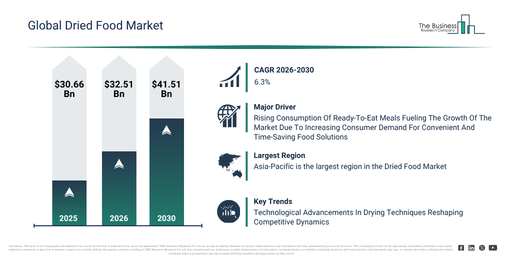
The dried food market has experienced robust growth in recent years. It is forecast to grow from $30.66 billion in 2025 to $32.51 billion in 2026, achieving a compound annual growth rate (CAGR) of 6.1%. This expansion in the past can be credited to factors like the rising demand for foods with a long shelf life, the proliferation of traditional preservation methods, increased food preservation practices in rural areas, growing urbanization alongside greater consumption of packaged food, and the development of essential food processing infrastructure.
The dried food market is projected to experience substantial expansion over the coming years, reaching a valuation of $41.51 billion by 2030, demonstrating a compound annual growth rate (CAGR) of 6.3%. This anticipated growth is driven by several factors, including an increased need for nutrient-rich convenience foods, the development of premium dried food categories, the broadening reach of e-commerce for food distribution, advancements in drying technologies, and a heightened demand for foods suitable for emergency preparedness. Key trends foreseen during this period involve a rising consumer preference for shelf-stable and convenient food items, the expansion of freeze-dried and high-end dried food segments, an increasing demand for organic and clean-label dehydrated options, the growth of online retail and direct-to-consumer sales channels for dried foods, and the increasing integration of fortified and functional dried food products.
Get A Free Sample Report With In-Depth Market Insights:
Dried Food Market Growth Factors: What’s Supporting Expansion?
The expanding consumption of ready-to-eat meals is anticipated to fuel the growth of the dried food market moving forward. Ready-to-eat meals are food products already prepared for consumption with little to no additional cooking or preparation. The increase in ready-to-eat meal consumption is driven by increasingly time-pressed lifestyles, particularly affecting working professionals and younger consumer demographics, thereby boosting demand for convenient food solutions that reduce preparation time while maintaining nutritional value and flavor. Dried food products support the rising consumption of ready-to-eat meals by serving as essential ingredients in product formulations, providing shelf-stable, lightweight, and extended shelf-life attributes that facilitate efficient storage, transportation, and quick reconstitution. For instance, in January 2025, according to the National Frozen & Refrigerated Foods Association, a US-based non-profit trade association representing all segments of the frozen and refrigerated foods industry, 88% of Gen Z and millennial consumers in the United States prioritized meals that could be prepared within 45 minutes or less, while 68% relied on frozen food options to streamline daily routines, with year-over-year data indicating continued growth in frozen food purchases compared to 2023 levels. Consequently, the increasing consumption of ready-to-eat meals is projected to drive the expansion of the dried food market.
Dried Food Market Segment Landscape And Growth Outlook
The dried food market covered in this report is segmented –
1) By Product Type: Dried Fruits, Dried Vegetables, Dried Meat And Seafood, Dried Herbs And Spices, Dried Ready Meals
2) By Drying Method: Sun Drying, Air Drying, Freeze Drying, Spray Drying, Vacuum Drying
3) By Nature: Conventional Dried Foods, Organic Dried Foods, Fortified And Enriched Dried Foods, Functional Dried Foods, Gourmet And Premium Dried Foods
4) By Distribution Channel: Supermarkets And Hypermarkets, Convenience Stores, Online Retail, Specialty Stores
5) By Application: Household Consumption, Food Processing Industry, Foodservice Industry
Subsegments:
1) By Dried Fruits: Sun Dried Fruits, Freeze Dried Fruits, Infused Dried Fruits, Organic Dried Fruits, Sweetened Dried Fruits
2) By Dried Vegetables: Dehydrated Leafy Vegetables, Root Vegetable Dry Products, Freeze Dried Vegetable Mixes, Air Dried Vegetable Products, Organic Dried Vegetables
3) By Dried Meat And Seafood: Dried Red Meat Products, Dried Poultry Products, Dried Fish Products, Dried Shellfish Products, Freeze Dried Meat Products
4) By Dried Herbs And Spices: Dried Culinary Herbs, Ground Spice Products, Whole Spice Products, Organic Herbs And Spices, Blended Seasoning Mixes
5) By Dried Ready Meals: Instant Soup Mixes, Dehydrated Pasta Meals, Freeze Dried Complete Meals, Ready-To-Cook Meal Kits, Ethnic Dried Meal Products
Dried Food Market Industry Trends: What’s Reshaping Demand?
Leading firms within the dried food market are prioritizing technological innovations in drying methods, particularly lyophilization, to enhance their market competitiveness. Lyophilization, also known as freeze-drying, represents a sophisticated low-temperature dehydration process that extracts moisture from food by first freezing it and then sublimating the ice under regulated vacuum settings. This technique offers superior preservation of nutritional value, cellular integrity, taste, texture, and overall sensory characteristics when contrasted with traditional heat-drying methods, leading to improved product quality and extended shelf life. As an illustration, in May 2024, Mountain House, a food manufacturing enterprise based in the US, launched two new freeze-dried Adventure Meals, specifically Chicken Tikka Masala and Kung Pao Chicken. This launch expanded their range of premium ready-to-eat options for outdoor and emergency consumption. These offerings leverage advanced freeze-drying technology to maintain vital vitamins, nutrients, and genuine flavor profiles, simultaneously allowing for quick rehydration in minutes by simply adding boiling water.
Dried Food Market Key Participants And Competitive Landscape
Major companies operating in the dried food market are Cargill Incorporated, Nestlé S.A., Archer Daniels Midland Company, Unilever PLC, Kraft Heinz Company, Olam Food Ingredients, Ajinomoto Co.Inc., Kerry Group plc, McCormick & Company Incorporated, Döhler Group, Bühler Group, Mercer Foods LLC, Sensient Technologies Corporation, Jain Irrigation Systems Ltd., Van Drunen Farms, Meelunie B.V., European Freeze Dry, Paradise Fruits Solutions GmbH, Symrise AG, SensoryEffects Ingredient Solutions
View The Full Dried Food Market Report:
Dried Food Market Geographic Analysis: Where Is Demand Rising Fastest?
Asia-Pacific was the largest region in the dried food market in 2025, and it is expected to be the fastest-growing region in the forecast period. The regions covered in the dried food market report are Asia-Pacific, South East Asia, Western Europe, Eastern Europe, North America, South America, Middle East, Africa.
Reach Out To Our Team:
The Business Research Company: https://www.thebusinessresearchcompany.com/
Americas: +1 310-496-7795
Asia: +44 7882 955267 & +91 8897263534
Europe: +44 7882 955267
Email us at: marketing@tbrc.info
Follow us on:
LinkedIn: https://in.linkedin.com/company/the-business-research-company
YouTube: https://www.youtube.com/channel/UC24_fI0rV8cR5DxlCpgmyFQ
Global Market Model: https://www.thebusinessresearchcompany.com/global-market-model

Wasay has over a decade of experience in market research, data modelling, and analytics, with prior experience at GlobalData and Decision Tree Consulting Services. At The Business Research Company , he leads research operations across syndicated studies, customized consulting engagements, and the Global Market Model platform. His professional experience includes supporting organizations such as Boston Consulting Group, KPMG, and Ernst & Young. Wasay holds a degree in Electronics and Communications Engineering, postgraduate management qualifications from International Management Institute Belgium and Indian School of Business and Entrepreneurship, and completed the Integrated Program in Business Analytics from Indian Institute of Management Indore.