
Backed by market attractiveness analysis, total addressable market sizing, company benchmarking matrices, interactive Excel dashboards, wider supply chain intelligence, emerging startup coverage, and detailed product-level insights, The Business Research Company’s 2026 market reports are designed to offer research that is more actionable and strategically valuable than ever.
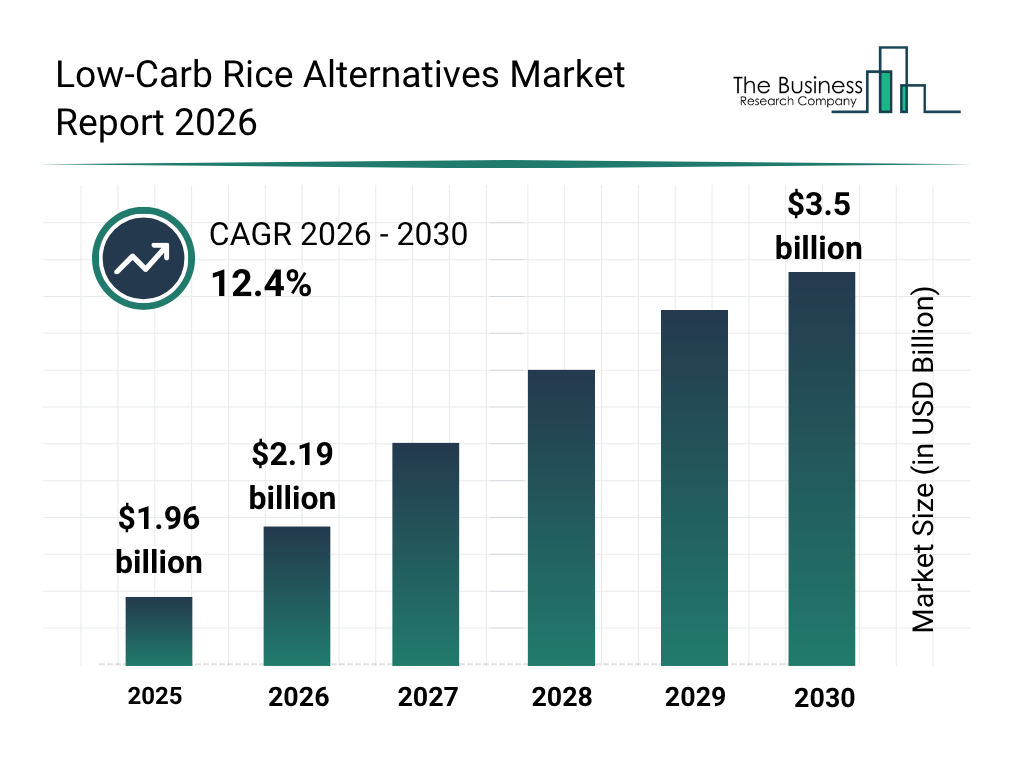
Low-Carb Rice Alternatives Market Set To Climb From $2.19 Billion In 2026 To $3.5 Billion By 2030
The low-carb rice alternatives market has seen significant expansion in recent years. Its size is expected to increase from $1.96 billion in 2025 to $2.19 billion in 2026, achieving a compound annual growth rate (CAGR) of 12.2%. The growth observed in the past can be attributed to a growing population of health-conscious consumers, the rising occurrence of diabetes and obesity, greater awareness of low-carb diets, the expansion of retail channels, and innovations in vegetable-based rice products.
The low-carb rice alternatives market size is projected to experience swift expansion over the coming years. It is anticipated to reach $3.5 billion by 2030, exhibiting a compound annual growth rate (CAGR) of 12.4%. This projected growth stems from several factors, including the increasing demand for keto and paleo diets, the expansion of online grocery and e-commerce platforms, advancements in R&D for plant-based ingredients, greater foodservice adoption, and the creation of fortified and functional rice alternatives. Key trends anticipated during this period involve a growing preference for low-carb and keto-friendly foods, the rising appeal of plant-based rice alternatives, an uptick in the home cooking and convenience food segments, the broadening availability of organic and clean label product offerings, and the increased embrace of functional and fortified rice alternatives.
Get A Free Sample Report With In-Depth Market Insights:
Low-Carb Rice Alternatives Market Growth Factors Behind Sustained Expansion
The expanding embrace of the ketogenic diet is anticipated to stimulate the growth of the low-carb rice alternatives market moving forward. Ketogenic adoption refers to the increasing number of consumers who adhere to a diet characterized by high fat, moderate protein, and very low carbohydrates, designed to aid in weight management, improve metabolic health, and regulate blood sugar. The growth in ketogenic adoption is fueled by its effectiveness in weight management, as it promotes fat burning and contributes to a reduction in overall calorie intake. Low-carb rice alternatives support this rising ketogenic trend by providing grain-free and vegetable-based substitutes that replicate the texture and culinary applications of traditional rice while significantly lowering carbohydrate content to align with keto dietary requirements. For instance, according to the British Dietetic Association, a UK-based trade union, in Europe, the percentage of consumers following keto saw a slight increase from 3.2% in 2023 to 3.4% in 2024. Similarly, in the United States, 26% of new dieters in 2025 planned to adopt low-carb methods like keto. Therefore, the increasing ketogenic adoption is a key driver for the growth of the low-carb rice alternatives market.
Low-Carb Rice Alternatives Market Breakdown By Product Type And Application
The low-carb rice alternatives market covered in this report is segmented –
1) By Product Type: Cauliflower Rice, Shirataki Rice, Konjac Rice, Broccoli Rice, Cabbage Rice, Other Product Types
2) By Distribution Channel: Supermarkets And Hypermarkets, Online Stores, Specialty Stores, Convenience Stores, Other Distribution Channels
3) By Application: Food And Beverages, Nutritional Supplements, Foodservice, Other Applications
4) By End-User: Households, Restaurants, Cafes, Other End-Users
Subsegments:
1) By Cauliflower Rice: Fresh Cauliflower Rice, Frozen Cauliflower Rice, Organic Cauliflower Rice, Seasoned Cauliflower Rice
2) By Shirataki Rice: Plain Shirataki Rice, Fortified Shirataki Rice, Pre Cooked Shirataki Rice, Flavored Shirataki Rice
3) By Konjac Rice: Pure Konjac Rice, Blended Konjac Rice, Instant Konjac Rice, Organic Konjac Rice
4) By Broccoli Rice: Fresh Broccoli Rice, Frozen Broccoli Rice, Organic Broccoli Rice, Seasoned Broccoli Rice
5) By Cabbage Rice: Fresh Cabbage Rice, Pre Shredded Cabbage Rice, Seasoned Cabbage Rice, Organic Cabbage Rice
6) By Other Product Types: Zucchini Rice Alternatives, Turnip Rice Alternatives, Lupin Based Rice Alternatives, Mixed Vegetable Rice Alternatives
Low-Carb Rice Alternatives Market Industry Trends Fueling Future Revenue Growth
Companies active in the low-carb rice alternatives market are concentrating on developing advanced solutions, such as high-protein, low-carb meal integrations, to improve nutritional value, assist with weight management, and offer greater convenience to health-conscious consumers. Low-carb meal integrations involve the incorporation of low-carbohydrate foods or ingredients into ready-to-eat meals, meal kits, or recipes to support diets with reduced carb intake. As an illustration, in February 2026, FitLife Foods, a US-based nutrition company, expanded its Carb Smart High-Protein Meals range, featuring low-carb rice alternatives as a central ingredient. These products, crafted to help busy consumers maintain healthier eating, include nutrient-dense, grain-free rice substitutes, high protein content, and ready-to-eat meal formats, supporting weight management, metabolic health, and convenient meal preparation without compromising taste or texture.
Low-Carb Rice Alternatives Market Competitive Overview And Top Companies
Major companies operating in the low-carb rice alternatives market are Kroger Co., Trader Joe’s Company, Taylor Farms Inc., Dole Food Company Inc., Greenyard NV, House Foods Group Inc., Birds Eye LLC, Earthbound Farm LLC, Pictsweet Farms Inc., FitLife Foods, Mann Packing Co. Inc., Eat Smart Inc., Miracle Noodle Inc., Great Value llc, Good & Gather, Yamaki Foods Co. Ltd., Hanover Foods Corporation, Soeos Inc., Vegolutionary Foods Inc., Flavoma Inc.
View The Full Low-Carb Rice Alternatives Market Report:
Low-Carb Rice Alternatives Market Top Region: Where Does Most Revenue Come From?
North America was the largest region in the low-carb rice alternatives market in 2025. Asia-Pacific is expected to be the fastest-growing region in the forecast period. The regions covered in the low-carb rice alternatives market report are Asia-Pacific, South East Asia, Western Europe, Eastern Europe, North America, South America, Middle East, Africa.
Reach Out To Our Team:
The Business Research Company: https://www.thebusinessresearchcompany.com/
Americas: +1 310-496-7795
Asia: +44 7882 955267 & +91 8897263534
Europe: +44 7882 955267
Email us at: marketing@tbrc.info
Follow us on:
LinkedIn: https://in.linkedin.com/company/the-business-research-company
YouTube: https://www.youtube.com/channel/UC24_fI0rV8cR5DxlCpgmyFQ
Global Market Model: https://www.thebusinessresearchcompany.com/global-market-model

Wasay has over a decade of experience in market research, data modelling, and analytics, with prior experience at GlobalData and Decision Tree Consulting Services. At The Business Research Company , he leads research operations across syndicated studies, customized consulting engagements, and the Global Market Model platform. His professional experience includes supporting organizations such as Boston Consulting Group, KPMG, and Ernst & Young. Wasay holds a degree in Electronics and Communications Engineering, postgraduate management qualifications from International Management Institute Belgium and Indian School of Business and Entrepreneurship, and completed the Integrated Program in Business Analytics from Indian Institute of Management Indore.