
Built to provide research that’s more actionable and strategically valuable, The Business Research Company’s 2026 market reports include market attractiveness analysis, total addressable market sizing, company benchmarking matrices, interactive Excel dashboards, broader supply chain intelligence, emerging startup tracking, and in-depth product insights.
Low-Sugar Sports Beverages Market CAGR Outlook And Future Development
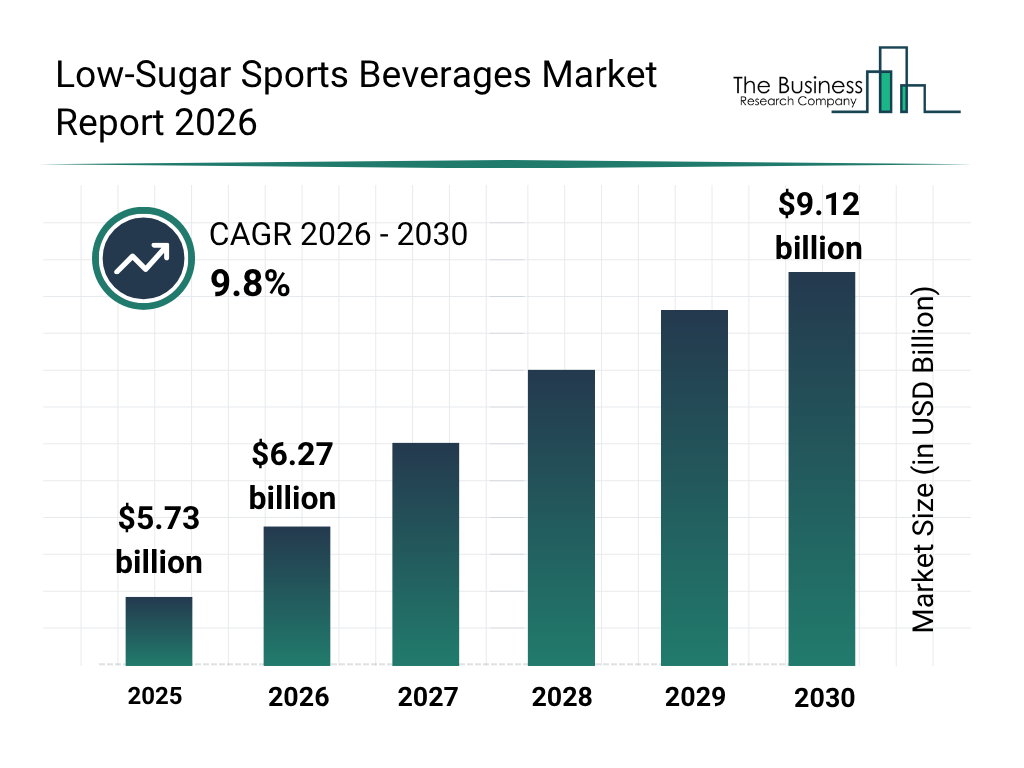
The low-sugar sports beverages market has shown substantial growth recently. It is forecast to expand from $5.73 billion in 2025 to $6.27 billion in 2026, at a compound annual growth rate (CAGR) of 9.6%. The expansion observed in prior periods is attributable to factors like increased participation in sports, greater health and wellness awareness, rising consumer demand for low-calorie drinks, the spread of fitness and gym facilities, and the introduction of innovative hydration solutions.
The low-sugar sports beverages market is projected for significant expansion over the coming years. Its valuation is anticipated to reach $9.12 billion by 2030, exhibiting a compound annual growth rate (CAGR) of 9.8%. This projected expansion during the forecast period is propelled by factors such as the increasing embrace of plant-based and natural components, greater penetration of online retail, a growing interest in tailored nutrition, improvements in functional beverage recipes, and the proliferation of global fitness and athletic occasions. Key developments expected during this period involve a rising need for low-sugar hydration options, an increase in functional and protein-enhanced sports drinks, consumers showing a stronger preference for natural and plant-derived ingredients, the broadening of online and specialized sports retail outlets, and an emphasis on customized nutrition and performance enhancement.
Get A Free Sample Report With In-Depth Market Insights:
Low-Sugar Sports Beverages Market Growth Drivers: What’s Behind The Acceleration?
The increasing consumer focus on health and wellness is stimulating the expansion of the low-sugar sports beverages market, spurred by rising health consciousness. Health and wellness refers to the heightened awareness and proactive measures individuals are adopting to maintain overall physical and mental well-being through preventive care, healthy lifestyle choices, and regular medical and dental checkups. This escalating consumer shift toward health and wellness is a result of growing awareness regarding lifestyle-related diseases, encouraging people to embrace healthier diets and wellness-centric products for long-term health. Low-sugar sports beverages contribute to health and wellness by offering hydration solutions that reduce overall sugar intake while still replenishing essential electrolytes lost during physical activity. For instance, in June 2024, data from the International Food Information Council (IFIC), a US-based non-profit organization, indicated that the proportion of Americans adhering to a specific diet or eating pattern over the past year remained high at 54%. Most people are looking to increase their protein intake, with interest climbing from 59% in 2022 to 67% in 2023 and reaching 71% in 2024. Additionally, roughly half of consumers aim to eat more fresh foods, which are widely considered the healthiest options. Therefore, a growing consumer shift toward health and wellness is driving the growth of the low-sugar sports beverages market.
Low-Sugar Sports Beverages Market Segment Landscape And Growth Outlook
The low-sugar sports beverages market covered in this report is segmented –
1) By Product Type: Isotonic Drinks, Hypotonic Drinks, Hypertonic Drinks, Protein Enriched Drinks, Functional Energy Drinks
2) By Flavor: Citrus, Berry, Mixed Fruit, Other Flavors
3) By Sweetener Type: Natural, Artificial, Blended
4) By Distribution Channel: Supermarkets And Hypermarkets, Convenience Stores, Online Retail, Specialty Sports Stores, Other Channels
5) By End-User: Athletes, Fitness Enthusiasts, General Consumers
Subsegments:
1) By Isotonic Drinks: Ready To Drink Isotonic Beverages, Powdered Isotonic Mixes, Effervescent Isotonic Tablets, Natural Ingredient Based Isotonic Drinks, Plant Based Isotonic Drinks
2) By Hypotonic Drinks: Electrolyte Enhanced Water, Low Carbohydrate Hydration Drinks, Zero Sugar Hypotonic Beverages, Mineral Infused Hypotonic Drinks, Herbal Extract Based Hypotonic Drinks
3) By Hypertonic Drinks: High Carbohydrate Recovery Drinks, Glucose Rich Energy Beverages, Endurance Performance Drinks, Post Workout Glycogen Replenishment Drinks, Concentrated Sports Fuel Drinks
4) By Protein Enriched Drinks: Whey Protein Sports Drinks, Plant Protein Sports Beverages, Collagen Infused Recovery Drinks, Branched Chain Amino Acid Fortified Drinks, High Protein Meal Replacement Sports Drinks
5) By Functional Energy Drinks: Caffeine Infused Sports Drinks, Vitamin Fortified Energy Beverages, Adaptogen Based Energy Drinks, Amino Acid Enhanced Energy Drinks, Natural Fruit Extract Energy Drinks
Low-Sugar Sports Beverages Market Trends: What’s Defining The Industry’s Next Phase?
Leading companies active in the low-sugar sports beverages market are focused on developing advanced products, such as lower-sugar sports drinks without artificial ingredients, to improve hydration effectiveness, maintain electrolyte equilibrium, and meet increasing consumer demand for healthier sports nutrition options. Lower-sugar sports drinks that are free from artificial ingredients are defined as hydration beverages crafted with reduced sugar and natural components, absent of artificial sweeteners, colors, or preservatives, specifically designed to restore electrolytes and aid physical performance. For instance, in October 2025, PepsiCo’s Gatorade, a US-based sports nutrition and beverage company, launched Gatorade Lower Sugar to enhance hydration support and provide a reduced-sugar choice for health-aware consumers seeking a sports drink. This drink contains 75% less sugar than traditional sports drinks while still supplying essential electrolytes such as sodium and potassium to support hydration during physical activity. It is formulated to offer efficient fluid replenishment with fewer calories, targeting athletes and consumers who desire healthier sports hydration alternatives. The new sports drink incorporates no artificial flavors, sweeteners, or colors from artificial sources, yet it still delivers the bold Gatorade color that athletes recognize and enjoy.
Low-Sugar Sports Beverages Market Leading Players And Competitive Positioning
Major companies operating in the low-sugar sports beverages market are Nestlé S.A., The Coca-Cola Company, Abbott Laboratories, Glanbia plc, Prime Hydration LLC, Zevia PBC, Nutrabolt Ltd., Amway Corporation, Skratch Labs LLC, Hydrant Inc., DripDrop Inc., High5 Sports Nutrition Ltd., Prestige Consumer Healthcare Inc., World Waters LLC, Ultima Health Products Inc., PLEZi Nutrition Inc., Precision Fuel & Hydration Ltd., Ryno Power Inc., GoodSport Nutrition LLC, Boost Nutraceuticals LLC, SOS Hydration Inc.
View The Full Low-Sugar Sports Beverages Market Report:
Low-Sugar Sports Beverages Market Regional Split: Which Areas Are Fueling Growth?
North America was the largest region in the low sugar sports beverages market in 2025. Asia-Pacific is expected to be the fastest-growing region in the forecast period. The regions covered in the low-sugar sports beverages market report are Asia-Pacific, South East Asia, Western Europe, Eastern Europe, North America, South America, Middle East, Africa.
Reach Out To Our Team:
The Business Research Company: https://www.thebusinessresearchcompany.com/
Americas: +1 310-496-7795
Asia: +44 7882 955267 & +91 8897263534
Europe: +44 7882 955267
Email us at: marketing@tbrc.info
Follow us on:
LinkedIn: https://in.linkedin.com/company/the-business-research-company
YouTube: https://www.youtube.com/channel/UC24_fI0rV8cR5DxlCpgmyFQ
Global Market Model: https://www.thebusinessresearchcompany.com/global-market-model

Wasay has over a decade of experience in market research, data modelling, and analytics, with prior experience at GlobalData and Decision Tree Consulting Services. At The Business Research Company , he leads research operations across syndicated studies, customized consulting engagements, and the Global Market Model platform. His professional experience includes supporting organizations such as Boston Consulting Group, KPMG, and Ernst & Young. Wasay holds a degree in Electronics and Communications Engineering, postgraduate management qualifications from International Management Institute Belgium and Indian School of Business and Entrepreneurship, and completed the Integrated Program in Business Analytics from Indian Institute of Management Indore.