
Built to provide research that’s more actionable and strategically valuable, The Business Research Company’s 2026 market reports include market attractiveness analysis, total addressable market sizing, company benchmarking matrices, interactive Excel dashboards, broader supply chain intelligence, emerging startup tracking, and in-depth product insights.
Sixth Generation (6G) Network Infrastructure Market Set To Climb From $8.66 Billion In 2026 To $31.28 Billion By 2030
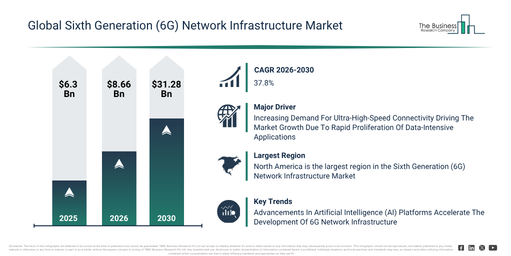
The market size for sixth generation (6G) network infrastructure has demonstrated substantial exponential growth in recent years. It will grow from $6.3 billion in 2025 to $8.66 billion in 2026 at a compound annual growth rate (CAGR) of 37.6%. Contributing factors to this historical growth include the expansion of 5G networks, an increasing appetite for high-speed data, the uptake of cloud-based network solutions, greater mobile broadband usage, and a surge in connected devices.
The market for sixth generation (6G) network infrastructure is anticipated to expand significantly in the near future. It is projected to reach $31.28 billion in 2030, demonstrating a compound annual growth rate (CAGR) of 37.8%. This expansion during the forecast period is fueled by the deployment of AI-integrated communication, the adoption of blockchain-enabled communication, the proliferation of holographic applications, an increase in massive machine type communication, and investments in ultra-low latency network infrastructure. Important trends expected in this period include the rollout of terahertz networks, AI-driven network optimization, advanced holographic communication applications, the integration of digital twin networks, and enhancements to ultra-reliable low latency communication.
Get A Free Sample Report With In-Depth Market Insights:
Sixth Generation (6G) Network Infrastructure Market Growth Factors: What’s Supporting Expansion?
The rising need for ultra-high-speed connectivity is projected to boost the expansion of the sixth generation (6G) network infrastructure market in the future. This type of connectivity denotes advanced wireless communication that can provide exceptionally rapid data transmission, very low latency, and uninterrupted network operation, surpassing current 5G benchmarks significantly. The increasing requirement for ultra-high-speed connectivity is primarily fueled by the quick spread of applications demanding substantial data, which need consistently high bandwidth and almost immediate response times that current network technologies cannot sufficiently accommodate. Sixth generation (6G) network infrastructure facilitates ultra-high-speed connectivity through the utilization of terahertz (THz) frequency bands, advanced massive MIMO technology, and AI-driven network management. This combination allows for the processing of immense data volumes with extremely low latency, thereby supporting swift data handling and fluid, real-time communication in sophisticated digital applications. As an illustration, data from Ofcom, the UK’s government-approved regulatory and competition authority, indicated that by November 2025, the adoption of ultra-high-speed packages (≥ 900 Mbps) had risen from 14% in 2023 to 17% in 2024, further climbing to 21% by 2025. Consequently, the escalating need for ultra-high-speed connectivity is a significant factor propelling the expansion of the sixth generation (6G) network infrastructure market.
Sixth Generation (6G) Network Infrastructure Market Segment Analysis And Revenue Potential
The sixth generation (6G) network infrastructure market covered in this report is segmented –
1) By Component: Hardware, Software, Services
2) By Communication Technology: Terahertz Communication, Optical Wireless Communication, Artificial Intelligence (AI)-Integrated Communication, Blockchain-Enabled Communication, Other Communication Technologies
3) By Deployment Mode: On Premises, Cloud Based, Hybrid
4) By Application Area: Enhanced Mobile Broadband (eMBB), Ultra-Reliable Low Latency Communication (URLLC), Massive Machine Type Communication (mMTC), Digital Twin Applications, Holographic Communication
5) By End User: Banking Financial Services And Insurance (BFSI), Healthcare And Life Sciences, Retail And Consumer Goods, Manufacturing And Automotive, Other End Users
Subsegments:
1) By Hardware: Base Stations, Antennas, Routers, Switches, Network Processors
2) By Software: Network Management Software, Network Security Software, Virtualization Software, Cloud Native Network Software, Automation And Orchestration Software
3) By Services: Consulting Services, Integration Services, Deployment Services, Maintenance And Support Services, Managed Network Services
Sixth Generation (6G) Network Infrastructure Market Industry Trends: What’s Reshaping Demand?
Leading companies active in the sixth generation (6G) network infrastructure market are concentrating on establishing strategic partnerships to enhance next-generation connectivity capabilities and boost global telecommunications competitiveness. A strategic partnership involves a formal alliance between two or more organizations that combine their capabilities, knowledge, and resources to achieve common objectives. For instance, in October 2025, NVIDIA Corporation, a US-based technology firm, collaborated with Nokia Corporation, a Finland-based telecommunications infrastructure provider, to develop an AI-native platform for 6G network advancement, aiming to accelerate innovation and reinforce America’s leadership in future telecommunications. This collaboration focuses on integrating AI computing capabilities with advanced radio access network (RAN) technologies to enable intelligent network automation, improved data processing at the edge, and scalable infrastructure designed to fulfill the performance demands of forthcoming 6G ecosystems.
Sixth Generation (6G) Network Infrastructure Market Key Players Shaping Industry Direction
Major companies operating in the sixth generation (6G) network infrastructure market are Samsung Electronics Co. Ltd., Huawei Technologies Co. Ltd., T-Mobile US Inc., Cisco Systems Inc., Intel Corporation, Orange S.A., Telefonica S.A., KDDI Corporation, Mitsubishi Electric Corporation, Qualcomm Incorporated, BT Group plc, Fujitsu Limited, Telefonaktiebolaget LM Ericsson, NEC Corporation, Nokia Corporation, ZTE Corporation, SK Telecom Co. Ltd., Mavenir Systems Inc., 6WIND S.A., Cohere Technologies Inc., and DeepSig Inc.
View The Full Sixth Generation (6G) Network Infrastructure Market Report:
Sixth Generation (6G) Network Infrastructure Market Regional Analysis: Which Geography Leads On Revenue?
North America was the largest region in the sixth-generation (6G) network infrastructure market in 2025. Asia-Pacific is expected to be the fastest-growing region in the forecast period. The regions covered in the sixth generation (6G) network infrastructure market report are Asia-Pacific, South East Asia, Western Europe, Eastern Europe, North America, South America, Middle East, Africa.
Reach Out To Our Team:
The Business Research Company: https://www.thebusinessresearchcompany.com/
Americas: +1 310-496-7795
Asia: +44 7882 955267 & +91 8897263534
Europe: +44 7882 955267
Email us at: marketing@tbrc.info
Follow us on:
LinkedIn: https://in.linkedin.com/company/the-business-research-company
YouTube: https://www.youtube.com/channel/UC24_fI0rV8cR5DxlCpgmyFQ
Global Market Model: https://www.thebusinessresearchcompany.com/global-market-model

Wasay has over a decade of experience in market research, data modelling, and analytics, with prior experience at GlobalData and Decision Tree Consulting Services. At The Business Research Company , he leads research operations across syndicated studies, customized consulting engagements, and the Global Market Model platform. His professional experience includes supporting organizations such as Boston Consulting Group, KPMG, and Ernst & Young. Wasay holds a degree in Electronics and Communications Engineering, postgraduate management qualifications from International Management Institute Belgium and Indian School of Business and Entrepreneurship, and completed the Integrated Program in Business Analytics from Indian Institute of Management Indore.