
Backed by market attractiveness analysis, total addressable market sizing, company benchmarking matrices, interactive Excel dashboards, wider supply chain intelligence, emerging startup coverage, and detailed product-level insights, The Business Research Company’s 2026 market reports are designed to offer research that is more actionable and strategically valuable than ever.
Structural Bioinformatics Software Market Size Forecast: How Big Could The Market Get By 2030?
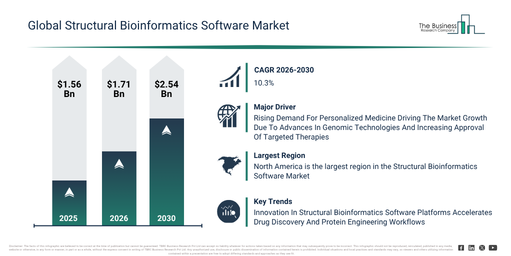
The structural bioinformatics software market has experienced swift expansion in size over recent years. It is projected to increase from $1.56 billion in 2025 to $1.71 billion in 2026, at a compound annual growth rate (CAGR) of 10.1%. The growth observed in the past can be attributed to several factors: an increasing demand for protein structure analysis, the expansion of pharmaceutical and biotechnology research, the adoption of molecular modeling tools, a rising focus on genomics and proteomics studies, and the development of visualization and analysis software.
The structural bioinformatics software market is anticipated to witness substantial expansion in the upcoming years. Its size is expected to reach $2.54 billion in 2030, exhibiting a compound annual growth rate (CAGR) of 10.3%. This expansion during the forecast period is propelled by factors such as the adoption of AI-powered structural prediction, the deployment of bioinformatics platforms in the cloud, integration with advanced drug discovery workflows, the enhancement of capabilities in academic and research institutions, and the rising demand for high-throughput and collaborative analysis solutions. Prominent trends throughout the forecast period include AI-driven structural predictions, cloud-based structural bioinformatics platforms, high-throughput molecular simulations, integration into drug discovery pipelines, and collaborative structural data management.
Get A Free Sample Report With In-Depth Market Insights:
Structural Bioinformatics Software Market Growth Backed By Core Demand Fundamentals
The structural bioinformatics software market is expected to experience growth in the future, propelled by the increasing demand for personalized medicine. Personalized medicine represents an approach that tailors healthcare and therapies according to a patient’s distinct biological and personal characteristics. The utilization of personalized medicine is on the rise, attributed to breakthroughs in genomic technologies that enable healthcare providers to analyze a patient’s genetic information quickly and accurately, thereby facilitating more targeted and effective treatments. Structural bioinformatics software supports personalized medicine by analyzing the 3D structures of proteins and other biomolecules to forecast how individual genetic variations affect drug response, allowing for customized therapies for each patient. For instance, in February 2024, according to the Personalized Medicine Coalition, a US-based non-profit organization, in 2023, the FDA approved 16 new personalized treatments for rare disease patients, which was an increase from six in 2022. The newly approved personalized treatments for 2023 also encompassed seven cancer drugs and three for other diseases and conditions. Consequently, the expanding demand for personalized medicine is a significant driver for the growth of the structural bioinformatics software market.
Structural Bioinformatics Software Market Segment Breakdown: Which Categories Lead On Revenue?
The structural bioinformatics software market covered in this report is segmented –
1) By Product Type: Visualization Software, Modeling Software, Analysis Software, Database Management Software, Other Product Types
2) By Deployment Mode: On-Premises, Cloud-Based
3) By Application: Drug Discovery, Protein Structure Analysis, Molecular Dynamics, Genomics and Proteomics, Other Applications
4) By End-User: Pharmaceutical and Biotechnology Companies, Academic and Research Institutes, Contract Research Organizations, Other End Users
Subsegments:
1) By Visualization Software: Three Dimensional Molecular Visualization, Protein Structure Rendering Tools, Interactive Structural Exploration Tools, Surface And Electrostatic Visualization Tools, Comparative Structure Visualization Tools
2) By Modeling Software: Homology Modeling Tools, Ab Initio Structure Prediction Tools, Threading And Fold Recognition Tools, Macromolecular Assembly Modeling Tools, Ligand Docking And Binding Modeling Tools
3) By Analysis Software: Structural Alignment And Comparison Tools, Binding Site Identification Tools, Energy Minimization And Stability Analysis Tools, Protein Folding And Conformation Analysis Tools, Mutational Impact And Functional Analysis Tools
4) By Database Management Software: Protein Structure Database Management Systems, Sequence And Structure Integration Databases, Annotation And Metadata Management Systems, Experimental Data Storage Platforms, Data Retrieval And Query Management Tools
5) By Other Product Types: Workflow Automation And Pipeline Management Tools, Simulation Support Utilities, Data Conversion And Format Standardization Tools, Collaboration And Reporting Tools, Integration And Application Programming Interface Management Tools
Structural Bioinformatics Software Market Growth Trends Reshaping The Competitive Landscape
Key companies operating within the structural bioinformatics software market are prioritizing the development of innovative solutions, such as integrated structural biology computational platforms, to accelerate drug discovery, refine protein engineering, and enhance the accuracy of molecular modeling. Integrated structural biology computational platforms represent advanced digital frameworks that combine tools for modeling, simulation, and data analysis to examine the three-dimensional structure of biological molecules, assisting researchers in deciphering molecular interactions, predicting protein structures, and advancing drug discovery and life science research. For instance, in August 2025, Biortus, a US-based contract research organization, launched BiortusAI, an AI- or ML-driven integrated structural biology computational platform designed to expedite protein design, antibody engineering, and hit discovery. This platform integrates structural biology data from X-ray crystallography and cryo-EM with advanced models like AlphaFold2, Chai-1/2, and Proteinix, enabling efficient workflows for enzyme optimization, nanobody design, and rapid GPCR hit identification with high precision. This structural bioinformatics tool reduces drug discovery cycles by over 50% through its AI-driven virtual screening and high-performance computing capabilities.
Structural Bioinformatics Software Market Key Participants And Competitive Landscape
Major companies operating in the structural bioinformatics software market are Dassault Systèmes SE, Schrödinger Inc., DeepMind Limited, Simulations Plus Inc., Chemical Computing Group ULC, MolSoft LLC, Cresset Group Ltd., OpenEye Scientific Software Inc., Nimbus Therapeutics LLC, Optibrium Ltd., DNASTAR Inc., Bioinformatics Solutions Inc., BioSolveIT GmbH, Acellera Ltd., InteLigand GmbH, Alchemistry Ltd., OpenStructure, Insilico Medicine Ltd., Exscientia plc, and Biortus Biosciences Co. Ltd.
View The Full Structural Bioinformatics Software Market Report:
Structural Bioinformatics Software Market Geographic Analysis: Where Is Demand Accelerating Fastest?
North America was the largest region in the structural bioinformatics software market in 2025. Asia-Pacific is expected to be the fastest-growing region in the forecast period. The regions covered in the structural bioinformatics software market report are Asia-Pacific, South East Asia, Western Europe, Eastern Europe, North America, South America, Middle East, Africa.
Reach Out To Our Team:
The Business Research Company: https://www.thebusinessresearchcompany.com/
Americas: +1 310-496-7795
Asia: +44 7882 955267 & +91 8897263534
Europe: +44 7882 955267
Email us at: marketing@tbrc.info
Follow us on:
LinkedIn: https://in.linkedin.com/company/the-business-research-company
YouTube: https://www.youtube.com/channel/UC24_fI0rV8cR5DxlCpgmyFQ
Global Market Model: https://www.thebusinessresearchcompany.com/global-market-model

Wasay has over a decade of experience in market research, data modelling, and analytics, with prior experience at GlobalData and Decision Tree Consulting Services. At The Business Research Company , he leads research operations across syndicated studies, customized consulting engagements, and the Global Market Model platform. His professional experience includes supporting organizations such as Boston Consulting Group, KPMG, and Ernst & Young. Wasay holds a degree in Electronics and Communications Engineering, postgraduate management qualifications from International Management Institute Belgium and Indian School of Business and Entrepreneurship, and completed the Integrated Program in Business Analytics from Indian Institute of Management Indore.