Backed by market attractiveness analysis, total addressable market sizing, company benchmarking matrices, interactive Excel dashboards, wider supply chain intelligence, emerging startup coverage, and detailed product-level insights, The Business Research Company’s 2026 market reports are designed to offer research that is more actionable and strategically valuable than ever.
Edge Artificial Intelligence (AI) Market Size Outlook: How Quickly Will Revenue Expand Through 2030?
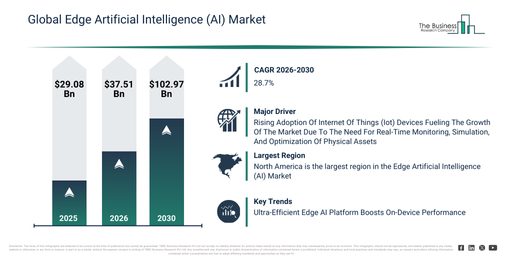
The edge artificial intelligence (AI) market size has seen substantial growth in recent years. It is forecast to grow from $29.08 billion in 2025 to $37.51 billion in 2026, achieving a compound annual growth rate (CAGR) of 29.0%. This historical expansion can be attributed to the increasing adoption of on-device computing solutions, a heightened demand for low-latency data processing, rising deployment within industrial automation, the expansion of smart devices and Internet of Things (IOT) applications, and a greater focus on real-time decision-making.
The edge artificial intelligence (AI) market is anticipated to experience substantial expansion in the coming years, with its size projected to reach $102.97 billion in 2030, demonstrating a compound annual growth rate (CAGR) of 28.7%. This growth in the forecast period is attributed to several factors, including the increasing integration of artificial intelligence (AI) at the network edge, a rising demand for privacy-preserving and secure data processing, broader adoption in autonomous systems and smart infrastructure, the expansion of edge computing platforms and devices, and an increase in investment for efficient and scalable AI deployments. Key trends for the forecast period encompass technology-driven innovations in edge computing hardware and software, advancements in artificial intelligence (AI) model optimization for edge devices, the development of low-power and high-performance processing systems, increasing research and development in real-time analytics and inference, and innovation in distributed and federated AI architectures.
Get A Free Sample Report With In-Depth Market Insights:
Edge Artificial Intelligence (AI) Market Expansion Drivers: What’s Shaping Future Growth?
The expansion of the edge artificial intelligence (AI) market is anticipated to be fueled by the increasing integration of internet of things (IoT) devices. Internet of things (IoT) devices are defined as a network of linked devices, including examples like smartphones, sensors, wearables, smart home devices, and security cameras, which facilitate communication and data exchange via the internet autonomously. The demand for internet of things (IoT) connected devices is growing because of the requirement for real-time data, which in turn boosts efficiency, permits remote oversight, and aids more informed choices across various sectors. Edge artificial intelligence (AI) supports the uptake of Internet of Things (IoT) devices by allowing real-time data processing and decision-making directly on these devices, thereby minimizing latency and lessening dependence on cloud infrastructure. This technology enhances device efficiency, reliability, and scalability, promoting wider implementation across industries. A notable example is the data from IoT Analytics, a Germany-based research firm specializing in IoT market insights, which reported in September 2024 that the count of connected IoT devices reached 16.6 billion in 2023, marking a 15% rise from 14.4 billion in 2022. Consequently, the increasing adoption of internet of things (IoT) devices is a significant force behind the growth of the edge artificial intelligence (AI) market.
Edge Artificial Intelligence (AI) Market Segment Breakdown: Which Categories Lead On Revenue?
The edge artificial intelligence (AI) market covered in this report is segmented –
1) By Component: Hardware, Software, Edge Cloud Infrastructure, Services
2) By Device Or Platform Type: Thin Edge Devices, Thick Edge Or Edge Gateway, Enterprise Or Near Edge
3) By Deployment Mode: Cloud, On Premises
4) By Application Or Function: Autonomous Vehicles And Robotics, Predictive Maintenance And Quality Control, Intelligent Surveillance And Security, Personalization And User Experience, Remote Monitoring And Diagnostics
5) By End User Industry: Smart Cities, Manufacturing, Consumer Electronics, Automotive, Healthcare, Government, Energy, Information Technology And Telecommunication, Retail, Other End User Industries
Subsegments:
1) By Hardware: Edge Servers, Edge Gateways, Sensor And Device Hardware
2) By Software: Edge Analytics Software, Edge Device Management Software, Artificial Intelligence (AI) Inference Software
3) By Edge Cloud Infrastructure: Edge Data Centers, Distributed Cloud Platforms, Network And Connectivity Infrastructure
4) By Services: Deployment And Integration Services, Maintenance And Support Services, Consulting And Training Services
Edge Artificial Intelligence (AI) Market Strategic Trends: What Defines The Next Growth Phase?
Leading firms in the edge artificial intelligence (AI) market are concentrating on creating sophisticated platforms, like integrated edge computing platforms, to facilitate immediate, energy-saving AI inference directly on devices and sensors, thereby decreasing latency and operational expenses. Full-scale onboard CO₂ capture systems denote comprehensive carbon capture technologies deployed straight onto ships, vehicles, or industrial machinery, which actively seize and store carbon dioxide emissions at their point of origin during activity. For example, in February 2025, Arm Holdings Ltd., a UK-based semiconductor design company, introduced the Armv9 edge AI platform. This platform incorporates a novel, highly efficient Cortex-A320 CPU, offering a 10x boost in machine learning performance over its previous version, complemented by the Ethos-U85 NPU. Furthermore, the platform comes with an enhanced Arm Kleidi for IoT software toolkit, capable of delivering up to a 70% performance increase for AI frameworks and integrating smoothly with widely used tools such as Llama.cpp, thereby simplifying development for more than 20 million developers. It additionally features advanced Armv9.2 security functionalities, including Pointer Authentication and Memory Tagging Extension, establishing a vital security groundwork for vulnerable edge devices managing sensitive information in industrial and smart city contexts.
Edge Artificial Intelligence (AI) Market Industry Leaders And Competitive Landscape
Major companies operating in the edge artificial intelligence (AI) market are Amazon Web Services Inc., Google LLC, Intel Corp., Qualcomm Incorporated, NVIDIA Corporation, NXP Semiconductors N.V., Renesas Electronics Corporation, Arm Limited, Ambarella Inc., CEVA Inc., TensTorrent Inc., EdgeCortix Inc., Samsung Electronics Co. Ltd., Horizon Robotics Inc., Mythic Inc., BrainChip Holdings Ltd., Texas Instruments Incorporated, Kneron Inc., Syntiant Corporation, Blaize Inc., Azure LLC, Edge Impulse Inc., Luxonis Inc., MediaTek NeuroPilot
View The Full Edge Artificial Intelligence (AI) Market Report:
Edge Artificial Intelligence (AI) Market Regional Analysis And Top Geography
North America was the largest region in the edge artificial intelligence (AI) market in 2025. Asia-Pacific is expected to be the fastest-growing region in the forecast period. The regions covered in the edge artificial intelligence (AI) market report are Asia-Pacific, South East Asia, Western Europe, Eastern Europe, North America, South America, Middle East, Africa.
Reach Out To Our Team:
The Business Research Company: https://www.thebusinessresearchcompany.com/
Americas: +1 310-496-7795
Asia: +44 7882 955267 & +91 8897263534
Europe: +44 7882 955267
Email us at: marketing@tbrc.info
Follow us on:
LinkedIn: https://in.linkedin.com/company/the-business-research-company
YouTube: https://www.youtube.com/channel/UC24_fI0rV8cR5DxlCpgmyFQ
Global Market Model: https://www.thebusinessresearchcompany.com/global-market-model

Wasay has over a decade of experience in market research, data modelling, and analytics, with prior experience at GlobalData and Decision Tree Consulting Services. At The Business Research Company , he leads research operations across syndicated studies, customized consulting engagements, and the Global Market Model platform. His professional experience includes supporting organizations such as Boston Consulting Group, KPMG, and Ernst & Young. Wasay holds a degree in Electronics and Communications Engineering, postgraduate management qualifications from International Management Institute Belgium and Indian School of Business and Entrepreneurship, and completed the Integrated Program in Business Analytics from Indian Institute of Management Indore.