Built to provide research that’s more actionable and strategically valuable, The Business Research Company’s 2026 market reports include market attractiveness analysis, total addressable market sizing, company benchmarking matrices, interactive Excel dashboards, broader supply chain intelligence, emerging startup tracking, and in-depth product insights.
Emotion Artificial Intelligence (AI) Market Size Forecast: How Big Could The Market Get By 2030?
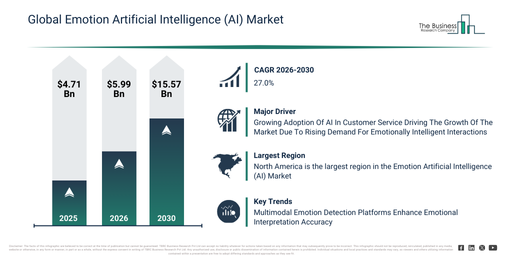
The emotion artificial intelligence market has seen rapid expansion in its size over recent years. It will grow from $4.71 billion in 2025 to $5.99 billion in 2026 at a compound annual growth rate (CAGR) of 27.2%. The growth observed in the past can be attributed to the increasing adoption of customer behavior analytics, the rising integration of emotion recognition in marketing campaigns, the growing use of biometric sensors for user experience analysis, the expansion of artificial intelligence in security and surveillance, and the increasing utilization of emotion analytics in healthcare monitoring.
The emotion artificial intelligence market is anticipated to experience substantial growth over the next few years, with an expected rise to $15.57 billion in 2030, demonstrating a compound annual growth rate (CAGR) of 27.0%. This expansion during the forecast period is driven by factors such as the increasing demand for personalized digital customer interactions, a surge in enterprise investments in affective computing solutions, the expanded deployment of emotion recognition in autonomous vehicles, the broadening application of emotion AI in human resource and recruitment processes, and the growing implementation of artificial intelligence-based emotional learning tools in education. Prominent trends for this period include technological advancements in multimodal emotion sensing systems, innovations in deep learning-based emotion recognition algorithms, developments in facial micro-expression detection models, ongoing research and developments in voice sentiment and tone analysis engines, and progress in real-time wearable emotion recognition devices.
Get A Free Sample Report With In-Depth Market Insights:
Emotion Artificial Intelligence (AI) Market Growth Backed By Core Demand Fundamentals
The increasing integration of AI within customer service is projected to stimulate the growth of the emotion artificial intelligence (AI) market going forward. AI in customer service refers to the deployment of artificial intelligence technologies, including chatbots, virtual assistants, and automated support systems, to enhance customer interactions, streamline support processes, and provide personalized solutions. The adoption of AI in customer service is escalating due to rising consumer demands for prompt, tailored, and emotionally aware responses across various digital channels. Emotion AI facilitates this adoption by enabling systems to detect, interpret, and respond to human emotions, thereby improving customer satisfaction, engagement, and loyalty. For instance, in April 2025, according to the Stanford Institute for Human-Centered Artificial Intelligence, a US-based artificial intelligence research institute, private artificial intelligence investment in the U.S. grew to $109.1 billion, with generative artificial intelligence attracting $33.9 billion globally, marking an 18.7% increase from 2023. Additionally, 78% of organizations reported using artificial intelligence in 2024, up from 55% compared to 2023. Therefore, the expanding adoption of AI in customer service is driving the growth of the emotion artificial intelligence (AI) market.
Emotion Artificial Intelligence (AI) Market Segment Outlook: Which Categories Are Growing Fastest?
The emotion artificial intelligence (AI) market covered in this report is segmented –
1) By Component: Software, Hardware, Services
2) By Technology: Facial Recognition, Speech Recognition, Biosensing, Machine Learning, Natural Language Processing
3) By Application: Human Resources And Recruitment, Driver Safety And Monitoring, Mental Health And Well-Being Monitoring, Personal Assistants And Virtual Agents, Marketing, Sales, And Advertising, Customer Experience Management
4) By End-User: Banking, Financial Services And Insurance (BFSI), Healthcare, Retail, Automotive, Information Technology (IT) And Telecommunications, Media And Entertainment
Subsegments:
1) By Software: Facial Expression Recognition Software, Voice Emotion Recognition Software, Text Sentiment Analysis Software, Behavioral Analytics Software, Physiological Signal Analysis Software
2) By Hardware: Emotion Detection Cameras, Microphones For Emotion Recognition, Wearable Sensors, Eye Tracking Devices, Physiological Monitoring Devices
3) By Services: Consulting And Implementation Services, Data Annotation And Training Services, System Integration Services, Maintenance And Support Services, Analytics And Reporting Services
Emotion Artificial Intelligence (AI) Market Growth Trends Reshaping The Competitive Landscape
Leading companies in the emotion artificial intelligence (AI) market are concentrating on developing advanced offerings, such as foundational voice-to-voice models, to enhance conversational quality, boost emotional intelligence, and lessen unnatural exchanges and user dissatisfaction. Foundational voice-to-voice models describe sophisticated AI systems that can participate in rapid, fluent, and emotionally responsive spoken dialogues. For instance, in September 2024, Hume AI Inc., a US-based artificial intelligence company, introduced EVI 2. This new voice-to-voice foundation model is capable of remarkably human-like conversations with subsecond response times. It incorporates a sophisticated understanding of a user’s tone of voice and the capacity to generate a wide array of tones, personalities, and speaking styles, allowing for seamless and adaptive interaction without seeming robotic. Additionally, it integrates a novel, safe voice modulation system and is specifically trained for emotional intelligence, thereby extending its utility across various applications and ensuring its responses align with user well-being.
Emotion Artificial Intelligence (AI) Market Company Landscape And Competitive Strategy
Major companies operating in the emotion artificial intelligence (AI) market are NICE Ltd., Uniphore Software Systems, Imentiv Inc., Entropik Technologies Pvt. Ltd., Smart Eye AB, Hume AI Inc., Imotions Inc., Realeyes, Beyond Emotion GmbH, audEERING GmbH, Emteq Labs Ltd., BeEmotion.ai, MorphCast Inc., Emaww, Kairos AR Inc., Vokaturi, Empath Inc., Behavioral Signals, Emotibot Technology (Shanghai) Co. Ltd., Eyeris Technologies Inc., MoodMe Co., Emotionise
View The Full Emotion Artificial Intelligence (AI) Market Report:
Emotion Artificial Intelligence (AI) Market Largest Region: Which Geography Holds The Biggest Share?
North America was the largest region in the emotion artificial intelligence market in 2025. Asia-Pacific is expected to be the fastest-growing region in the forecast period. The regions covered in the emotion artificial intelligence (AI) market report are Asia-Pacific, South East Asia, Western Europe, Eastern Europe, North America, South America, Middle East, Africa.
Reach Out To Our Team:
The Business Research Company: https://www.thebusinessresearchcompany.com/
Americas: +1 310-496-7795
Asia: +44 7882 955267 & +91 8897263534
Europe: +44 7882 955267
Email us at: marketing@tbrc.info
Follow us on:
LinkedIn: https://in.linkedin.com/company/the-business-research-company
YouTube: https://www.youtube.com/channel/UC24_fI0rV8cR5DxlCpgmyFQ
Global Market Model: https://www.thebusinessresearchcompany.com/global-market-model

Wasay has over a decade of experience in market research, data modelling, and analytics, with prior experience at GlobalData and Decision Tree Consulting Services. At The Business Research Company , he leads research operations across syndicated studies, customized consulting engagements, and the Global Market Model platform. His professional experience includes supporting organizations such as Boston Consulting Group, KPMG, and Ernst & Young. Wasay holds a degree in Electronics and Communications Engineering, postgraduate management qualifications from International Management Institute Belgium and Indian School of Business and Entrepreneurship, and completed the Integrated Program in Business Analytics from Indian Institute of Management Indore.