Market attractiveness scoring, total addressable market sizing, company benchmarking matrices, interactive Excel dashboards, deeper supply chain intelligence, emerging startup tracking, and granular product-level insights are among the key offerings featured in The Business Research Company’s 2026 market reports, designed to deliver more actionable and strategically valuable research.
Generative AI Market Valued At $47.28 Billion In 2026, Projected To Reach $129.83 Billion By 2030
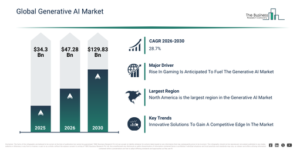
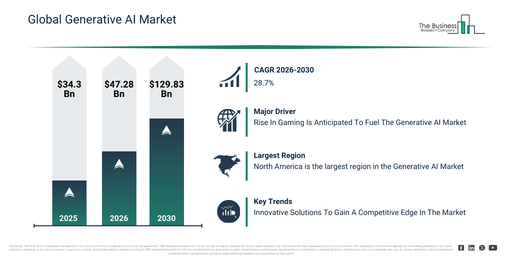
The generative AI market has experienced rapid expansion in recent years. It is anticipated to increase from $34.3 billion in 2025 to $47.28 billion in 2026, exhibiting a compound annual growth rate (CAGR) of 37.8%. The historical growth can be ascribed to advancements in deep learning models, the availability of large datasets, the proliferation of cloud computing, foundational neural network research, and an increase in AI research funding.
The generative AI market size is projected to undergo significant growth in the coming years. It is forecast to expand to $129.83 billion in 2030, achieving a compound annual growth rate (CAGR) of 28.7%. This expansion during the forecast period is attributable to enterprise AI adoption, the demand for automating creative tasks, the development of multimodal AI models, a regulatory emphasis on AI governance, and the increasing availability of API-based AI services. Key trends identified for the forecast period include text and content generation, image and video synthesis, tools for code generation, AI creative design platforms, and the creation of synthetic data.
Request A Complimentary Generative AI Market Research Sample:
Key Factor Propelling The Generative AI Market Forward
The increasing prevalence of gaming is anticipated to stimulate expansion in the generative AI market in the future. Gaming refers to the engagement in electronic or tabletop games, typically for leisure, rivalry, or skill enhancement. Generative AI facilitates the production of dynamic and adaptable game content, including characters, settings, and storylines, thereby improving player experiences via customized and evolving gameplay features. For example, data from Uswitch Limited, a UK-based online comparison and switching service provider, indicated in May 2023 that approximately 3.2 billion online gamers existed worldwide in 2022. This global gamer count is projected to increase further over the next ten years, peaking at 5.7 billion by 2032, representing a 44% rise compared to 2022. Consequently, the expansion of gaming is a key impetus for the generative AI market.
Generative AI Market Segments And Subsegments Explained
The generative AI market covered in this report is segmented –
1) By Component: Software, Services
2) By Offering Type: Image, Video, Speech, Other Offering Types
3) By Technology: Generative Adversarial Networks (GANs), Transformer, Variational Autoencoder (VAE), Diffusion Networks
4) By End-User: Media And Entertainment, BFSI (Banking, Financial Services And Insurance), IT And Telecom, Healthcare, Automotive And Transportation, Other End-Users
Subsegments:
1) By Software: AI Model Frameworks, Text Generation Tools, Image And Video Generation Software, Code Generation Tools, Design And Creative Tools
2) By Services: Consulting Services For AI Implementation, Managed Services For AI Operations, Training And Support Services, Custom AI Model Development, API Integration Services
Emerging Trends Transforming The Generative AI Market
Major companies in the generative AI market are concentrating on developing innovative solutions, such as business chatbots, to gain a competitive edge. A business chatbot is an AI-driven software designed to engage in conversational interactions with users, providing information, assistance, and performing tasks within a business context. For instance, in November 2023, Amazon, a US-based technology company, unveiled Q, a business chatbot powered by generative AI, intended to streamline communications and assist employees with tasks including generating blog posts. Amazon’s Q is engineered to synthesize content and enhance day-to-day communications, offering tailored experiences by connecting to company data.
Generative AI Market Key Players: Major Companies In The 2026 Report
Major companies operating in the generative AI market are Alphabet Inc.; Microsoft Corporation; Meta Platforms Inc.; Amazon Web Services Inc.; Intel Corporation; International Business Machines Corporation; Tata Consultancy Services Limited; NVIDIA Corporation; Salesforce Inc.; Adobe Inc.; Wipro Limited; VEESUAL; OpenAI LP; Larsen & Toubro Technology Services Limited; iGenie; Paige AI Inc.; Synthesia; Inworld AI; Rephrase.ai; D-ID; Mostly AI
Explore The Full Generative AI Market Report With Forecasts To 2030:
Generative AI Market By Region: Where Is Demand Strongest?
North America was the largest region in the generative AI market in 2025. The regions covered in the generative AI market report are Asia-Pacific, South East Asia, Western Europe, Eastern Europe, North America, South America, Middle East, Africa.
Reach Out To Our Team:
The Business Research Company: https://www.thebusinessresearchcompany.com/
Americas: +1 310-496-7795
Asia: +44 7882 955267 & +91 8897263534
Europe: +44 7882 955267
Email us at: marketing@tbrc.info
Follow us on:
LinkedIn: https://in.linkedin.com/company/the-business-research-company
YouTube: https://www.youtube.com/channel/UC24_fI0rV8cR5DxlCpgmyFQ
Global Market Model: https://www.thebusinessresearchcompany.com/global-market-model

Wasay has over a decade of experience in market research, data modelling, and analytics, with prior experience at GlobalData and Decision Tree Consulting Services. At The Business Research Company , he leads research operations across syndicated studies, customized consulting engagements, and the Global Market Model platform. His professional experience includes supporting organizations such as Boston Consulting Group, KPMG, and Ernst & Young. Wasay holds a degree in Electronics and Communications Engineering, postgraduate management qualifications from International Management Institute Belgium and Indian School of Business and Entrepreneurship, and completed the Integrated Program in Business Analytics from Indian Institute of Management Indore.