Market attractiveness scoring, total addressable market sizing, company benchmarking matrices, interactive Excel dashboards, deeper supply chain intelligence, emerging startup tracking, and granular product-level insights are among the key offerings featured in The Business Research Company’s 2026 market reports, designed to deliver more actionable and strategically valuable research.
Linux Software Market Growth Outlook: How Much Bigger Will The Market Be By 2030?
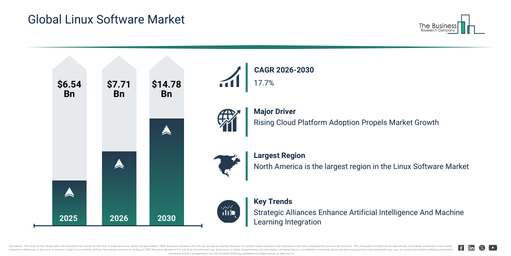
The linux software market size has experienced rapid expansion in recent years. It is projected to increase from $6.54 billion in 2025 to $7.71 billion in 2026, exhibiting a compound annual growth rate (CAGR) of 18.0%. The growth observed in the historic period can be attributed to the rise of the open-source movement, the growth of linux-compatible hardware, an increasing demand for cost-effective software solutions, the early adoption of enterprise linux distributions, and the growth of developer communities.
The linux software market is projected to experience swift expansion over the coming years. By 2030, this market is forecasted to reach $14.78 billion, exhibiting a compound annual growth rate (CAGR) of 17.7%. This projected growth is primarily driven by factors such as the burgeoning cloud computing sector, a heightened need for cybersecurity and robust platforms, advancements in virtualization and container technologies, the integration of AI and machine learning on linux, and the increasing uptake of open-source software by businesses. Significant trends expected during this period encompass open-source collaboration platforms, improved cross-platform compatibility, enhancements in security and privacy, the development of cloud-native linux applications, and continued innovation in virtualization and containerization.
Request A Free Linux Software Market Sample From The Business Research Company:
How Is The Key Growth Driver Influencing The Linux Software Market?
The growing adoption of cloud platforms is anticipated to propel the expansion of the linux software market in the future. These platforms are defined as cloud computing environments that offer on-demand access to computing resources, storage, and applications over the internet. Their rising popularity is attributed to benefits such as cost efficiency, scalability, flexibility, enhanced security, and improved collaboration capabilities. Linux software is widely deployed in cloud platforms due to its stability, scalability, and open-source nature, which enables efficient management and deployment of cloud services and applications. For instance, in March 2024, Flexera, a US-based computer software company, reported that multi-cloud usage in 2023 saw a slight rise, increasing from 87% to 89%. Thus, the expanding adoption of cloud platforms serves as a key driver for the linux software market.
Linux Software Market Segmentation By Category: What Does The 2026 Report Cover?
The linux software market covered in this report is segmented –
1) By Type: Web Browsers, Office Suites, Media Players, Graphics And Designs, Other Types
2) By Organization Size: Small and Medium-Sized Enterprises (SMEs), Large Enterprises
3) By Distribution: Standalone, Network, Cloud, Other Distributions
4) By Application: Household, Enterprise, Government, Other Applications
Subsegments:
1) By Web Browsers: Firefox, Chromium, Opera, Midori, Vivaldi
2) By Office Suites: LibreOffice, OpenOffice, WPS Office, OnlyOffice, Calligra Suite
3) By Media Players: VLC Media Player, MPV, Rhythmbox, Clementine, Audacious
4) By Graphics And Designs: GIMP, Inkscape, Blender, Krita, Darktable
5) By Other Types: Text Editors, File Managers, Virtualization Software, Development Tools, Security Tools
How Are Industry Players Changing The Linux Software Market Landscape?
Key players in the Linux software market are establishing strategic partnerships to provide essential automated machine learning and AI fairness technologies, aiming to boost data processing and application efficiency. Such strategic partnerships involve companies leveraging each other’s strengths and resources to achieve mutual benefits and success. For instance, in September 2023, Fujitsu Ltd., a Japan-based information and communications technology company, partnered with the Linux Foundation, a US-based non-profit organization, with the goal of promoting artificial intelligence (AI) democratization by enabling global developers to securely access cutting-edge technologies on open platforms. This collaboration seeks to develop innovative applications and solutions for both business and societal challenges, as Fujitsu’s automated machine learning and AI fairness technologies are planned for release as open-source software.
Linux Software Market Global Key Players And Competitive Overview
Major companies operating in the linux software market are Amazon Inc., Alphabet Inc., Samsung Electronics Co Ltd, Microsoft Corporation, Meta Platforms Inc., Dell Technologies Inc, International Business Machines Corporation, Oracle Corporation, Fujitsu Ltd., SUSE S.A., Mozilla Foundation, Debian, Arch Linux, Linux Mint, LibreOffice, Shotcut, Elementary OS, Ubuntu, VideoLAN
Explore Comprehensive Linux Software Market Coverage In The Full Report:
Regional Analysis Of The Linux Software Market: Where Is The Industry Concentrated?
North America was the largest region in the linux software market in 2025. The regions covered in the linux software market report are Asia-Pacific, South East Asia, Western Europe, Eastern Europe, North America, South America, Middle East, Africa.
Reach Out To Our Team:
The Business Research Company: https://www.thebusinessresearchcompany.com/
Americas: +1 310-496-7795
Asia: +44 7882 955267 & +91 8897263534
Europe: +44 7882 955267
Email us at: marketing@tbrc.info
Follow us on:
LinkedIn: https://in.linkedin.com/company/the-business-research-company
YouTube: https://www.youtube.com/channel/UC24_fI0rV8cR5DxlCpgmyFQ
Global Market Model: https://www.thebusinessresearchcompany.com/global-market-model

Wasay has over a decade of experience in market research, data modelling, and analytics, with prior experience at GlobalData and Decision Tree Consulting Services. At The Business Research Company , he leads research operations across syndicated studies, customized consulting engagements, and the Global Market Model platform. His professional experience includes supporting organizations such as Boston Consulting Group, KPMG, and Ernst & Young. Wasay holds a degree in Electronics and Communications Engineering, postgraduate management qualifications from International Management Institute Belgium and Indian School of Business and Entrepreneurship, and completed the Integrated Program in Business Analytics from Indian Institute of Management Indore.