The Business Research Company’s 2026 market reports are designed to deliver research that is more actionable and strategically valuable. Key offerings include market attractiveness scoring, total addressable market sizing, company benchmarking matrices, interactive Excel dashboards, deeper supply chain intelligence, emerging startup tracking, and granular product-level insights.
Machine Learning in Supply Chain Management Market Historical Growth Vs. Forecast Growth: How Do The Numbers Compare?
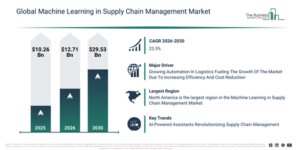
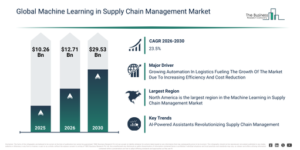
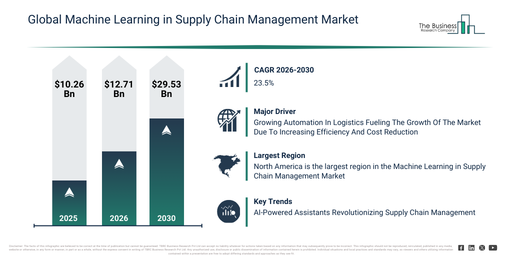
The machine learning in supply chain management market has experienced substantial growth in its size over recent years. It is anticipated to increase from $10.26 billion in 2025 to $12.71 billion in 2026, representing a compound annual growth rate (CAGR) of 23.8%. This historical expansion can be ascribed to elements such as the development of global trade networks, the proliferation of e-commerce logistics, the implementation of cloud supply chain platforms, an increasing need for operational efficiency, and the digital transformation of warehouse operations.
The machine learning in supply chain management market is anticipated to experience substantial growth in the coming years, reaching a valuation of $29.53 billion by 2030, at a compound annual growth rate (CAGR) of 23.5%. This projected expansion is primarily driven by the integration of autonomous supply chain systems, the increasing adoption of AI-powered warehouse automation, the deployment of predictive logistics platforms, the development of real-time data analytics, and growing investments in smart logistics. Key trends shaping this period include predictive demand forecasting, AI-based inventory optimization, automated logistics planning, enhanced real-time supply chain visibility, and the integration of risk analytics.
Start With A Free Sample Of The Machine Learning in Supply Chain Management Market Research Report:
The Leading Growth Driver In The Machine Learning in Supply Chain Management Market Explained
The increasing adoption of automation within logistics is anticipated to fuel the expansion of the machine learning in supply chain management market in the future. Logistics automation involves employing technologies like robotics, artificial intelligence, and software platforms to enhance and optimize supply chain operations, requiring limited human involvement. The rise of automation in logistics stems from its capacity to boost efficiency, lower expenses, and address increasing e-commerce needs through technological solutions that improve operational scale and client contentment. Machine learning improves supply chain management by facilitating predictive analysis, accurate demand projections, and prompt decision-making. Furthermore, it propels automation in logistics via optimized routing, robotic solutions for warehouses, and smart inventory management. An example of this trend is observed in September 2024, where the International Federation of Robotics (IFR), an industry association based in Germany, reported that the global count of operational factory robots reached 4,281,585 units in 2023. This represented a 10% surge from the 3,904,000 units documented in 2022. Consequently, the expanding automation in logistics is a key factor boosting the development of the machine learning in supply chain management market.
Key Segments Shaping The Machine Learning in Supply Chain Management Market Landscape
The machine learning in supply chain management market covered in this report is segmented –
1) By Component: Software, Services
2) By Technology: Artificial Intelligence, Deep Learning, Natural Language Processing, Predictive Analytics
3) By Deployment Mode: Cloud-Based, On-Premises
4) By Application: Demand Forecasting, Inventory Management, Supplier Selection, Logistics Optimization, Risk Management
5) By End-User: Retail And E-Commerce, Manufacturing, Healthcare, Automotive, Food And Beverage, Consumer Goods, Other End-Users
Subsegments:
1) By Software: Demand Forecasting Software, Warehouse Management Software (WMS), Transportation Management Systems (TMS), Inventory Optimization Software, Procurement And Sourcing Analytics Tools, Supply Chain Planning Software, Risk Management And Compliance Software
2) By Services: Managed Services, Professional Services, Consulting Services, Training And Support Services
Machine Learning in Supply Chain Management Market Trend Spotlight: Key Shifts Shaping Future Demand
Leading companies in the machine learning in supply chain management market are concentrating on developing technologically advanced solutions, such as artificial intelligence (AI) assistants for supply chain management, to improve decision-making, optimize operations, and boost overall efficiency. An AI assistant for supply chain management is an intelligent software tool that utilizes artificial intelligence to automate and enhance supply chain processes like forecasting, inventory management, and logistics planning. For example, in February 2024, One Network Enterprises, a US-based provider of digital supply chain solutions, launched NEO Assistant, a revolutionary AI tool designed specifically for supply chain management. This cutting-edge platform employs both AI and machine learning (ML) technologies to deliver real-time monitoring, intelligent prescriptions, and interactive visualizations. By merging AI-driven insights with ML-powered predictive analytics, NEO Assistant improves decision-making and operational effectiveness across complex logistics networks. The system provides users with actionable recommendations and streamlined problem-solving capabilities, proving highly effective in navigating dynamic supply chain environments.
Machine Learning in Supply Chain Management Market Competitive Analysis: Who Are The Main Competitors?
Major companies operating in the machine learning in supply chain management market are Amazon.com Inc., Microsoft Corporation, Deutsche Post AG, FedEx Corporation, Mærsk A/S, Siemens AG, International Business Machines Corporation, Oracle Corporation, SAP SE, Ferguson Enterprises LLC, Zoetop Business Co. Ltd., H&M Hennes & Mauritz AB, J. C. Penney Corporation Inc., ALTANA AG, Koch Industries Inc., Industria de Diseño Textil S.A., FourKites Inc., Noodle.AI Inc., Lokad SAS, Garvis Inc., Logility Inc.
Find The Complete Machine Learning in Supply Chain Management Market Outlook In The Full Report:
Mapping The Machine Learning in Supply Chain Management Market: Regional Leadership And Global Reach
North America was the largest region in the machine learning in supply chain management market in 2025. The regions covered in the machine learning in supply chain management market report are Asia-Pacific, South East Asia, Western Europe, Eastern Europe, North America, South America, Middle East, Africa.
Reach Out To Our Team:
The Business Research Company: https://www.thebusinessresearchcompany.com/
Americas: +1 310-496-7795
Asia: +44 7882 955267 & +91 8897263534
Europe: +44 7882 955267
Email us at: marketing@tbrc.info
Follow us on:
LinkedIn: https://in.linkedin.com/company/the-business-research-company
YouTube: https://www.youtube.com/channel/UC24_fI0rV8cR5DxlCpgmyFQ
Global Market Model: https://www.thebusinessresearchcompany.com/global-market-model

Wasay has over a decade of experience in market research, data modelling, and analytics, with prior experience at GlobalData and Decision Tree Consulting Services. At The Business Research Company , he leads research operations across syndicated studies, customized consulting engagements, and the Global Market Model platform. His professional experience includes supporting organizations such as Boston Consulting Group, KPMG, and Ernst & Young. Wasay holds a degree in Electronics and Communications Engineering, postgraduate management qualifications from International Management Institute Belgium and Indian School of Business and Entrepreneurship, and completed the Integrated Program in Business Analytics from Indian Institute of Management Indore.