Built to provide research that’s more actionable and strategically valuable, The Business Research Company’s 2026 market reports include market attractiveness analysis, total addressable market sizing, company benchmarking matrices, interactive Excel dashboards, broader supply chain intelligence, emerging startup tracking, and in-depth product insights.
Network Slicing Orchestration Market Expansion Outlook: What Revenue Opportunities Are Ahead?
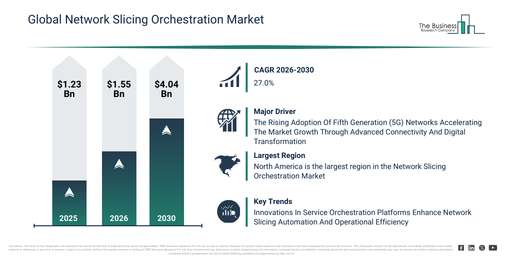
The network slicing orchestration market size has demonstrated substantial growth in recent years. Its value is expected to rise from $1.23 billion in 2025 to $1.55 billion in 2026, achieving a compound annual growth rate (CAGR) of 26.8%. This historical expansion can be attributed to a surge in 5G deployments, an increase in mobile data traffic, the increasing virtualization of telecom networks, the demand for improved quality of service, and the expansion of software-defined networking (SDN) and network functions virtualization (NFV).
The network slicing orchestration market is set for significant expansion in the coming years. It is projected to reach $4.04 billion by 2030, driven by a compound annual growth rate (CAGR) of 27.0%. This growth during the forecast period is fueled by several factors, including the increasing development of private 5G networks, the enlargement of edge computing infrastructure, a rise in the adoption of network slicing in enterprise applications, higher investments in cloud-native telecom architectures, and the demand for ultra-low latency applications such as V2X and AR/VR. Noteworthy trends for this period involve the standardization of multi-domain and multi-vendor orchestration, the rise of slice-as-a-service business models, the integration of service assurance with real-time analytics, an increasing need for secure and compliant network slices, and lifecycle automation for dynamic network resource allocation.
Get A Free Sample Report With In-Depth Market Insights:
Network Slicing Orchestration Market Growth Factors: What’s Supporting Expansion?
The expanding implementation of fifth-generation (5G) networks is projected to drive the future growth of the network slicing orchestration market. These fifth-generation (5G) networks represent advanced mobile communication systems, offering considerably faster data transmission, extremely low latency, and improved network capacity, thereby supporting a broad spectrum of consumer and business uses. This growing embrace of fifth-generation (5G) networks is fueled by widespread commercial rollouts from telecommunications providers and increasing business requirements for digital shifts, cloud services, and Internet of Things (IoT) solutions. Network slicing orchestration is crucial in facilitating the uptake of fifth-generation (5G) networks, as it allows for the automated establishment, administration, and refinement of virtual network slices, guaranteeing that network resources are flexibly assigned to fulfill the varied performance demands of fifth-generation (5G) applications. For example, data reported in March 2025 by 5G Americas, a US-based mobile industry association, indicated that global fifth-generation (5G) connections hit 2.25 billion in 2024, showcasing rapid expansion when compared to prior years. Consequently, the increasing acceptance of fifth-generation (5G) networks is propelling the growth of the network slicing orchestration market.
Network Slicing Orchestration Market Segment Landscape And Growth Outlook
The network slicing orchestration market covered in this report is segmented –
1) By Component: Solutions, Services
2) By Deployment Mode: On Premises, Cloud
3) By Application Area: Enhanced Mobile Broadband (eMBB), Ultra-Reliable Low-Latency Communications (URLLC), Massive Machine-Type Communications (mMTC), Vehicle-to-Everything (V2X) Communications
4) By End User: Banking, Financial Services, and Insurance (BFSI), Healthcare, Manufacturing, Information Technology (IT) and Telecommunications, Automotive, Other End Users
Subsegments:
1) By Solutions: Network Slicing Orchestration Software, Network Automation Software, Service Assurance and Analytics Software, Security and Compliance Software, Artificial Intelligence (AI)-Enabled Optimization Software
2) By Services: Consulting and Advisory Services, Integration and Deployment Services, Managed Orchestration Services, Maintenance and Support Services, Training and Certification Services
Network Slicing Orchestration Market Industry Trends: What’s Reshaping Demand?
Companies prominent in the network slicing orchestration market are concentrating on creating sophisticated solutions, such as platforms for service orchestration powered by artificial intelligence (AI), to automate the setup and performance enhancement of multi-domain services for a variety of fifth-generation (5G) applications and enterprise scenarios. These artificial intelligence (AI)-driven service orchestration platforms are software tools that leverage AI and machine learning to automate the entire lifecycle—design, deployment, management, and optimization—of services across various network domains in real time. This capability facilitates intent-based automation, offers predictive assurance, and allows for dynamic resource allocation, thereby improving service quality, boosting scalability, and increasing operational efficiency. An example of this trend is Ericsson, a telecommunications technology provider from Sweden, which introduced its Ericsson Service Orchestration and Assurance product in February 2024. This offering empowers communication service providers to design, implement, and manage services across diverse network domains through artificial intelligence (AI)-driven automation, intent-based orchestration, and integrated assurance functionalities. It supports dynamic multi-service connectivity, enhances operational efficiency, and facilitates hybrid network environments.
Network Slicing Orchestration Market Leading Companies And Competitive Benchmarking
Major companies operating in the network slicing orchestration market are Samsung Electronics Co. Ltd., AT&T Inc., Huawei Technologies Co. Ltd., International Business Machines Corporation, Cisco Systems Inc., Intel Corporation, Oracle Corporation, Telefonaktiebolaget LM Ericsson, Broadcom Inc., Fujitsu Limited, Capgemini SE, NEC Corp., Nokia Corporation, Telefónica S.A., ZTE Corporation, Rakuten Symphony Inc., Juniper Networks Inc., Amdocs Limited, Ciena Corporation, Netcracker Technology Corporation, Mavenir Systems Inc., Ribbon Communications Inc., and Airspan Networks Inc.
View The Full Network Slicing Orchestration Market Report:
Network Slicing Orchestration Market Top Region By Revenue And Market Share
North America was the largest region in the network slicing orchestration market in 2025. Asia-Pacific is expected to be the fastest-growing region in the forecast period. The regions covered in the network slicing orchestration market report are Asia-Pacific, South East Asia, Western Europe, Eastern Europe, North America, South America, Middle East, Africa.
Reach Out To Our Team:
The Business Research Company: https://www.thebusinessresearchcompany.com/
Americas: +1 310-496-7795
Asia: +44 7882 955267 & +91 8897263534
Europe: +44 7882 955267
Email us at: marketing@tbrc.info
Follow us on:
LinkedIn: https://in.linkedin.com/company/the-business-research-company
YouTube: https://www.youtube.com/channel/UC24_fI0rV8cR5DxlCpgmyFQ
Global Market Model: https://www.thebusinessresearchcompany.com/global-market-model

Wasay has over a decade of experience in market research, data modelling, and analytics, with prior experience at GlobalData and Decision Tree Consulting Services. At The Business Research Company , he leads research operations across syndicated studies, customized consulting engagements, and the Global Market Model platform. His professional experience includes supporting organizations such as Boston Consulting Group, KPMG, and Ernst & Young. Wasay holds a degree in Electronics and Communications Engineering, postgraduate management qualifications from International Management Institute Belgium and Indian School of Business and Entrepreneurship, and completed the Integrated Program in Business Analytics from Indian Institute of Management Indore.