Designed to make market research more actionable and strategically valuable, The Business Research Company’s 2026 market reports feature market attractiveness scoring, total addressable market sizing, company benchmarking matrices, interactive Excel dashboards, deeper supply chain intelligence, emerging startup tracking, and granular product-level insights.
Virtual Kitchen Market Forecast 2026–2030: Size, Value And Compound Annual Growth Rate
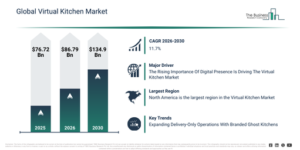
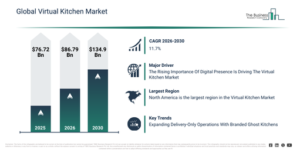
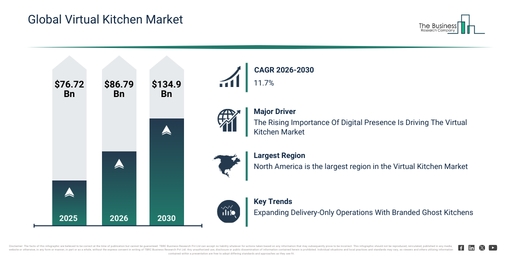
The virtual kitchen market has seen rapid expansion in recent years. Its size is expected to climb from $76.72 billion in 2025 to $86.79 billion in 2026, achieving a compound annual growth rate (CAGR) of 13.1%. This past growth is primarily attributed to the rise of online food delivery platforms, escalating urbanization trends, an increasing demand for convenient food options, reduced entry barriers for food businesses, and the expansion of smartphone-based ordering.
The virtual kitchen market is anticipated to experience significant expansion in the coming years, projected to reach $134.9 billion by 2030, demonstrating a compound annual growth rate (CAGR) of 11.7%. This expansion during the forecast period stems from factors such as increasing demand for cloud kitchens in tier-2 cities, the rising adoption of AI-based demand forecasting, the expanded use of sustainable packaging, a growing emphasis on operational scalability, and greater integration with third-party delivery platforms. Noteworthy trends for the forecast period encompass the increasing adoption of delivery-only restaurant models, a rise in the use of kitchen management software, a heightened focus on cost-efficient food operations, the expansion of multi-brand virtual kitchens, and improved integration of data-driven menu optimization.
Try Before You Buy: Free Sample Of The Virtual Kitchen Market Report:
Virtual Kitchen Market Growth Engine: The Factor Boosting Demand Globally
The expanding importance of digitalization is projected to boost the expansion of the virtual kitchen market in the future. Digitalization involves transforming information, data, or physical items into a digital form, making them readily processable, storable, and transmittable by computers. The increasing importance of digitalization stems from its capacity to elevate brand recognition and exposure, foster greater customer involvement, refine customer assistance, and offer economical marketing solutions. Digitalization is fundamental to the success and operational effectiveness of virtual kitchens, achieving this by simplifying processes, enriching customer interactions, and enhancing resource allocation. This technology allows virtual kitchens to function with greater efficiency, lower expenses, and deliver a superior customer experience, which ultimately fuels their growth and triumphs in the competitive food delivery sector. As an illustration, in August 2024, data from Eurostat, a government department located in Luxembourg, indicated that 59% of EU enterprises had attained at least a fundamental degree of digital intensity in 2023. This included 58% of small and medium-sized enterprises reaching this benchmark, in contrast to 91% of large enterprises. Consequently, the expanding relevance of digitalization is propelling the expansion of the virtual kitchen market.
Which Categories And Subcategories Shape The Virtual Kitchen Market?
The virtual kitchen market covered in this report is segmented –
1) By Component: Software, Services, Hardware, Other Components
2) By Application: Workplaces, Schools, Other Applications
3) By End-User: Commercial Space, Hospitality, Other End Users
Subsegments:
1) By Software: Kitchen Management Software, Order Management Software, Menu And Recipe Management Software, Delivery And Logistics Software, Pos (Point Of Sale) And Payment Solutions, Inventory And Supply Chain Management Software, Customer Relationship Management (Crm) Software, AI And Data Analytics Solutions For Virtual Kitchens
2) By Services: Cloud-Based Kitchen Solutions, Virtual Kitchen Setup And Integration Services, Maintenance And Support Services, Delivery And Logistics Services, Branding And Marketing Services, Consulting Services For Virtual Kitchen Operations, Packaging And Food Safety Compliance Services
3) By Hardware: Kitchen Equipment (Ovens, Fryers, Refrigerators), Pos Hardware (Tablets, Receipt Printers), Kitchen Automation Hardware (Robotic Food Prep Tools), Delivery Fleet Hardware (Vehicles, Delivery Bags), Iot Devices For Smart Kitchens, Voice-Activated Ordering Systems, Kitchen Display Systems (Kds)
4) By Other Components: Packaging Materials (Eco-Friendly Packaging, Food Containers), Cloud Infrastructure (Servers, Storage, Networking), Online Ordering And Delivery Platforms, Third-Party Integrations (Food Delivery Apps), Data Security And Compliance Tools
Virtual Kitchen Market Trend Insights: Strategic Focus Areas Of Leading Companies
Major companies in the virtual kitchen market are focusing on creating advanced solutions, such as multi-brand ghost kitchen platforms, to address the growing demand for food service models optimized for delivery. This demand is fueled by consumer convenience, the potential for low-overhead expansion, and the significant growth of digital ordering. A multi-brand ghost kitchen platform is a kitchen setup primarily designed for delivery, integrating several restaurant concepts under one shared back-of-house operation. This approach enables efficient use of ingredients, centralized operational flows, and lower real estate costs compared to traditional dine-in establishments. For instance, in August 2023, WOWorks, a restaurant group based in the US, launched WOW Kitchens. This innovative ghost kitchen prototype supports multi-brand delivery and pickup services, streamlines menu integration across different brands by utilizing overlapping ingredients, operates within cloud-kitchen facilities without dining areas, employs a digital ordering platform to manage multiple virtual brands, and offers franchisees a cost-effective method to expand their presence and capitalize on delivery-driven demand.
Leading Organizations In The Virtual Kitchen Market
Major companies operating in the virtual kitchen market are Uber Eats, DoorDash Inc., Deliveroo, Foodpanda, CloudKitchens, GrubHub Holdings Inc., Kitopi, Postmates Inc., Rebel Foods, Kitchen United, Deliverect, Kitchen Connect, Zuul Kitchens Inc., Dahmakan, Taster Group Ltd., Franklin Junction, The Local Culinary, Smart City Kitchens, Ghost Kitchen Orlando, Kouzina FoodTech, Nextbite
Continue Reading: The Full Virtual Kitchen Market Report:
Virtual Kitchen Market Regional Spotlight: Top Geography And Report Coverage
North America was the largest region in the virtual kitchen market in 2025. Asia-Pacific is expected to be the fastest-growing region in the forecast period. The regions covered in the virtual kitchen market report are Asia-Pacific, South East Asia, Western Europe, Eastern Europe, North America, South America, Middle East, Africa.
Reach Out To Our Team:
The Business Research Company: https://www.thebusinessresearchcompany.com/
Americas: +1 310-496-7795
Asia: +44 7882 955267 & +91 8897263534
Europe: +44 7882 955267
Email us at: marketing@tbrc.info
Follow us on:
LinkedIn: https://in.linkedin.com/company/the-business-research-company
YouTube: https://www.youtube.com/channel/UC24_fI0rV8cR5DxlCpgmyFQ
Global Market Model: https://www.thebusinessresearchcompany.com/global-market-model

Wasay has over a decade of experience in market research, data modelling, and analytics, with prior experience at GlobalData and Decision Tree Consulting Services. At The Business Research Company , he leads research operations across syndicated studies, customized consulting engagements, and the Global Market Model platform. His professional experience includes supporting organizations such as Boston Consulting Group, KPMG, and Ernst & Young. Wasay holds a degree in Electronics and Communications Engineering, postgraduate management qualifications from International Management Institute Belgium and Indian School of Business and Entrepreneurship, and completed the Integrated Program in Business Analytics from Indian Institute of Management Indore.