
Read more about the article Advanced Authentication In Defense Market Competitive Landscape: Dell Technologies Inc. And Other Key Players
Advanced Authentication In Defense Market Analysis

Advanced Authentication In Defense Market Competitive Landscape: Dell Technologies Inc. And Other Key Players

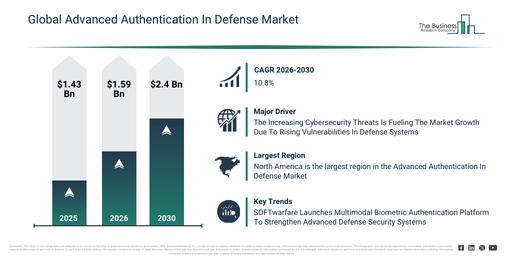
#What Is The Projected CAGR Of The Advanced Authentication In Defense Market Through 2030?#_x000D_ The advanced authentication in defense market size has experienced substantial expansion in recent years. It is projected to increase from $1.43 billion in 2025 to $1.59 billion in 2026, exhibiting a compound annual growth rate (CAGR) of 11.2%. Historically, this market's expansion can be ascribed to factors such as increasing cyber threats targeting defense networks, the adoption of token-based and hardware authentication solutions, the implementation of identity and access management systems in military organizations, the deployment of smart cards and common access cards for personnel, and the integration of single sign-on (SSO) solutions to streamline secure access._x000D_ _x000D_ The market for advanced authentication in defense is projected to experience swift expansion over the coming years, reaching $2.4 billion in 2030 at a compound annual growth rate (CAGR) of 10.8%. This anticipated growth is driven by factors such as the increasing uptake of risk-based and behavioral analytics for authentication, the broadening of cloud-based authentication offerings within defense, the escalating need for mobile device authentication in operational settings, improvements in public key infrastructure (PKI) technologies, and a heightened emphasis on multi-layered and adaptive authentication to combat advanced cyber threats. Key developments expected during this forecast period involve a greater dependence on multi-layered defense authentication frameworks, a rising necessity for secure identity verification specifically for classified missions, a wider integration of token-based and card-based access solutions, an increased deployment of authentication tools to mitigate insider threats, and an expansion of authentication protocols across various joint military operations._x000D_ _x000D_ #Claim Your Free Advanced Authentication In Defense Market Sample Report With Key Data And Trends:#_x000D_ https://thebusinessresearchcompany.com/sample_request?id=10433064&type=smp&name=Advanced%20Authentication%20In%20Defense%20Market%20Report%202026&utm_source=Blogs&utm_medium=Paid&utm_campaign=Oct_PR_x000D_ _x000D_ #Advanced Authentication In Defense Market Demand Analysis: The Driving Force Behind Expansion#_x000D_ The escalating cybersecurity threats are projected to fuel the expansion of advanced authentication within the defense market in the future. These threats refer to malicious attacks or unauthorized actions aimed at computer systems, networks, or data, intending to steal, damage, or disrupt digital operations. The rising cybersecurity threats in defense are largely due to the increasing dependence on interconnected digital systems, which broadens the attack surface and creates more entry points for potential cyber intrusions, data breaches, and system disruptions. Advanced authentication in defense improves cybersecurity by ensuring that only verified and authorized personnel can access sensitive military systems and networks, thereby reducing the risk of data breaches and cyberattacks. For instance, in November 2024, according to the report published by the Department of Defence, an Australia-based government department, the Australian Signals Directorate (ASD) received more than 36,700 cybercrime calls to its Australian Cyber Security Hotline in 2023–24, marking a 12% increase from the previous financial year. Therefore, the increasing cybersecurity threats are driving the growth of the advanced authentication in defense market._x000D_ _x000D_ #Breaking Down The Advanced Authentication In Defense Market By Segment#_x000D_ The advanced authentication in defense market covered in this report is segmented –_x000D_ _x000D_ 1) By Component: Hardware Components, Software Solutions, Services_x000D_ 2) By Technology Type: Biometric Authentication, Multi-Factor Authentication (MFA), Public Key Infrastructure (PKI), Behavioral Biometrics_x000D_ 3) By Deployment Mode: On-Premises Authentication, Cloud-based Authentication_x000D_ 4) By Application Area: Identity Management, Access Control, Secure Communications, Data Protection_x000D_ 5) By User Type: Military Personnel, Government Agencies, Defense Contractors, Cybersecurity Professionals_x000D_ _x000D_ Subsegments:_x000D_ 1) By Hardware Components: Biometric Scanners, Smart Cards, Security Tokens, Authentication Readers, Hardware Security Modules (HSMs)_x000D_ 2) By Software Solutions: Identity And Access Management (IAM) Software, Multi-Factor Authentication (MFA) Software, Public Key Infrastructure (PKI) Software, Biometric Authentication Software, Risk-Based Authentication Software_x000D_ 3) By Services: Consulting Services, Integration And Deployment Services, Support And Maintenance Services, Managed Authentication Services, Training And Education Services_x000D_ _x000D_ #Top Trend Influencing The Advanced Authentication In Defense Market Outlook#_x000D_ Leading companies active in the advanced authentication in defense market are prioritizing the development of innovative solutions, such as multimodal biometric authentication, to bolster security, enhance identity verification precision, and thwart unauthorized access. Multimodal biometric authentication is a security framework that authenticates a user's identity by employing two or more biometric characteristics, including fingerprint, facial recognition, iris scan, or voice. It contributes to improved security and accuracy by mitigating the risk of spoofing or incorrect matches when relying solely on a single biometric factor. For instance, in October 2024, SOFTwarfare LLC, a US-based provider of Zero Trust Identity solutions, unveiled an innovative multimodal biometric authentication platform specifically engineered for Joint All-Domain Command and Control (JADC2) environments at the AUSA Annual Meeting & Exposition. This platform aims to strengthen security, refine identity verification accuracy, and prevent unauthorized access within Department of Defense operations. The system unifies several biometric modalities, such as fingerprint, facial recognition, and voice authentication, into a singular platform, significantly reducing the chance of identity deception or false positives. Moreover, it integrates sophisticated functionalities like User and Entity Behavioral Analytics (UEBA) for real-time risk assessment and supports implementation across air-gapped, cloud, and hybrid defense infrastructures._x000D_ _x000D_ #Advanced Authentication In Defense Market Competitive Landscape And Major Players#_x000D_ Major companies operating in the advanced authentication in defense market are Dell Technologies Inc., Broadcom Inc., Fujitsu Limited, NEC Corporation, Thales Group S.A., Atos SE, Booz Allen Hamilton Inc., General Dynamics Information Technology Inc., IDEMIA Group, Ping Identity Holding Corp., OneSpan Inc., ForgeRock Inc., Accops Systems Pvt. Ltd., iProov Ltd., Sekoia.io SAS, Aware Inc., Secret Double Octopus Ltd., Veridium Ltd., SurePassID Corporation, Biometric Signature ID LLC_x000D_ _x000D_ #Read The Full Advanced Authentication In Defense Market Report By The Business Research Company:#_x000D_ https://thebusinessresearchcompany.com/report/advanced-authentication-in-defense-global-market-report?utm_source=Blogs&utm_medium=Paid&utm_campaign=Oct_PR_x000D_ _x000D_ #Where Is The Advanced Authentication In Defense Market Largest? Key Regional Insights#_x000D_ North America was the largest region in the advanced authentication in defense market in 2025. Asia-Pacific is expected to be the fastest-growing region in the forecast period. The regions covered in the advanced authentication in defense market report are Asia-Pacific, South East Asia, Western Europe, Eastern Europe, North America, South America, Middle East, Africa._x000D_ _x000D_ #Reach Out To Our Team:#_x000D_ _x000D_ The Business Research Company: https://www.thebusinessresearchcompany.com/_x000D_ Americas: +1 310-496-7795_x000D_ Asia: +44 7882 955267 & +91 8897263534_x000D_ Europe: +44 7882 955267_x000D_ Email us at: marketing@tbrc.info_x000D_ _x000D_ #Follow us on:#_x000D_ _x000D_ LinkedIn: https://in.linkedin.com/company/the-business-research-company_x000D_ YouTube: https://www.youtube.com/channel/UC24_fI0rV8cR5DxlCpgmyFQ_x000D_ Global Market Model: https://www.thebusinessresearchcompany.com/global-market-model
Continue ReadingAdvanced Authentication In Defense Market Competitive Landscape: Dell Technologies Inc. And Other Key Players
Read more about the article North America Leads The Additive Manufacturing For Rocket Engines Market: Regional Analysis And 2030 Forecast
Additive Manufacturing For Rocket Engines Market Analysis

North America Leads The Additive Manufacturing For Rocket Engines Market: Regional Analysis And 2030 Forecast

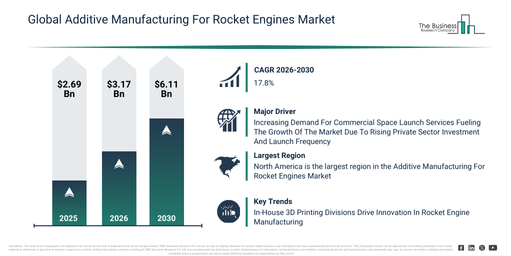
#Additive Manufacturing For Rocket Engines Market Revenue Projected To Rise To $6.11 Billion By 2030#_x000D_ The additive manufacturing for rocket engines market has experienced rapid expansion in recent years. Its value is projected to climb from $2.69 billion in 2025 to $3.17 billion in 2026, at a compound annual growth rate (CAGR) of 17.8%. This historic growth can be attributed to the early adoption of 3D printing technologies in aerospace, increasing demand for lightweight rocket components, a concentrated effort to reduce production costs and lead times, the development of metal powder materials suitable for engine components, and the successful implementation of additive manufacturing in small-scale engine prototypes._x000D_ _x000D_ The additive manufacturing for rocket engines market is projected to experience substantial expansion in the coming years, reaching a valuation of $6.11 billion by 2030, driven by a compound annual growth rate (CAGR) of 17.8%. This anticipated growth during the forecast period is fueled by several factors, including heightened investment in new rocket initiatives, broader application of 3D printing for intricate engine designs, a stronger focus on improving performance and reducing weight, the increasing adoption of additive manufacturing by private space enterprises, and the incorporation of digital design and simulation tools to boost production efficiency. Key trends expected throughout this period encompass a rising need for additive manufacturing to lessen the weight of engine components, greater utilization of AM for quick prototyping of rocket parts, an increased application of complex shapes to enhance propulsion effectiveness, the expansion of reusable launch vehicle projects demanding AM components, and a greater dependency on advanced, high-performance alloys to withstand extreme thermal stresses._x000D_ _x000D_ #Want Deeper Additive Manufacturing For Rocket Engines Market Insights? Get A Free Sample Report:#_x000D_ https://thebusinessresearchcompany.com/sample_request?id=28447053&type=smp&name=Additive%20Manufacturing%20For%20Rocket%20Engines%20Market%20Report%202026&utm_source=Blogs&utm_medium=Paid&utm_campaign=Oct_PR_x000D_ _x000D_ #Primary Growth Driver Shaping The Additive Manufacturing For Rocket Engines Market Outlook#_x000D_ The future expansion of the additive manufacturing for rocket engines market is anticipated to be driven by the growing need for commercial space launch services. These services involve private rocket launch operations transporting satellites, cargo, or crew into orbit for diverse clients, offering dependable and economical alternatives to state-run missions. This surge in demand stems from increased private sector investment in satellite-based communication and Earth observation technologies, prompting companies to plan more frequent missions. Additive manufacturing for rocket engines improves commercial space launch services by facilitating the creation of lightweight, intricate component designs, boosting engine performance, and enhancing fuel economy. Furthermore, it cuts down on manufacturing time and expenses, thereby speeding up launch schedules and enhancing overall mission dependability. For example, the Federal Aviation Administration reported in November 2024 that commercial space operations surged by over 30% in 2023, reaching 148 launches, with forecasts suggesting a more than twofold increase by 2028. Consequently, the escalating need for commercial space launch services is fueling the expansion of the additive manufacturing for rocket engines market._x000D_ _x000D_ #Additive Manufacturing For Rocket Engines Market Structure: A Detailed Look At Segments And Subsegments#_x000D_ The additive manufacturing for rocket engines market covered in this report is segmented –_x000D_ _x000D_ 1) By Material Type: Metals, Polymers, Ceramics, Other Material Types_x000D_ 2) By Technology: Selective Laser Melting, Electron Beam Melting, Fused Deposition Modeling, Other Technologies_x000D_ 3) By Application: Prototyping, Production, Research And Development (R&D)_x000D_ 4) By End-User: Aerospace, Defense, Other End Users_x000D_ _x000D_ Subsegments:_x000D_ 1) By Metals: Titanium Alloys, Nickel-Based Superalloys, Stainless Steel, Aluminum Alloys_x000D_ 2) By Polymers: High-Performance Thermoplastics, Composite Polymers, Polyamide (Nylon)_x000D_ 3) By Ceramics: Silicon Carbide, Alumina-Based Ceramics, Zirconia-Based Ceramics_x000D_ 4) By Other Material Types: Hybrid Materials, Metal Matrix Composites, Functionally Graded Materials_x000D_ _x000D_ #Additive Manufacturing For Rocket Engines Market Innovation And Strategy Trends Among Leading Companies#_x000D_ Major companies operating in the additive manufacturing for rocket engines market are focusing on developing technologically advanced solutions, such as 3D printing additive manufacturing systems, to improve production scalability, reduce costs, and enhance performance in rocket engine components. These 3D printing additive manufacturing systems are technologies that build parts layer by layer from digital designs, enabling complex, efficient, and rapid production. For instance, in June 2025, Innospace, a South Korea-based aerospace and defense company, launched an advanced in-house 3D printing division to manufacture rocket engines and key components for its space launch vehicles, leveraging proprietary metal additive manufacturing technology. This is expected to significantly boost competitiveness by enabling faster, more precise, and cost-effective production, potentially reducing manufacturing costs by up to 50% compared to traditional methods. This division integrates all stages of production, from design to quality verification, and has already produced 13 critical components, including oxidizer pumps for the HANBIT launch vehicle._x000D_ _x000D_ #Top Companies Competing In The Additive Manufacturing For Rocket Engines Market#_x000D_ Major companies operating in the additive manufacturing for rocket engines market are Northrop Grumman Corporation, General Electric Company, L3Harris Technologies Inc., TRUMPF SE + Co. KG, Space Exploration Technologies Corp., Blue Origin Enterprises L.P., DMG MORI Aktiengesellschaft, United Launch Alliance LLC (ULA), RUAG Holding AG, Sierra Space Corporation, Rocket Lab USA Inc., Firefly Aerospace Inc., MT Aerospace AG, Velo3D Inc., Gilmour Space Technologies Pty Ltd., Ursa Major Technologies Inc., Orbex Ltd., Sintavia LLC, Vast Space Corp., EOS GmbH, Equatorial Space Systems Pty Ltd., Skyrora Ltd._x000D_ _x000D_ #View The Complete Additive Manufacturing For Rocket Engines Market Study With Segment And Regional Data:#_x000D_ https://thebusinessresearchcompany.com/report/additive-manufacturing-for-rocket-engines-global-market-report?utm_source=Blogs&utm_medium=Paid&utm_campaign=Oct_PR_x000D_ _x000D_ #Additive Manufacturing For Rocket Engines Market Regional Outlook Across Major Geographies#_x000D_ North America was the largest region in the additive manufacturing for rocket engines market in 2025. Asia-Pacific is expected to be the fastest-growing region in the forecast period. The regions covered in the additive manufacturing for rocket engines market report are Asia-Pacific, South East Asia, Western Europe, Eastern Europe, North America, South America, Middle East, Africa._x000D_ _x000D_ #Reach Out To Our Team:#_x000D_ _x000D_ The Business Research Company: https://www.thebusinessresearchcompany.com/_x000D_ Americas: +1 310-496-7795_x000D_ Asia: +44 7882 955267 & +91 8897263534_x000D_ Europe: +44 7882 955267_x000D_ Email us at: marketing@tbrc.info_x000D_ _x000D_ #Follow us on:#_x000D_ _x000D_ LinkedIn: https://in.linkedin.com/company/the-business-research-company_x000D_ YouTube: https://www.youtube.com/channel/UC24_fI0rV8cR5DxlCpgmyFQ_x000D_ Global Market Model: https://www.thebusinessresearchcompany.com/global-market-model

Continue ReadingNorth America Leads The Additive Manufacturing For Rocket Engines Market: Regional Analysis And 2030 Forecast

Artificial Intelligence (AI)-Powered Industrial Drones Market Research 2026: Market Size, Trends, Segments And Growth Forecast

Artificial Intelligence (AI)-Powered Industrial Drones market size was valued at $18.23 billion in 2026, projected to reach $38.02 billion by 2030 at a 20.2% CAGR. Key players: SZ DJI Technology Co Ltd, AeroVironment Inc

Continue ReadingArtificial Intelligence (AI)-Powered Industrial Drones Market Research 2026: Market Size, Trends, Segments And Growth Forecast
Read more about the article Active Phased Array Radar Market Trends 2026: Spotlight On Wideband Module Innovations Enhancing Performance
Active Phased Array Radar Market Analysis

Active Phased Array Radar Market Trends 2026: Spotlight On Wideband Module Innovations Enhancing Performance

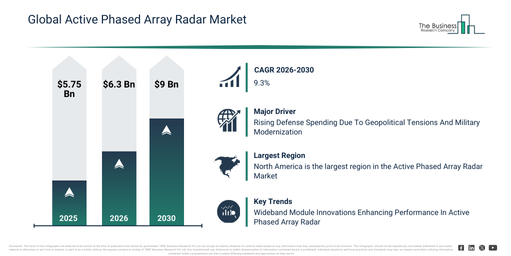
#Active Phased Array Radar Market Size Analysis: Historical Growth And Future Revenue Projections#_x000D_ The active phased array radar market size has experienced significant growth in recent years. This market is expected to expand from $5.75 billion in 2025 to $6.3 billion in 2026, registering a compound annual growth rate (CAGR) of 9.6%. Historically, this expansion can be attributed to the rising integration of active phased array radars within military defense systems, ongoing advancements in electronically scanned array and multifunction radar technologies, increasing demand for high-precision target detection and tracking, the growth of surveillance, reconnaissance, and air traffic control applications, and the development of gallium nitride-based radar modules for improved performance._x000D_ _x000D_ The active phased array radar market is projected to experience substantial expansion in the coming years, reaching $9 billion in 2030 with a compound annual growth rate (CAGR) of 9.3%. This expansion is driven by factors such as the incorporation of AI and machine learning for predictive target tracking and threat analysis, increased use in missile defense and advanced naval and air platforms, the creation of compact and energy-efficient phased array radar systems, greater implementation in developing markets with updated defense infrastructure, and the broadening of multifunction and networked radar systems for comprehensive situational awareness. Key developments anticipated during this period encompass a rising need for multi-function phased array radar in missile defense, enhanced uptake of GaN-based radar modules for improved efficiency, greater utilization of electronically scanned arrays in maritime surveillance, an expansion of radar applications for extreme-weather observation, and more extensive integration of active phased array radars into future aircraft._x000D_ _x000D_ #Preview The Active Phased Array Radar Market Report With A Free Sample:#_x000D_ https://thebusinessresearchcompany.com/sample_request?id=46583811&type=smp&name=Active%20Phased%20Array%20Radar%20Market%20Report%202026&utm_source=Blogs&utm_medium=Paid&utm_campaign=Oct_PR_x000D_ _x000D_ #Active Phased Array Radar Market Drivers: What Is Fueling Demand Through 2030?#_x000D_ The active phased array radar market is projected to expand due to increasing defense spending. Defense spending is defined as the financial resources governments allocate to maintain and improve armed forces, military infrastructure, weapon acquisition, personnel wages, research and development, and national security operations. This rise in defense expenditure is occurring amidst escalating geopolitical tensions and the modernization of military technologies, as nations prioritize security, invest in advanced solutions to counter emerging threats, and aim to maintain strategic superiority. Active phased array radar systems support defense budgets by facilitating more efficient surveillance, target tracking, and threat detection with reduced personnel and maintenance costs, thereby enhancing military operational effectiveness. For illustration, as reported by France 24 S.A., a France-based international news broadcasting company, Russia's military spending surged to $149 billion in 2024, representing a 38 percent increase compared to 2023. Consequently, the increasing defense spending is a key factor driving the growth of the active phased array radar market._x000D_ _x000D_ #Active Phased Array Radar Market Segmentation Analysis: Core Categories And Subcategories#_x000D_ The active phased array radar market covered in this report is segmented –_x000D_ _x000D_ 1) By Technology Type: Analog Phased Array, Digital Phased Array, Hybrid Phased Array, Vector Phased Array_x000D_ 2) By Component: Transmitter, Receiver, Antenna, Digital Signal Processor, Other Components_x000D_ 3) By Frequency Band: Low Band, Super Band, Communication Band, Extended Band, Kurtz Band, Other Frequency Bands_x000D_ 4) By Application: Defense Systems, Aerospace And Air Traffic Management, Maritime Surveillance, Weather Monitoring, Automotive Industry_x000D_ 5) By End User Industry: Aerospace And Defense, Maritime, Environmental Monitoring, Automotive Advanced Driver Assistance Systems, Telecommunications_x000D_ _x000D_ Subsegments:_x000D_ 1) By Analog Phased Array: Ground-Based Analog Surveillance Radars, Analog Beamforming Air-Defense Radars, Legacy-Platform Analog Phased Array Upgrade Kits_x000D_ 2) By Digital Phased Array: Software-Defined Digital Beamforming Radars, Multi-Function Active Electronically Scanned Array (AESA) Systems, High-Resolution Digital Imaging Radars for Target Tracking_x000D_ 3) By Hybrid Phased Array: Hybrid Analog-Digital Beamforming Surveillance Radars, Cost-Optimized Multi-Mode Hybrid AESA Systems, Adaptive Beam-Control Hybrid Radar Architectures_x000D_ 4) By Vector Phased Array: Polarization-Controlled Phased Array Radars, Precision Vector-Beam Targeting Radars, Electronic Warfare Vector-Steered Radar Systems_x000D_ _x000D_ #Which Trends Will Define The Active Phased Array Radar Market Through 2030?#_x000D_ Leading companies operating in the active phased array radar market are focusing on developing technological advancements, specifically wideband front-end modules, to improve radar performance, reduce system complexity, and support multi-mission capabilities. These wideband front-end modules are compact, integrated components that combine transmit and receive functions, enabling efficient signal amplification and low-noise reception across a broad frequency range. For instance, in June 2025, MACOM Technology Solutions Inc., a US-based semiconductor company, launched the ENGSD00088 Transmit or Receive Module. This product operates from 2 to 18 GHz, integrating a high-power GaN amplifier, GaAs low noise amplifier, and T/R switch in a compact form. It delivers 2.5W output, 25 dB transmit gain, and 27 dB receive gain, ensuring reliable performance for electronic countermeasures and phased array radar. The module aims to simplify system design while enhancing power efficiency and signal clarity._x000D_ _x000D_ #Active Phased Array Radar Market Major Companies And Industry Participants#_x000D_ Major companies operating in the active phased array radar market are Rheinmetall AG , Mitsubishi Electric Corporation , Raytheon Technologies Corporation , Lockheed Martin Corporation , BAE Systems plc, Northrop Grumman Corporation , Thales Group , L3Harris Technologies Inc. , General Atomics Aeronautical Systems Inc. , Elbit Systems Ltd., Kongsberg Gruppen ASA , Aselsan A.S., Hensoldt AG , Hanwha Systems Co Ltd., Leonardo S.p.A. , Indra Sistemas S.A. , Saab AB , CesiumAstro Inc., CEA Technologies Pty Limited, China Electronics Technology Group Corporation_x000D_ _x000D_ #Buy The Full Active Phased Array Radar Global Market Report 2026:#_x000D_ https://thebusinessresearchcompany.com/report/active-phased-array-radar-global-market-report?utm_source=Blogs&utm_medium=Paid&utm_campaign=Oct_PR_x000D_ _x000D_ #Active Phased Array Radar Market Geographic Analysis: Which Region Accounts For The Biggest Share?#_x000D_ North America was the largest region in the active phased array radar market in 2025. Asia-Pacific is expected to be the fastest-growing region in the forecast period. The regions covered in the active phased array radar market report are Asia-Pacific, South East Asia, Western Europe, Eastern Europe, North America, South America, Middle East, Africa._x000D_ _x000D_ #Reach Out To Our Team:#_x000D_ _x000D_ The Business Research Company: https://www.thebusinessresearchcompany.com/_x000D_ Americas: +1 310-496-7795_x000D_ Asia: +44 7882 955267 & +91 8897263534_x000D_ Europe: +44 7882 955267_x000D_ Email us at: marketing@tbrc.info_x000D_ _x000D_ #Follow us on:#_x000D_ _x000D_ LinkedIn: https://in.linkedin.com/company/the-business-research-company_x000D_ YouTube: https://www.youtube.com/channel/UC24_fI0rV8cR5DxlCpgmyFQ_x000D_ Global Market Model: https://www.thebusinessresearchcompany.com/global-market-model

Continue ReadingActive Phased Array Radar Market Trends 2026: Spotlight On Wideband Module Innovations Enhancing Performance