Read more about the article Aerospace Energy Storage Market Trends 2026: Spotlight On High-Energy-Density Batteries Driving Extended Range And Enhanced Performance In Electric Aviation And Beyond
Aerospace Energy Storage Market Analysis

Aerospace Energy Storage Market Trends 2026: Spotlight On High-Energy-Density Batteries Driving Extended Range And Enhanced Performance In Electric Aviation And Beyond

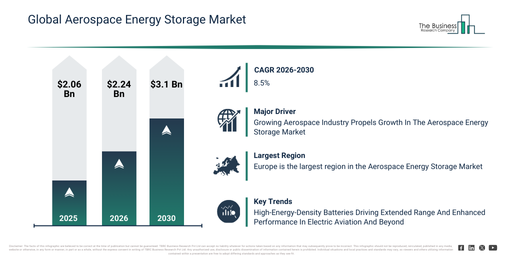
#Aerospace Energy Storage Market Size Analysis: Historical Growth And Future Revenue Projections#_x000D_ The aerospace energy storage market has experienced significant growth in recent years, with its size projected to increase from $2.06 billion in 2025 to $2.24 billion in 2026, demonstrating a compound annual growth rate (CAGR) of 8.6%. The historical growth of this market can be attributed to the early adoption of onboard energy storage systems supporting essential aerospace functions, a rising demand for lightweight power solutions driven by strict weight and space constraints, the initial development of energy conversion systems to stabilize power supply in aircraft, an increasing use of advanced materials to enhance storage efficiency and safety, and the expansion of electrical subsystem requirements in modern aerospace platforms._x000D_ _x000D_ The aerospace energy storage market is projected for significant expansion over the coming years, with its size expected to reach $3.1 billion in 2030 at a compound annual growth rate (CAGR) of 8.5%. This anticipated growth is primarily driven by the increasing integration of high-density storage technologies to support electric and hybrid aircraft, the ongoing development of advanced materials for improved storage performance and sustainability, the expanding incorporation of energy storage systems into next-generation avionics and propulsion architectures, the widespread aerospace electrification initiatives demanding more efficient power management, and technological breakthroughs enabling safer and longer-duration energy storage solutions. Furthermore, key trends during this forecast period include advancements in lightweight aerospace battery systems, the growing integration of high-density energy storage for spacecraft, the creation of thermal-resilient power storage materials, a surge in the use of hybrid energy storage architectures, and a rising demand for aerospace batteries that are safe, compact, and resistant to vibrations._x000D_ _x000D_ #Preview The Aerospace Energy Storage Market Report With A Free Sample:#_x000D_ https://thebusinessresearchcompany.com/sample_request?id=11877&type=smp&name=Aerospace%20Energy%20Storage%20Market%20Report%202026&utm_source=Blogs&utm_medium=Paid&utm_campaign=Oct_PR_x000D_ _x000D_ #Aerospace Energy Storage Market Drivers: What Is Fueling Demand Through 2030?#_x000D_ The expanding aerospace sector is anticipated to drive the aerospace energy storage market going forward. This industry encompasses the design, development, production, and maintenance of aircraft and spacecraft, utilizing aerospace energy storage systems, such as advanced batteries and other storage solutions, to power electrical components. These systems facilitate the integration of electrification technologies, leading to enhanced performance, efficiency, and sustainability. For instance, in September 2024, figures from the Aerospace Industries Association (AIA), a US-based trade association, indicated that the U.S. aerospace and defense industry reached a significant milestone in 2023, with sales exceeding $955 billion, which represented a 7.1% increase compared to the previous year. Consequently, the growth of the aerospace industry is propelling the aerospace energy storage market.

Aerospace Energy Storage Market Driver: Rising Adoption Of Unmanned Aerial Vehicles (Uavs) Driving The Market Growth Due To Increasing Demand For Advanced Aerospace Energy Storage

_x000D_ _x000D_ #Aerospace Energy Storage Market Segmentation Analysis: Core Categories And Subcategories#_x000D_ The aerospace energy storage market covered in this report is segmented –_x000D_ _x000D_ 1) By Type: Lead Acid Battery, Lithium Battery, Other Types_x000D_ 2) By Technology: Batteries, Flywheels, Fuel Cells, Other Technology_x000D_ 3) By Application: Aircraft, Spacecraft_x000D_ _x000D_ Subsegments:_x000D_ 1) By Lead Acid Battery: Flooded Lead Acid Battery, Valve-Regulated Lead Acid (VRLA) Battery_x000D_ 2) By Lithium Battery: Lithium-Ion Battery, Lithium Polymer Battery, Lithium Iron Phosphate (LiFePO4) Battery_x000D_ 3) By Other Types: Nickel-Cadmium (NiCd) Battery, Nickel-Metal Hydride (NiMH) Battery, Solid-State Batteries, Ultracapacitors_x000D_ _x000D_ #Which Trends Will Define The Aerospace Energy Storage Market Through 2030?#_x000D_ Major companies operating in the aerospace energy storage market are focused on developing innovative products like high-energy-density batteries to extend aircraft range and enhance performance. High-energy-density batteries are those capable of storing a large amount of energy relative to their mass or volume, which helps expand range, increase payload, and improve efficiency in electric aircraft and other transport uses. As an illustration, in June 2025, MAGNIX TECHNOLOGIES PTY LTD., a US-based manufacturing company, introduced its new Samson battery, powered by a 400 Wh/kg cell. This advanced high-energy-density battery is designed to boost the range and payload of electric aircraft, encompassing airplanes, helicopters, and eVTOLs, while also supporting applications in defense, industry, energy storage, and marine sectors. The Samson battery features a long cycle life, advanced safety mechanisms, and simple integration, making it appropriate for both commercial and military operations. Its versatility also permits its use in non-aerospace areas such as stationary energy storage and marine propulsion, emphasizing the growing movement towards innovative batteries that improve performance, reduce environmental impact, and advance the future of electric mobility._x000D_ _x000D_ #Aerospace Energy Storage Market Major Companies And Industry Participants#_x000D_ Major companies operating in the aerospace energy storage market are Tesla Inc, GE Energy, Raytheon Technologies, The Boeing Company, Lockheed Martin, BYD Co. Ltd, Northrop Grumman, Honeywell Aerospace, Jabil Energy Storage, Siemens Energy AG, NextEra Energy Resources, Eaton Corporation plc, Rolls-Royce PLC, Parker Hannifin, Sichuan Changhong Battery Co. Ltd., GreenSmith Energy Management Systems, Sungrow Power Supply Co.Ltd, Samsung SDI, Fluence Energy Inc., Saft Batteries, LG Energy Solution Ltd, Meggitt PLC, Invenergy LLC, Enphase Energy, A123 Systems LLC, Eagle-Picher Technologies LLC, ComEd, Electric Power Systems Inc, NEC Energy Solutions, EAS Batteries GmbH, Kokam Co. Ltd, Xtreme Power, Custom Cells, EEnovate Technology, nanoFlowcell Holdings plc, Cuberg Inc., Gnanomat S.L., Electroflight Ltd., Nsure Reliable Power Solutions_x000D_ _x000D_ #Buy The Full Aerospace Energy Storage Global Market Report 2026:#_x000D_ https://thebusinessresearchcompany.com/report/aerospace-energy-storage-global-market-report?utm_source=Blogs&utm_medium=Paid&utm_campaign=Oct_PR_x000D_ _x000D_ #Aerospace Energy Storage Market Geographic Analysis: Which Region Accounts For The Biggest Share?#_x000D_ Europe was the largest region in the aerospace energy storage market in 2025. Asia-Pacific is expected to be the fastest-growing region in the forecast period. The regions covered in the aerospace energy storage market report are Asia-Pacific, South East Asia, Western Europe, Eastern Europe, North America, South America, Middle East, Africa._x000D_ _x000D_ #Reach Out To Our Team:#_x000D_ _x000D_ The Business Research Company: https://www.thebusinessresearchcompany.com/_x000D_ Americas: +1 310-496-7795_x000D_ Asia: +44 7882 955267 & +91 8897263534_x000D_ Europe: +44 7882 955267_x000D_ Email us at: marketing@tbrc.info_x000D_ _x000D_ #Follow us on:#_x000D_ _x000D_ LinkedIn: https://in.linkedin.com/company/the-business-research-company_x000D_ YouTube: https://www.youtube.com/channel/UC24_fI0rV8cR5DxlCpgmyFQ_x000D_ Global Market Model: https://www.thebusinessresearchcompany.com/global-market-model

Continue ReadingAerospace Energy Storage Market Trends 2026: Spotlight On High-Energy-Density Batteries Driving Extended Range And Enhanced Performance In Electric Aviation And Beyond
Read more about the article Rubber Compound Market Outlook 2026–2030: Growth Trends, Market Dynamics And Emerging Opportunities
Rubber Compound Market Analysis

Rubber Compound Market Outlook 2026–2030: Growth Trends, Market Dynamics And Emerging Opportunities

Rubber Compound market size reached $37.94 billion in 2026 and is expected to grow to $47.85 billion by 2030 at a 6.0% CAGR. Major players: Continental AG, Shin-Etsu Chemical Co. Ltd., Ravago Manufacturing Americas LLC

Continue ReadingRubber Compound Market Outlook 2026–2030: Growth Trends, Market Dynamics And Emerging Opportunities
Read more about the article Mobile Phone Memory Market Size Forecast: How The Industry Is Expected To Grow From 2026 To 2030
Mobile Phone Memory Market Analysis

Mobile Phone Memory Market Size Forecast: How The Industry Is Expected To Grow From 2026 To 2030

Mobile Phone Memory market size stood at $47.25 billion in 2026 and is projected to reach $65.68 billion by 2030 at a 8.6% CAGR. Key players: Samsung Electronics Co Ltd, SK Hynix Inc

Continue ReadingMobile Phone Memory Market Size Forecast: How The Industry Is Expected To Grow From 2026 To 2030
Read more about the article Aerospace Electronics Market Growth Driven By Rising Defense Investments: Outlook To 2030
Aerospace Electronics Market Analysis

Aerospace Electronics Market Growth Driven By Rising Defense Investments: Outlook To 2030

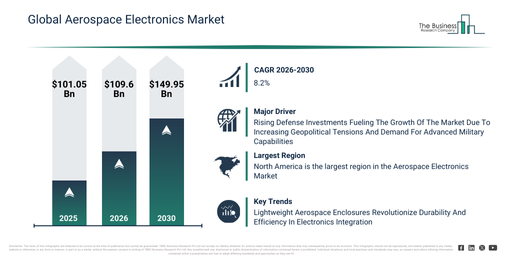
#What Is The Aerospace Electronics Market Growth Rate? A 8.2% CAGR Outlook Through 2030#_x000D_ The aerospace electronics market size has experienced considerable growth in recent years. Looking ahead, it is projected to expand from $101.05 billion in 2025 to $109.6 billion in 2026, registering a compound annual growth rate (CAGR) of 8.5%. Historically, this expansion has been propelled by several key factors, including the increasing adoption of integrated modular avionics (IMA) in modern aircraft, the development of aircraft health monitoring systems for predictive maintenance, a rising demand for reliable mission computers and engine control electronics, the implementation of advanced cockpit voice recorders and navigation displays, and substantial government and defense investment in high-performance aerospace electronic systems._x000D_ _x000D_ The aerospace electronics market is anticipated to experience substantial expansion in the coming years. By 2030, its value is projected to reach $149.95 billion, exhibiting a compound annual growth rate (CAGR) of 8.2%. This anticipated growth during the forecast period stems from factors such as the increasing integration of sophisticated actuation and control systems, the broadening of electrical wiring interconnect systems (EWIS) for advanced aircraft, a heightened demand for compact and efficient power supply units, the embrace of intelligent and connected avionics to improve situational awareness, and the rising acquisition of aerospace electronics for both unmanned and space platforms. Key trends during the same period encompass a growing preference for integrated modular avionics (IMA) architectures, an uptick in the adoption of advanced aircraft health monitoring electronics, an increasing requirement for miniature, highly reliable aerospace components, the expansion of critical electronic subsystems within defense applications, and a greater incorporation of power-efficient avionics into next-generation aircraft._x000D_ _x000D_ #Access A Free Sample Of The Latest Aerospace Electronics Market Analysis:#_x000D_ https://thebusinessresearchcompany.com/sample_request?id=53380194&type=smp&name=Aerospace%20Electronics%20Market%20Report%202026&utm_source=Blogs&utm_medium=Paid&utm_campaign=Oct_PR_x000D_ _x000D_ #Why Is The Aerospace Electronics Market Growing? The Key Demand Driver Explained#_x000D_ Future expansion of the aerospace electronics market is anticipated to be driven by increasing investments within the defense sector. The defense sector encompasses industry and governmental bodies dedicated to the creation, manufacturing, and maintenance of military equipment and services. This surge in defense spending stems from escalating geopolitical tensions, with mounting threats such as terrorism, cyberattacks, and regional conflicts prompting nations to increase their defense budgets to strengthen capabilities and achieve strategic deterrence. Aerospace electronics significantly bolster the defense sector through sophisticated communication, navigation, surveillance, and electronic warfare capabilities, leading to improved precision targeting, efficient real-time data exchange, and heightened overall mission success. For example, the House of Commons Library, a UK-based research and information service, reported in May 2025 that the UK’s defense expenditure is projected to rise from $62.16 billion (£53.9 billion) in 2023-24 to $65.61 billion (£56.9 billion) in 2024-25, further increasing to $68.96 billion (£59.8 billion) in 2025-26, indicating an average yearly real-terms growth of 2.4% during this timeframe. Consequently, the increased investments within the defense sector are propelling the aerospace electronics market forward._x000D_ _x000D_ #What Are The Main Segments Of The Aerospace Electronics Market?#_x000D_ The aerospace electronics market covered in this report is segmented –_x000D_ _x000D_ 1) By Product Type: Communication Systems, Navigation Systems, Flight Control Systems, Avionics, Power Management Systems_x000D_ 2) By Component: Sensors, Microcontrollers, Antennas, Display Systems, Computing Systems_x000D_ 3) By Application: Commercial Aviation, Military Aviation, Space Exploration, Unmanned Aerial Vehicles (UAVs)_x000D_ 4) By End-User: Original Equipment Manufacturer (OEM), Aftermarket_x000D_ _x000D_ Subsegments:_x000D_ 1) By Communication Systems: Satellite Communication (SATCOM) Systems, VHF Or UHF Radio Systems, Data Link Communication Systems, Intercom Systems_x000D_ 2) By Navigation Systems: Global Positioning Systems (GPS), Inertial Navigation Systems (INS), Terrain Awareness And Warning Systems (TAWS), Automatic Direction Finders (ADF)_x000D_ 3) By Flight Control Systems: Fly-by-Wire (FBW) Systems, Autopilot Systems, Flight Management Systems (FMS), Automatic Flight Control Systems (AFCS)_x000D_ 4) By Avionics: Surveillance And Collision Avoidance Systems, Flight Data Recorders (FDR), Weather Radar Systems, Electronic Warfare Systems_x000D_ 5) By Power Management Systems: Power Distribution Units (PDU), Auxiliary Power Units (APU), Battery Management Systems (BMS), Power Conversion Units_x000D_ _x000D_ #Aerospace Electronics Market Trend Analysis: Where Leading Companies Are Focusing#_x000D_ Leading companies in the aerospace electronics market are concentrating on developing advanced products, such as new hermetic packages, to reduce the weight and enhance the durability of essential aerospace electronic systems in challenging environments. Hermetic packages are airtight enclosures designed to protect electronic components from environmental factors like moisture, gas, dust, and pressure. For instance, in September 2023, SCHOTT AG, a Germany-based multinational glass company, introduced lightweight microelectronic packages specifically tailored for the aerospace industry. These packages address the stringent requirements of aviation and space applications, where every gram of weight is critical for both performance and cost efficiency. SCHOTT’s new lightweight microelectronic packages for aerospace achieve up to two-thirds less weight than traditional kovar-based packages by employing aluminum as their primary material. Despite their reduced mass, these packages deliver robust hermetic protection for sensitive avionics and electronics, ensuring long-term reliability under the demanding conditions of aerospace environments. They are highly versatile, finding suitability in various applications, including microwave and RF packages, DC/DC converter packages, and hermetic sensor packages for both aircraft and satellites._x000D_ _x000D_ #Which Companies Are Major Players In The Aerospace Electronics Market?#_x000D_ Major companies operating in the aerospace electronics market are RTX Corporation, The Boeing Company, Lockheed Martin, Airbus SE, Panasonic Holdings Corporation, General Dynamics Corporation, Northrop Grumman Corporation, Honeywell International Inc., GE Aerospace, BAE Systems, Safran S.A., Eaton Corporation, Thales Group, L3Harris Technologies Inc., Parker Hannifin Corporation, Leonardo S.p.A., Ametek Inc., Elbit Systems, Teledyne Technologies Incorporated, TransDigm Group Incorporated_x000D_ _x000D_ #Get The Complete Aerospace Electronics Market Analysis Here:#_x000D_ https://thebusinessresearchcompany.com/report/aerospace-electronics-global-market-report?utm_source=Blogs&utm_medium=Paid&utm_campaign=Oct_PR_x000D_ _x000D_ #Which Region Held The Largest Share Of The Aerospace Electronics Market In 2025?#_x000D_ North America was the largest region in the aerospace electronics market in 2025. Asia-Pacific is expected to be the fastest-growing region in the forecast period. The regions covered in the aerospace electronics market report are Asia-Pacific, South East Asia, Western Europe, Eastern Europe, North America, South America, Middle East, Africa._x000D_ _x000D_ #Reach Out To Our Team:#_x000D_ _x000D_ The Business Research Company: https://www.thebusinessresearchcompany.com/_x000D_ Americas: +1 310-496-7795_x000D_ Asia: +44 7882 955267 & +91 8897263534_x000D_ Europe: +44 7882 955267_x000D_ Email us at: marketing@tbrc.info_x000D_ _x000D_ #Follow us on:#_x000D_ _x000D_ LinkedIn: https://in.linkedin.com/company/the-business-research-company_x000D_ YouTube: https://www.youtube.com/channel/UC24_fI0rV8cR5DxlCpgmyFQ_x000D_ Global Market Model: https://www.thebusinessresearchcompany.com/global-market-model
Continue ReadingAerospace Electronics Market Growth Driven By Rising Defense Investments: Outlook To 2030