With a focus on actionable insights and strategic value, The Business Research Company’s 2026 market reports include market attractiveness scoring, total addressable market sizing, company benchmarking matrices, interactive Excel dashboards, deeper supply chain intelligence, emerging startup tracking, and granular product-level insights.
How Much Will The Factory Automation Market Be Worth By 2030?
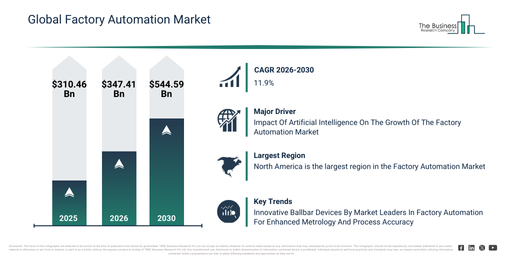
The factory automation market has seen significant growth in recent years. Its valuation is projected to rise from $310.46 billion in 2025 to $347.41 billion in 2026, achieving a compound annual growth rate (CAGR) of 11.9%. Historically, this expansion has been influenced by factors such as the proliferation of mass manufacturing industries, escalating labor cost pressures, a greater need for uniform product quality, the development of electronics and automotive manufacturing, and the accessibility of programmable automation technologies.
The factory automation market is projected to experience significant growth in the upcoming years. It is forecast to reach $544.59 billion in 2030, showing a compound annual growth rate (CAGR) of 11.9%. This expansion during the forecast period is driven by factors such as the increasing adoption of AI-enabled automation systems, the proliferation of smart factories, a rising demand for customized production runs, a growing emphasis on operational efficiency, and increasing investments in industrial digitalization. Major trends anticipated in this period include the expanded deployment of industrial robots in production lines, the rising uptake of smart sensors and controllers, the development of data-driven predictive maintenance systems, the increasing integration of PLC and SCADA platforms, and an enhanced focus on flexible manufacturing systems.
Get Access To A Free Factory Automation Market Report Sample:
The Key Driver Behind The Factory Automation Market’s 11.9% CAGR
The integration of artificial intelligence is anticipated to drive expansion in the factory automation market. Artificial intelligence describes the replication of human intelligence processes by machines, typically through computer systems, allowing them to carry out tasks traditionally requiring human intellect, such as learning, reasoning, and problem-solving. The increasing uptake of AI is fueled by technological progress, greater data availability, industrial demand for automation and efficiency, and rising investment and research. Implementing artificial intelligence within factory automation systems enables manufacturers to achieve elevated levels of efficiency, productivity, quality, flexibility, and safety, resulting in competitive advantages and improved business outcomes. The adoption of artificial intelligence is propelling the growth of the factory automation market.
Factory Automation Market Classification: Main Segments And Detailed Subsegments
The factory automation market covered in this report is segmented –
1) By Component: Sensors, Controllers, Switches And Relays, Industrial Robots, Drives
2) By Factory Automation Technology: Supervisory Control And Data Acquisition (SCADA), Programmable Automation Controller (PAC), Programmable Logic Controller (PLC), Distributed Control System (DCS), Human Machine Interface (HMI)
3) By End-User: Manufacturing, Automotive, Packaging And Processing, Semiconductor And Electronics, Printing And Converting
Subsegments:
1) By Sensors: Proximity Sensors, Vision Sensors, Temperature Sensors, Pressure Sensors, Level Sensors, Flow Sensors, Position Sensors
2) By Controllers: Programmable Logic Controllers (PLCs), Distributed Control Systems (DCS), Human-Machine Interface (HMI), Motion Controllers, Embedded Controllers
3) By Switches And Relays: Limit Switches, Push Button Switches, Safety Switches, Electromechanical Relays, Solid-State Relays
4) By Industrial Robots: Articulated Robots, SCARA Robots, Cartesian Robots, Collaborative Robots (Cobots), Delta Robots
5) By Drives: AC Drives, DC Drives, Servo Drives, Variable Frequency Drives (VFDs), Stepper Drives
Factory Automation Market Strategic Shifts: What Leading Players Are Prioritizing
Leading companies in the factory automation market are developing advanced products, such as ballbar devices, to maintain their market position. These ballbar devices, also known as ballbar systems or ballbar testers, are precise measurement tools utilized in metrology and precision engineering. Within factory automation, their purpose is to guarantee the quality and accuracy of machined parts by identifying errors and deviations in a machine’s movement and positioning.
Factory Automation Market Company Analysis: Major Industry Participants
Major companies operating in the factory automation market are Siemens AG, Mitsubishi Electric Corporation, Schneider Electric SE, Honeywell International Inc., ABB Ltd., Toshiba Corporation, Eaton Corporation, Parker Hannifin Corporation, Emerson Electric Co., Danfoss, Rockwell Automation Inc., Bosch Rexroth AG, Omron Corporation, Keyence Corporation, Fanuc Corporation, SMC Corporation, Yaskawa Electric Corporation, Festo, KUKA Robotics, Phoenix Contact, Endress+Hauser Group, Beckhoff Automation, Yokogawa Electric Corporation, Advantech Co. Ltd., WAGO GmbH & Co. KG, Pepperl+Fuchs GmbH, Pilz GmbH & Co. KG, HIMA Paul Hildebrandt GmbH
Get Full Access To The Factory Automation Market Report 2026:
Factory Automation Market Global Regional Breakdown: Key Regions Analyzed
North America was the largest region in the factory automation market in 2025. The regions covered in the factory automation market report are Asia-Pacific, South East Asia, Western Europe, Eastern Europe, North America, South America, Middle East, Africa
Reach Out To Our Team:
The Business Research Company: https://www.thebusinessresearchcompany.com/
Americas: +1 310-496-7795
Asia: +44 7882 955267 & +91 8897263534
Europe: +44 7882 955267
Email us at: marketing@tbrc.info
Follow us on:
LinkedIn: https://in.linkedin.com/company/the-business-research-company
YouTube: https://www.youtube.com/channel/UC24_fI0rV8cR5DxlCpgmyFQ
Global Market Model: https://www.thebusinessresearchcompany.com/global-market-model

Wasay has over a decade of experience in market research, data modelling, and analytics, with prior experience at GlobalData and Decision Tree Consulting Services. At The Business Research Company , he leads research operations across syndicated studies, customized consulting engagements, and the Global Market Model platform. His professional experience includes supporting organizations such as Boston Consulting Group, KPMG, and Ernst & Young. Wasay holds a degree in Electronics and Communications Engineering, postgraduate management qualifications from International Management Institute Belgium and Indian School of Business and Entrepreneurship, and completed the Integrated Program in Business Analytics from Indian Institute of Management Indore.