Market attractiveness scoring, total addressable market sizing, company benchmarking matrices, interactive Excel dashboards, deeper supply chain intelligence, emerging startup tracking, and granular product-level insights are among the key offerings featured in The Business Research Company’s 2026 market reports, designed to deliver more actionable and strategically valuable research.
Modular Automation Market Valued At $15.94 Billion In 2026, Projected To Reach $24.57 Billion By 2030
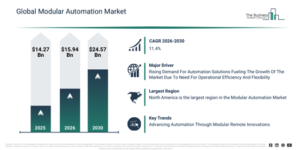
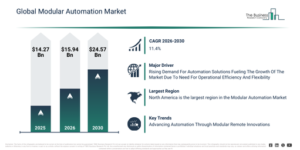
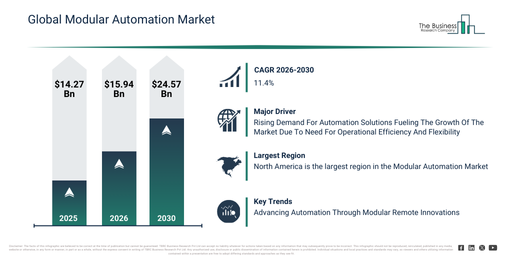
The modular automation market has experienced rapid expansion in recent years. It is anticipated to expand from $14.27 billion in 2025 to $15.94 billion in 2026, achieving a compound annual growth rate (CAGR) of 11.7%. Factors contributing to its historical growth include the adoption of industrial automation, the rising demand for manufacturing efficiency, the expansion of mass customization, the necessity for faster production changeovers, and a reduction in labor dependency.
The modular automation market is projected to experience swift expansion in the coming years. By 2030, its value is anticipated to reach $24.57 billion, exhibiting a compound annual growth rate (CAGR) of 11.4%. This expansion during the forecast period is fueled by the integration of AI-driven automation, the proliferation of smart manufacturing, the escalating demand for modular production expansion, increasing investment in digital factories, and its uptake by small and medium enterprises. Key trends shaping this period encompass the increasing adoption of flexible manufacturing systems, a growing need for plug and play automation, an elevated emphasis on scalable production lines, the expansion of smart factory implementations, and a preference for minimized installation and downtime.
Request A Complimentary Modular Automation Market Research Sample:
Key Factor Propelling The Modular Automation Market Forward
The rising need for automation solutions is anticipated to boost the expansion of the modular automation market in the future. Automation solutions encompass technologies, systems, or services engineered to execute tasks with minimal human involvement, thereby improving efficiency, precision, and output across diverse sectors. The uptake of automation solutions is primarily increasing due to the heightened need for operational efficiency, as enterprises aim to decrease expenses, lessen inaccuracies, and enhance productivity via smart and optimized processes. Modular automation further refines automation solutions by providing adaptable, expandable, and readily adjustable systems that can swiftly conform to evolving production requirements and technological progress. Consequently, the increasing demand for automation solutions is propelling the growth of the modular automation market.
Modular Automation Market Segments And Subsegments Explained
The modular automation market covered in this report is segmented –
1) By Type: Modular Control Systems, Modular Production & Assembly Systems, Modular Process Automation Systems, Modular Material Handling Systems, Modular Robotics & Automation Cells
2) By Technology: Industrial Internet Of Things (IIoT), Robotics
3) By Enterprise Size: Small And Medium Enterprises, Large Enterprises
4) By Application: Assembly, Inspection, Testing, Material Handling, Packaging
5) By End-User Industry: Manufacturing, Healthcare, Aerospace And Defense, Energy And Utilities
Subsegments:
1) By Modular Control Systems: Modular PLC & PAC Systems, Distributed I/O & Remote Terminal Modules, Modular Safety Control Systems, Scalable Motion Control Modules, Software-Configurable Control Platforms
2) By Modular Production & Assembly Systems: Modular Assembly Stations, Reconfigurable Production Lines, Standardized Workcell Modules, Plug-and-Play Assembly Units, Flexible Transfer & Indexing Modules
3) By Modular Process Automation Systems: Process Skid-Mounted Automation Units, Standardized Process Equipment Modules, Modular Batch Processing Units, Pre-Engineered Process Automation Skids, Distributed Process Control Modules
4) By Modular Material Handling Systems: Modular Conveyor Systems, Automated Guided Vehicle (AGV) Modules, Autonomous Mobile Robot (AMR) Modules, Modular Palletizing & Depalletizing Units, Reconfigurable Sorting & Routing Modules
5) By Modular Robotics & Automation Cells: Robot Workcell Modules, Collaborative Robot (Cobot) Cells, Vision-Integrated Robotics Modules, Pick-and-Place Automation Cells, End-of-Line Robotic Packaging Cells
Emerging Trends Transforming The Modular Automation Market
Leading companies within the modular automation market are concentrating on developing technological advancements, such as modular remote units, to improve system flexibility, enable quicker deployment, and enhance operational efficiency across diverse industrial applications. A modular remote unit is an adaptable, self-contained instrument utilized in automation systems to execute control, monitoring, or data acquisition tasks remotely, thereby allowing for versatile system expansion and decentralized operation. For example, in May 2025, WEG S.A., a Brazil-based motors and generators company, introduced the RUW200, a next-generation modular remote unit engineered to optimize device integration and operational performance within industrial automation environments. Designed as a compact and scalable solution, the RUW200 offers advanced connectivity through dual Ethernet ports and supports key industrial communication protocols, including EtherNet or IP, Modbus-TCP, and MQTT, positioning it as fully IoT-ready. The unit supports expansion with up to eight I/O modules, providing adaptability to various automation requirements, and is fully interoperable with WEG’s existing PLC platforms, including the PLC200, PLC410, and PLC500.
Modular Automation Market Key Players: Major Companies In The 2026 Report
Major companies operating in the modular automation market are Siemens AG, General Electric Company (GE), Mitsubishi Electric Corporation, Schneider Electric SE, Honeywell International Inc., ABB Ltd, Toshiba Corporation, Emerson Electric Co., Bosch Rexroth AG, Rockwell Automation Inc., Keyence Corporation, FANUC Corporation, Phoenix Contact GmbH & Co. KG, Festo Inc., Yokogawa Electric Corporation, Beckhoff Automation GmbH & Co. KG, Ascential Technologies Inc., Pilz GmbH & Co. KG, HIMA Paul Hildebrandt GmbH, Modular Automation Ltd.
Explore The Full Modular Automation Market Report With Forecasts To 2030:
Modular Automation Market By Region: Where Is Demand Strongest?
North America was the largest region in the modular automation market in 2025. Asia-Pacific is expected to be the fastest-growing region in the forecast period. The regions covered in the modular automation market report are Asia-Pacific, South East Asia, Western Europe, Eastern Europe, North America, South America, Middle East, Africa
Reach Out To Our Team:
The Business Research Company: https://www.thebusinessresearchcompany.com/
Americas: +1 310-496-7795
Asia: +44 7882 955267 & +91 8897263534
Europe: +44 7882 955267
Email us at: marketing@tbrc.info
Follow us on:
LinkedIn: https://in.linkedin.com/company/the-business-research-company
YouTube: https://www.youtube.com/channel/UC24_fI0rV8cR5DxlCpgmyFQ
Global Market Model: https://www.thebusinessresearchcompany.com/global-market-model

Wasay has over a decade of experience in market research, data modelling, and analytics, with prior experience at GlobalData and Decision Tree Consulting Services. At The Business Research Company , he leads research operations across syndicated studies, customized consulting engagements, and the Global Market Model platform. His professional experience includes supporting organizations such as Boston Consulting Group, KPMG, and Ernst & Young. Wasay holds a degree in Electronics and Communications Engineering, postgraduate management qualifications from International Management Institute Belgium and Indian School of Business and Entrepreneurship, and completed the Integrated Program in Business Analytics from Indian Institute of Management Indore.