Built to provide research that’s more actionable and strategically valuable, The Business Research Company’s 2026 market reports include market attractiveness analysis, total addressable market sizing, company benchmarking matrices, interactive Excel dashboards, broader supply chain intelligence, emerging startup tracking, and in-depth product insights.
Robotic Welding Cell Market Growth From $4.35 Billion In 2026 To $7.08 Billion By 2030 At A CAGR Of 12.9%
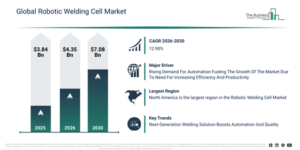
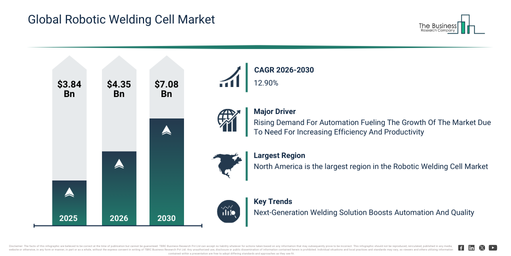
The robotic welding cell market has seen rapid expansion in recent years. This market is anticipated to expand from $3.84 billion in 2025 to $4.35 billion in 2026, growing at a compound annual growth rate (CAGR) of 13.2%. The historical growth of this market can be attributed to several factors including acute labor shortages and skills gaps, the demand for high and consistent weld quality, the adoption of Industry 4.0 and smart manufacturing, initiatives for cost reduction and increased productivity, and a focus on workplace safety and compliance.
The robotic welding cell market is anticipated to experience substantial growth over the next few years. It is forecast to reach $7.08 billion in 2030, demonstrating a compound annual growth rate (CAGR) of 12.9%. This expansion during the forecast period can be attributed to factors such as labor shortages and skills gaps, an increasing demand for superior quality welds, a heightened emphasis on safety and compliance, the rising adoption of automation (Industry 4.0) in manufacturing, and technological advancements including AI/ML in robotics. Key trends emerging in this period feature the rise of collaborative robots (Cobots), real-time weld defect detection powered by AI/ML, sophisticated sensor fusion and adaptive welding, the integration of laser and hybrid welding techniques, and the widespread use of off-line programming and simulation.
Get A Free Sample Report With In-Depth Market Insights:
Robotic Welding Cell Market Demand Drivers: What’s Powering Industry Growth?
The escalating demand for automation is anticipated to propel the growth of the robotic welding cells market moving forward. Automation refers to the utilization of technology or machines to carry out tasks with minimal or no human intervention. The increasing demand for automation is attributed to the necessity for improved operational efficiency as businesses aim to reduce costs, minimize errors, and enhance productivity. Robotic welding cells augment manufacturing automation by providing precise and consistent welding operations, positioning them as ideal for high-volume and complex production settings. They reduce manual labor and inaccuracies by performing repetitive tasks efficiently, leading to better productivity and product quality. For instance, in September 2024, according to the International Federation of Robotics, a Germany-based non-profit organization, there were 4,281,585 robotic units operating in factories globally in 2023, marking a 10% increase from 3,904,000 units in 2022. Therefore, the rising demand for automation is driving the expansion of the robotic welding cells market.
Robotic Welding Cell Market Segment Outlook: Which Categories Are Growing Fastest?
The robotic welding cell market covered in this report is segmented –
1) By Cell Type: Pre-Engineered Modular Welding Cells, Custom Bespoke Welding Cells, Cell-As-A-Service Managed Automation
2) By Welding Process: Arc Welding, Resistance (Spot) Welding, Laser Or Plasma Welding
3) By Type Of Robot: Articulated Robots, SCARA Robots, Cartesian Robots, Collaborative Robots (Cobots)
4) By Deployment Mode: Greenfield Integrated Lines, Retrofit Add-On Cells, Lease Managed Service
Subsegments:
1) By Pre Engineered Modular Welding Cells, Standard Single Robot Welding Cell, Dual Robot Welding Cell, Compact Footprint Welding Cell, High Throughput Production Welding Cell
2) By Custom Bespoke Welding Cells, Large Structure Welding Cell, Multi Process Welding Cell, Heavy Duty Industrial Welding Cell, Flexible Reconfigurable Welding Cell
3) By Cell As A Service Managed Automation, Subscription Based Welding Cell, Performance Based Welding Cell, Fully Managed Robotic Welding Cell, Scalable On Demand Welding Cell
Robotic Welding Cell Market Innovation Trends: What Developments Are Reshaping The Industry?
Major companies operating in the robotic welding cells market are concentrating on developing sophisticated systems, such as AI-driven adaptive welding solutions, to enhance efficiency, improve quality, and decrease manual programming and material waste. These AI-powered adaptive welding systems consist of advanced software and sensor suites that enable welding robots to perceive their environment and implement real-time adjustments to parameters like path, speed, and heat input. For instance, in May 2025, Novarc Technologies Inc., a Canada-based robotics and automation company, unveiled the NovAI system. This is a comprehensive AI-powered platform crafted to introduce advanced vision and real-time cognitive adaptation to articulated robotic and collaborative robot (cobot) welding cells. The system integrates a patented Spool Welding Robot (SWR) with machine vision and AI algorithms, allowing the robot to autonomously identify weld joints, compute optimal torch angles and paths, and dynamically adjust to part variations and thermal distortion during the weld process without human intervention. Additionally, it incorporates predictive process analytics and continuous learning capabilities, which significantly boost first-pass weld quality and reduce rework and operational costs for manufacturers.
Robotic Welding Cell Market Key Players Shaping Industry Direction
Major companies operating in the robotic welding cell market are Siasun Robot & Automation Co. Ltd., Miller Electric Mfg. LLC, Panasonic Corporation, Mitsubishi Electric Corporation, ABB Ltd., AGR Robotics, Valk Welding B.V., SERVO-ROBOT Inc., Kawasaki Heavy Industries Ltd., Tiesse Robot S.p.A., FANUC Corporation, Cloos Robotic Welding Inc., Lincoln Electric Holdings Inc., Yaskawa Electric Corporation, KUKA AG, Staubli International AG, Nachi-Fujikoshi Corp., Daihen Corporation, Comau S.p.A., IGM Robotersysteme AG
View The Full Robotic Welding Cell Market Report:
Robotic Welding Cell Market Regional Analysis: Which Region Leads By Revenue?
North America was the largest region in the robotic welding cell market in 2025. Asia-Pacific is expected to be the fastest-growing region in the forecast period. The regions covered in the robotic welding cell market report are Asia-Pacific, South East Asia, Western Europe, Eastern Europe, North America, South America, Middle East, Africa.
Reach Out To Our Team:
The Business Research Company: https://www.thebusinessresearchcompany.com/
Americas: +1 310-496-7795
Asia: +44 7882 955267 & +91 8897263534
Europe: +44 7882 955267
Email us at: marketing@tbrc.info
Follow us on:
LinkedIn: https://in.linkedin.com/company/the-business-research-company
YouTube: https://www.youtube.com/channel/UC24_fI0rV8cR5DxlCpgmyFQ
Global Market Model: https://www.thebusinessresearchcompany.com/global-market-model

Wasay has over a decade of experience in market research, data modelling, and analytics, with prior experience at GlobalData and Decision Tree Consulting Services. At The Business Research Company , he leads research operations across syndicated studies, customized consulting engagements, and the Global Market Model platform. His professional experience includes supporting organizations such as Boston Consulting Group, KPMG, and Ernst & Young. Wasay holds a degree in Electronics and Communications Engineering, postgraduate management qualifications from International Management Institute Belgium and Indian School of Business and Entrepreneurship, and completed the Integrated Program in Business Analytics from Indian Institute of Management Indore.