The Business Research Company’s 2026 market reports are designed to deliver research that is more actionable and strategically valuable. Key offerings include market attractiveness scoring, total addressable market sizing, company benchmarking matrices, interactive Excel dashboards, deeper supply chain intelligence, emerging startup tracking, and granular product-level insights.
Which Factors Will Shape The Recycling Equipment Market Size Through 2030?
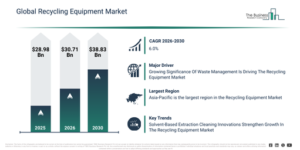
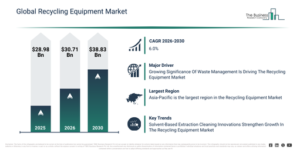
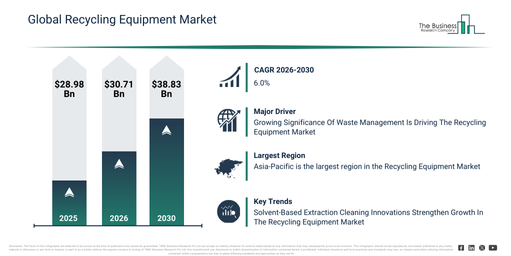
The recycling equipment market has shown robust growth recently. It is projected to increase from $28.98 billion in 2025 to $30.71 billion in 2026, exhibiting a compound annual growth rate (CAGR) of 6.0%. This growth observed in the past can be attributed to factors such as an increase in municipal solid waste generation, growing industrial waste volumes, the expansion of metal recycling operations, rising awareness of resource recovery, and the accessibility of conventional recycling machinery.
The recycling equipment market size is anticipated to demonstrate significant expansion over the next few years. It will grow to $38.83 billion in 2030 at a compound annual growth rate (CAGR) of 6.0%. This projected growth throughout the forecast period can be attributed to more stringent environmental regulations on waste disposal, the expansion of circular economy initiatives, increased investments in recycling infrastructure, a rise in electronic waste generation, and the demand for recycled raw materials in manufacturing. Key trends for this period include the rising adoption of automated recycling systems, an increasing demand for high efficiency material separation equipment, the growing use of advanced shredding and granulation technologies, the expansion of recycling infrastructure specifically for plastics and e-waste, and a stronger focus on energy-efficient and low-emission recycling equipment.
Request A Free Recycling Equipment Market Sample To Support Your Strategic Planning:
What Is Propelling The Recycling Equipment Market Toward $38.83 Billion By 2030?
The increasing importance of waste management is expected to propel the growth of the recycling equipment market going forward. Waste management involves the activities and processes of collecting, handling, processing, storing, and transporting waste materials from their point of origin to their final disposal location. The growing significance of waste management is fueled by rising environmental awareness, stringent regulations, urbanization, resource scarcity, and advancements in recycling technologies. Recycling equipment is increasingly crucial to modern waste management, as it streamlines the separation, processing, and transformation of recyclable materials, thereby significantly reducing waste sent to landfills, lowering environmental impact, and supporting the transition toward a sustainable circular economy. Therefore, the growing significance of waste management is driving the recycling equipment market.
What Are The Key Segments And Subsegments In The Recycling Equipment Market?
The recycling equipment market covered in this report is segmented –
1) By Equipment: Baler Press, Shredders, Granulators, Agglomerators, Shears, Separators, Extruders, Other Equipments
2) By Processed Material: Metal, Plastic, Construction Waste, Paper, Rubber, Other Processed Materials
3) By Application: Municipal Solid Waste Recycling, Commercial And Industrial Waste, Metals Separation And Recycling, E-Waste Recycling, Transfer Station Recycling
Subsegments:
1) By Baler Press: Horizontal Baler, Vertical Baler, Manual Baler, Automated Baler
2) By Shredders: Single-Shaft Shredders, Dual-Shaft Shredders, Four-Shaft Shredders, High-Speed Shredders
3) By Granulators: High-Speed Granulators, Slow-Speed Granulators, Wet Granulators, Dry Granulators
4) By Agglomerators: Batch Agglomerators, Continuous Agglomerators, Agglomerating Mills
5) By Shears: Metal Shears, Plastic Shears, Cable Shears
6) By Separators: Magnetic Separators, Eddy Current Separators, Air Separators, Density Separators
7) By Extruders: Single-Screw Extruders, Twin-Screw Extruders, Ram Extruders, Ventless Extruders, Degassing Extruders
8) By Other Equipments: Crushers, Compactors, Conveyors, Washing & Drying Systems, Pelletizers, Briquetting Machines, Sorting Systems, Pulverizers
Recycling Equipment Market Trends Behind The 6% CAGR Forecast
Leading companies within the recycling equipment market are concentrating on developing advanced solutions, such as solvent-based extraction cleaning, to boost recyclate purity, enabling recyclers to fulfill stringent quality requirements for end-use applications. This solvent-based extraction cleaning method utilizes chemical solvents to remove impurities, including non-intentionally added substances, odors, adhesives, and printing inks, from polymer chains without damaging the polymer structure, thereby producing high-quality recycled plastic suitable for sensitive applications. For instance, in November 2025, Lindner-Recyclingtech GmbH, an Austria-based shredding and recycling systems company, collaborated with Procter & Gamble, a US-based consumer goods company, to introduce Flexloop, a system featuring solvent-based extraction, at the trade fair K 2025. The Flexloop process incorporates an additional solvent extraction step after preliminary mechanical cleaning, reliably removing NIAS (non-intentionally added substances) such as pesticides, phthalates, dioxins, and organic residues, alongside odors, adhesives, and printing inks, from polymer chains. The elevated purity level achieved expands new application possibilities, allowing post-consumer recyclate to be used even in sensitive packaging like cosmetics and personal care products. The modular Flexloop system is designed for integration into existing Lindner washing and recycling lines, empowering recyclers to improve quality without replacing their entire infrastructure. Its lower capital expenditure and operating costs, in comparison to chemical recycling, establish it as a cost-efficient and scalable solution.
Major Companies Profiled In The Recycling Equipment Market Report
Major companies operating in the recycling equipment market are Metso, Danieli Centro Recycling, TOMRA Sorting ASA, Wastequip, Vecoplan AG, Shred-Tech, BHS-Sonthofen GmbH, Machinex Industries Inc., Stadler Anlagenbau GmbH, CP Manufacturing Inc., Marathon Equipment, General Kinematics Corporation, WEIMA Maschinenbau GmbH, Komar Industries Inc., Bollegraaf Recycling Solutions, Lindner Recyclingtech, Kiverco Limited, Eldan Recycling A/S, Granutech-Saturn Systems, Green Machine LLC, Suny Group, American Baler Company, Presona AB, ZERMA Machinery & Recycling Technology, Recycling Equipment Manufacturing Inc
Explore The Business Research Company’s Complete Recycling Equipment Market Report:
Where Does The Recycling Equipment Market Generate The Most Revenue?
Asia-Pacific was the largest region in the recycling equipment market in 2025. The regions covered in the recycling equipment market report are Asia-Pacific, South East Asia, Western Europe, Eastern Europe, North America, South America, Middle East, Africa
Reach Out To Our Team:
The Business Research Company: https://www.thebusinessresearchcompany.com/
Americas: +1 310-496-7795
Asia: +44 7882 955267 & +91 8897263534
Europe: +44 7882 955267
Email us at: marketing@tbrc.info
Follow us on:
LinkedIn: https://in.linkedin.com/company/the-business-research-company
YouTube: https://www.youtube.com/channel/UC24_fI0rV8cR5DxlCpgmyFQ
Global Market Model: https://www.thebusinessresearchcompany.com/global-market-model

Wasay has over a decade of experience in market research, data modelling, and analytics, with prior experience at GlobalData and Decision Tree Consulting Services. At The Business Research Company , he leads research operations across syndicated studies, customized consulting engagements, and the Global Market Model platform. His professional experience includes supporting organizations such as Boston Consulting Group, KPMG, and Ernst & Young. Wasay holds a degree in Electronics and Communications Engineering, postgraduate management qualifications from International Management Institute Belgium and Indian School of Business and Entrepreneurship, and completed the Integrated Program in Business Analytics from Indian Institute of Management Indore.