
Built to provide research that’s more actionable and strategically valuable, The Business Research Company’s 2026 market reports include market attractiveness analysis, total addressable market sizing, company benchmarking matrices, interactive Excel dashboards, broader supply chain intelligence, emerging startup tracking, and in-depth product insights.
Automotive Plastic Materials Market Growth Analysis: How Will Revenue Trend Over The Forecast Period?
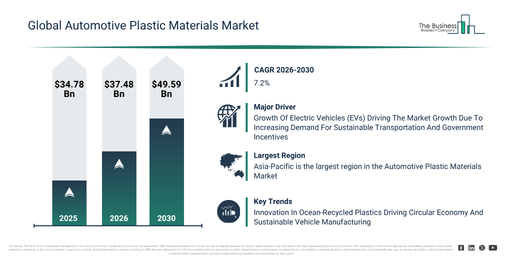
The automotive plastic materials market has experienced significant expansion in recent years. Projections indicate that its size will grow from $34.78 billion in 2025 to $37.48 billion in 2026, at a compound annual growth rate (CAGR) of 7.8%. The historical growth of this market can be attributed to several factors, including the adoption of lightweight vehicle designs, an increase in passenger vehicle production, the rising demand for fuel-efficient vehicles, the growing replacement of metal components with plastics, and the expansion of automotive component manufacturing.
The automotive plastic materials market size is projected to experience robust expansion over the forthcoming years. It is anticipated to achieve a valuation of $49.59 billion by 2030, demonstrating a compound annual growth rate (CAGR) of 7.2%. This anticipated expansion within the forecast period stems from factors such as increasing electric vehicle production, a heightened need for sustainable polymer materials, the growing uptake of high-performance engineering plastics, the broadening of advanced automotive manufacturing capabilities, and a strengthened emphasis on circular material utilization. Prominent developments expected during this period encompass the greater adoption of lightweight engineering plastics, a rising requirement for high-performance polymer composites, the increased incorporation of heat-resistant plastic materials, the proliferation of multi-material plastic component designs, and an intensified focus on recyclable automotive plastic materials.
Get A Free Sample Report With In-Depth Market Insights:
Automotive Plastic Materials Market Development Factors: What’s Supporting Demand?
The expansion of electric vehicles (EVs) is anticipated to drive the advancement of the automotive plastic materials sector in the future. EVs, which operate mainly on electric motors drawing power from stored batteries, are seeing increased acceptance due to ambitions for sustainability, reduced emissions, and progress in battery innovations. The growing uptake of electric vehicles is also fueled by their reduced operational expenses, primarily owing to electricity being more economical than traditional fuel, along with decreased maintenance requirements stemming from fewer moving components. Automotive plastics facilitate electric vehicles by cutting down vehicle mass to enhance driving range, boosting energy efficiency through lighter construction, and offering adaptable design options for battery enclosures and internal parts, all while supporting safety, resilience, and passenger comfort. As an illustration, in January 2025, figures from Cox Automotive, a US-based system software company, showed that electric vehicle (EV) sales were adjusted to 1,212,758 units in 2023, representing a 49% rise from 2022, and further ascended in 2024, increasing by 7.3% to reach 1,301,411 units. Consequently, the expansion of electric vehicles (EVs) is a primary catalyst for the increasing demand in the automotive plastic materials market.
Automotive Plastic Materials Market Segment Landscape: Which Areas Lead Development?
The automotive plastic materials market covered in this report is segmented –
1) By Product Type: Polypropylene, Polyurethane, Polyvinyl Chloride, Acrylonitrile Butadiene Styrene, Polycarbonate, Other Product Types
2) By Vehicle Type: Passenger Cars, Light Commercial Vehicles, Heavy Commercial Vehicles, Electric Vehicles
3) By Process Technology: Injection Molding, Extrusion, Blow Molding
4) By Application: Interior Components, Exterior Components, Under The Hood Components, Electrical And Electronic Components, Chassis And Structural Parts, Other Applications
5) By End Use Industry: Original Equipment Manufacturers, Aftermarket
Subsegments:
1) By Polypropylene: Homopolymer Polypropylene Automotive Plastics, Copolymer Polypropylene Automotive Plastics, Glass Fiber Reinforced Polypropylene Plastics, Impact Modified Polypropylene Plastics
2) By Polyurethane: Flexible Polyurethane Foams, Rigid Polyurethane Foams, Thermoplastic Polyurethane Elastomers, Coating Grade Polyurethane Materials
3) By Polyvinyl Chloride: Rigid Polyvinyl Chloride Automotive Plastics, Flexible Polyvinyl Chloride Automotive Plastics, Plasticized Polyvinyl Chloride Compounds, High Impact Polyvinyl Chloride Materials
4) By Acrylonitrile Butadiene Styrene: General Purpose Acrylonitrile Butadiene Styrene Plastics, High Heat Resistant Acrylonitrile Butadiene Styrene Plastics, Electroplated Acrylonitrile Butadiene Styrene Materials, Flame Retardant Acrylonitrile Butadiene Styrene Compounds
5) By Polycarbonate: Transparent Polycarbonate Automotive Plastics, Glass Reinforced Polycarbonate Materials, Ultraviolet Stabilized Polycarbonate Plastics, Impact Resistant Polycarbonate Grades
6) By Other Product Types: Polyamide Automotive Plastics, Polyethylene Automotive Plastics, Polybutylene Terephthalate Plastics, Thermoplastic Elastomer Automotive Materials
Automotive Plastic Materials Market Transformation Trends: What Innovations Are Driving Change?
Leading companies within the automotive plastic materials market are concentrating on creating novel products, like ocean-recycled automotive plastics, aiming to boost sustainability, encourage circular economy practices, and decrease lifecycle carbon emissions in vehicle production. These ocean-recycled automotive plastics represent specialized polymer substances made from plastic refuse gathered from marine settings. They undergo sorting, processing, and re-engineering into robust, lightweight, high-performance automotive parts that match the functionality of traditional virgin plastics, all while considerably lessening ecological footprint. An illustrative example occurred in October 2024 when Kia Corporation, an automotive producer based in South Korea, unveiled a special edition trunk liner for the Kia EV3. This liner was crafted from plastic salvaged from the Great Pacific Garbage Patch, in partnership with The Ocean Cleanup. This accessory incorporates around 40% recycled ocean plastic and goes through stringent sorting, recycling, and traceability verification steps to guarantee its material integrity and automotive-level quality. It exhibits similar durability and performance to standard trunk liners, simultaneously promoting the use of circular resources in car manufacturing. Such advancements highlight the increasing adoption of recycled and sustainable plastic materials within the automotive sector, driving forward environmentally conscious mobility solutions.
Automotive Plastic Materials Market Industry Leaders And Competitive Landscape
Major companies operating in the automotive plastic materials market are BASF SE, Saudi Basic Industries Corporation, LG Chem Ltd., LyondellBasell Industries N.V., Mitsubishi Chemical Group Corporation, Syensqo SA, Celanese Corporation, Asahi Kasei Corporation, Evonik Industries AG, Toray Industries Inc., Borealis AG, Envalior, INEOS Group Limited, Arkema SA, Sumitomo Chemical Co. Ltd., Teijin Limited, UBE Corporation, EMS-CHEMIE HOLDING AG, Kuraray Co. Ltd., Avient Corporation, Teknor Apex Company
View The Full Automotive Plastic Materials Market Report:
Automotive Plastic Materials Market Regional Breakdown: Where Is Demand Concentrated?
Asia-Pacific was the largest region in the automotive plastic materials market in 2025. Asia-Pacific is expected to be the fastest-growing region in the forecast period. The regions covered in the automotive plastic materials market report are Asia-Pacific, South East Asia, Western Europe, Eastern Europe, North America, South America, Middle East, Africa.
Reach Out To Our Team:
The Business Research Company: https://www.thebusinessresearchcompany.com/
Americas: +1 310-496-7795
Asia: +44 7882 955267 & +91 8897263534
Europe: +44 7882 955267
Email us at: marketing@tbrc.info
Follow us on:
LinkedIn: https://in.linkedin.com/company/the-business-research-company
YouTube: https://www.youtube.com/channel/UC24_fI0rV8cR5DxlCpgmyFQ
Global Market Model: https://www.thebusinessresearchcompany.com/global-market-model

Wasay has over a decade of experience in market research, data modelling, and analytics, with prior experience at GlobalData and Decision Tree Consulting Services. At The Business Research Company , he leads research operations across syndicated studies, customized consulting engagements, and the Global Market Model platform. His professional experience includes supporting organizations such as Boston Consulting Group, KPMG, and Ernst & Young. Wasay holds a degree in Electronics and Communications Engineering, postgraduate management qualifications from International Management Institute Belgium and Indian School of Business and Entrepreneurship, and completed the Integrated Program in Business Analytics from Indian Institute of Management Indore.