
Featuring market attractiveness scoring, total addressable market sizing, company benchmarking matrices, interactive Excel dashboards, deeper supply chain intelligence, emerging startup tracking, and granular product-level insights, The Business Research Company’s 2026 market reports are built to deliver research that is both more actionable and more strategically valuable.
Automotive Polymer Composites Market Revenue Outlook: What CAGR Lies Ahead Through 2030?
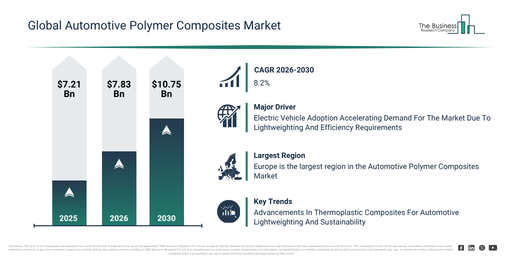
The automotive polymer composites market has demonstrated robust expansion recently. Projections indicate a rise from $7.21 billion in 2025 to $7.83 billion in 2026, exhibiting a compound annual growth rate (CAGR) of 8.7%. This historical increase is linked to a heightened demand for lighter automotive parts, an uptick in global automotive manufacturing, the imperative for better fuel economy, the widespread substitution of metal components with polymer materials, and the increased integration of robust composite materials in vehicle production.
The automotive polymer composites market size is anticipated to undergo significant expansion in the foreseeable future. It is forecast to expand, reaching $10.75 billion in 2030, with a compound annual growth rate (CAGR) of 8.2%. Several factors are expected to fuel this growth during the forecast period, such as an escalating demand for lightweight materials in electric vehicles, the increasing innovation of sustainable automotive composite solutions, the rising adoption of advanced manufacturing processes for composites, the expanding application of polymer composites in structural vehicle applications, and a growing need for high-performance materials in next-generation vehicles. Prominent trends anticipated for the forecast period encompass a greater adoption of lightweight polymer composite materials for vehicle weight reduction, an increasing demand for high-strength composite components in automotive design, the progressing development of recyclable and sustainable automotive composite materials, a rising utilization of advanced polymer composites specifically for electric vehicle applications, and the increasing integration of customized composite solutions to achieve improved vehicle performance.
Get A Free Sample Report With In-Depth Market Insights:
Automotive Polymer Composites Market Expansion Drivers: What’s Shaping Future Growth?
The increasing acceptance of electric vehicles (EVs) is anticipated to fuel the expansion of the automotive polymer composites market moving forward. Electric vehicles operate using electric motors powered by rechargeable batteries instead of internal combustion engines. The surge in electric vehicles is mainly attributed to heightened environmental concerns, given their zero tailpipe emissions, which contribute to reduced air pollution and greenhouse gas emissions compared to conventional fuel-powered vehicles. Automotive polymer composites support electric vehicles by decreasing the overall vehicle weight while maintaining strength, thereby enhancing battery efficiency and extending the driving range. For instance, in January 2024, a report by Kelley Blue Book, a US-based Cox Automotive company, revealed that a record 1.2 million car buyers in the United States selected electric vehicles in 2023, representing 7.6% of the entire U.S. vehicle market, an increase from 5.9% in 2022. Thus, the rising adoption of electric vehicles (EVs) is a primary driver for the growth of the automotive polymer composites market.
Automotive Polymer Composites Market Segment Outlook: Which Categories Are Growing Fastest?
The automotive polymer composites market covered in this report is segmented –
1) By Type: Thermoset Composites, Thermoplastic Composites
2) By Manufacturing Process: Injection Molding, Compression Molding, Resin Transfer Molding, Pultrusion, Filament Winding
3) By Material Type: Epoxy, Polyurethane, Polyamide, Polypropylene, Polyethylene, Polyester, Vinyl Ester, Other Material Types
4) By Application: Interior Components, Exterior Components, Structural Components, Powertrain Components
5) By End User: Passenger Cars, Commercial Vehicles, Electric Vehicles, Off Highway Vehicles
Subsegments:
1) By Thermoset Composites: Epoxy Based Composites, Polyester Based Composites, Vinyl Ester Composites
2) By Thermoplastic Composites: Polypropylene Composites, Polyamide Composites, Polyether Ether Ketone Composites
Automotive Polymer Composites Market Strategic Trends: What Defines The Next Growth Phase?
Major companies operating in the automotive polymer composites market are focusing on developing innovative solutions, such as thermoplastic composites, to enhance vehicle lightweighting, improve fuel efficiency and EV range, and deliver higher strength-to-weight performance with greater design flexibility. A thermoplastic composite is a lightweight, recyclable material made by reinforcing a heat-moldable plastic with fibers to improve strength and performance. For instance, in May 2026, Hanwha Azdel Inc., a US-based provider of high-performance thermoplastic technologies for the automotive industry, launched SuperLite S25, a new thermoplastic composite containing 25% post-consumer recycled polypropylene (rPP) designed specifically for automotive parts. This lightweight reinforced thermoplastic (LWRT) composite combines recycled polypropylene with long chopped glass fibers, offering automotive manufacturers a sustainable solution for parts such as headliners, door panels, sun visors, and underbody components while maintaining a high strength-to-weight ratio and excellent noise, vibration, and harshness (NVH) performance. It advances the automotive sector’s adoption of recycled materials, supporting vehicle lightweighting goals while reducing environmental impact through substantial recycled content incorporation.
Automotive Polymer Composites Market Leading Companies And Competitive Benchmarking
Major companies operating in the automotive polymer composites market are BASF SE, Saudi Basic Industries Corporation, LyondellBasell Industries N.V., Mitsubishi Chemical Group Corporation, DuPont de Nemours Inc., Toray Industries Inc., Covestro AG, Celanese Corporation, Teijin Limited, Owens Corning, Hexcel Corporation, Henkel AG & Co. KGaA, SGL Carbon SE, Arkema S.A., Gurit Holding AG, Evonik Industries AG, Johns Manville Corporation, Kolon Industries Inc., Tata AutoComp Systems Limited, IDI Composites International Inc., TPI Composites Inc., UFP Technologies Inc., Plasan Sasa Ltd., GMS Composites Ltd., Revchem Composites Inc.
View The Full Automotive Polymer Composites Market Report:
Automotive Polymer Composites Market Top Region: Where Does Most Revenue Come From?
Europe was the largest region in the automotive polymer composites market in 2025. Asia-Pacific is expected to be the fastest-growing region in the forecast period. The regions covered in the automotive polymer composites market report are Asia-Pacific, South East Asia, Western Europe, Eastern Europe, North America, South America, Middle East, Africa.
Reach Out To Our Team:
The Business Research Company: https://www.thebusinessresearchcompany.com/
Americas: +1 310-496-7795
Asia: +44 7882 955267 & +91 8897263534
Europe: +44 7882 955267
Email us at: marketing@tbrc.info
Follow us on:
LinkedIn: https://in.linkedin.com/company/the-business-research-company
YouTube: https://www.youtube.com/channel/UC24_fI0rV8cR5DxlCpgmyFQ
Global Market Model: https://www.thebusinessresearchcompany.com/global-market-model

Wasay has over a decade of experience in market research, data modelling, and analytics, with prior experience at GlobalData and Decision Tree Consulting Services. At The Business Research Company , he leads research operations across syndicated studies, customized consulting engagements, and the Global Market Model platform. His professional experience includes supporting organizations such as Boston Consulting Group, KPMG, and Ernst & Young. Wasay holds a degree in Electronics and Communications Engineering, postgraduate management qualifications from International Management Institute Belgium and Indian School of Business and Entrepreneurship, and completed the Integrated Program in Business Analytics from Indian Institute of Management Indore.