Featuring market attractiveness scoring, total addressable market sizing, company benchmarking matrices, interactive Excel dashboards, deeper supply chain intelligence, emerging startup tracking, and granular product-level insights, The Business Research Company’s 2026 market reports are built to deliver research that is both more actionable and more strategically valuable.
Smart Ferry Electrification Market Forecast: What Value Will The Market Reach By 2030?
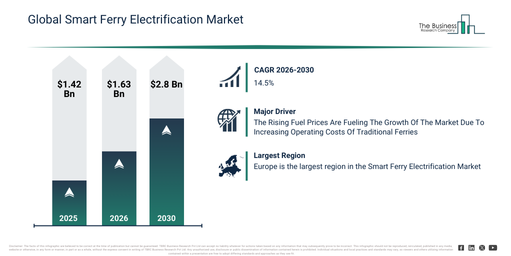
The smart ferry electrification market has experienced rapid growth in its size during recent years. This market is projected to expand from $1.42 billion in 2025 to $1.63 billion by 2026, exhibiting a compound annual growth rate (CAGR) of 14.8%. In the historic period, this growth can be attributed to several factors including the expansion of short-distance ferry routes, the early adoption of hybrid electric ferries, rising fuel cost pressures on operators, initial government incentives for electric vessels, and the development of port-side charging infrastructure.
The market for smart ferry electrification is projected to experience swift expansion over the coming years. This market is set to reach a valuation of $2.8 billion by 2030, demonstrating a compound annual growth rate (CAGR) of 14.5%. This anticipated growth during the forecast period is fueled by several factors, including heightened investments in eco-friendly maritime transport, an increase in battery technology capacity, escalating regulatory demands concerning maritime emissions, the growing implementation of hydrogen fuel cell ferries, and augmented public financing for smart ferry initiatives. Key trends during this period are expected to encompass the broader embrace of battery-electric ferry propulsion, the proliferation of intelligent charging and energy management systems, a greater incorporation of renewable energy sources, the increasing deployment of digital platforms for fleet monitoring, and an intensified commitment to achieving zero-emission maritime transport.
Get A Free Sample Report With In-Depth Market Insights:
Smart Ferry Electrification Market Expansion Drivers: What’s Shaping Future Growth?
Elevated fuel costs are projected to stimulate expansion within the smart ferry electrification market in the future. This increase in fuel prices stems from a global surge in crude oil demand, resulting in reduced supply, increased expenses, and subsequent impacts on transportation and production efficacy. Elevated fuel expenses increase the operational burden for conventional ferries, positioning electric propulsion as a more economical choice. This incentivizes operators to embrace smart ferry electrification to decrease fuel consumption, lower expenditures, and improve overall long-term efficiency. An illustration of this trend is provided by the Competition and Markets Authority (CMA), a UK-based government department. Their data from March 2025 shows that in October 2024, petrol was priced at an average of 134.4 pence per liter (ppl) and diesel at 139.7 pence per liter (ppl). By February 2025, these figures had climbed to 139.6 pence per liter (ppl) for petrol and 146.8 pence per liter (ppl) for diesel, indicating rises of 5.2 pence per liter (ppl) and 7.1 pence per liter (ppl) respectively. Consequently, increasing fuel costs are a primary catalyst for the expansion of the smart ferry electrification market.
Smart Ferry Electrification Market Segment Landscape: Which Areas Lead Development?
The smart ferry electrification market covered in this report is segmented –
1) By Propulsion Type: Fully Electric, Hybrid Electric
2) By Ferry Type: Passenger Ferry, Vehicle Ferry, Cargo Ferry, Other Ferry Types
3) By Battery Type: Lithium-Ion, Lead-Acid, Solid-State, Other Battery Types
4) By Power Output: Up To 1 Megawatt (MW), 1–5 Megawatt (MW), Above 5 Megawatt (MW)
5) By End-User: Commercial, Government, Other End-Users
Subsegments:
1) By Fully Electric: Battery Electric, Hydrogen Fuel Cell
2) By Hybrid Electric: Diesel-Electric, Gas-Electric
Smart Ferry Electrification Market Strategic Trends: What Defines The Next Growth Phase?
Leading companies within the smart ferry electrification market are prioritizing the development of innovative products, such as the Island-class electric-ready ferry, to boost energy efficiency, decrease emissions, and enhance capabilities for passenger and vehicle transport. The Island-class electric-ready ferry itself is a hybrid-electric vessel engineered to run on battery power, facilitating efficient transport of passengers and vehicles while simultaneously reducing emissions. For example, in May 2025, Damen Shipyards Galati, a shipbuilding company based in Romania, launched the Damen RoRo 8117 E3, an Island Class ferry fully prepared for electric operation, intended for BC Ferries. This vessel is the seventh Damen addition to BC Ferries’ fleet, equipped with both battery and diesel-hybrid systems, and designed to transport up to 47 vehicles and 390 passengers. It can operate entirely on electric power once terminal charging infrastructure is established, recharging using renewable energy during the periods of passenger embarkation and disembarkation. This ferry forms part of an order for four identical vessels that will service routes connecting coastal communities across British Columbia, replacing older diesel-powered ships with more sustainable, low-emission alternatives.
Smart Ferry Electrification Market Industry Leaders And Competitive Landscape
Major companies operating in the smart ferry electrification market are GE Vernova LLC, ABB Ltd, Mitsubishi Heavy Industries, Ltd., LG Energy Solution Ltd., Rolls-Royce Holdings plc, Nidec Corporation, Danfoss Editron A/S, Fincantieri S.p.A., Kongsberg Gruppen ASA, Damen Shipyards Group, AVL, MAN Energy Solutions SE, Austal Limited, Meyer Werft GmbH & Co. KG, Corvus Energy ASA, Artemis Technologies, Incat Tasmania Pty Ltd, Leclanché SA, EST-Floattech AS, Schottel GmbH.
View The Full Smart Ferry Electrification Market Report:
Smart Ferry Electrification Market Geographic Analysis: Where Is Demand Rising Fastest?
Europe was the largest region in the smart ferry electrification market in 2025. Asia-Pacific is expected to be the fastest-growing region in the forecast period. The regions covered in the smart ferry electrification market report are Asia-Pacific, South East Asia, Western Europe, Eastern Europe, North America, South America, Middle East, Africa.
Reach Out To Our Team:
The Business Research Company: https://www.thebusinessresearchcompany.com/
Americas: +1 310-496-7795
Asia: +44 7882 955267 & +91 8897263534
Europe: +44 7882 955267
Email us at: marketing@tbrc.info
Follow us on:
LinkedIn: https://in.linkedin.com/company/the-business-research-company
YouTube: https://www.youtube.com/channel/UC24_fI0rV8cR5DxlCpgmyFQ
Global Market Model: https://www.thebusinessresearchcompany.com/global-market-model

Wasay has over a decade of experience in market research, data modelling, and analytics, with prior experience at GlobalData and Decision Tree Consulting Services. At The Business Research Company , he leads research operations across syndicated studies, customized consulting engagements, and the Global Market Model platform. His professional experience includes supporting organizations such as Boston Consulting Group, KPMG, and Ernst & Young. Wasay holds a degree in Electronics and Communications Engineering, postgraduate management qualifications from International Management Institute Belgium and Indian School of Business and Entrepreneurship, and completed the Integrated Program in Business Analytics from Indian Institute of Management Indore.