Backed by market attractiveness analysis, total addressable market sizing, company benchmarking matrices, interactive Excel dashboards, wider supply chain intelligence, emerging startup coverage, and detailed product-level insights, The Business Research Company’s 2026 market reports are designed to offer research that is more actionable and strategically valuable than ever.
Smart Food Logistics Market Growth Analysis: How Will Revenue Trend Over The Forecast Period?
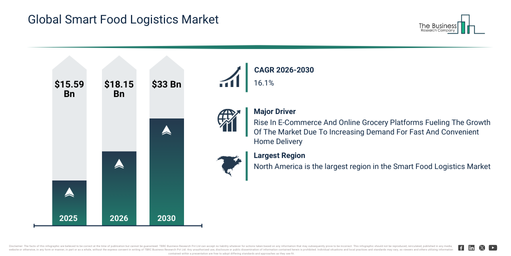
The smart food logistics market has experienced substantial growth in recent times. It is projected to increase from $15.59 billion in 2025 to $18.15 billion in 2026, demonstrating a compound annual growth rate (CAGR) of 16.4%. Historically, this growth can be attributed to the expansion of global food trade, rising demand for cold chain logistics, increased regulatory focus on food safety, growth in organized retail food distribution, and the adoption of digital logistics platforms.
The smart food logistics market is projected to undergo substantial expansion in the coming years. It is forecast to achieve a valuation of $33 billion by 2030, progressing at a compound annual growth rate (CAGR) of 16.1%. This growth during the forecast period can be linked to heightened investments in intelligent cold chain infrastructure, a greater emphasis on reducing food waste, the broadening of predictive logistics analytics, a surging requirement for traceable food supply chains, and the increased integration of autonomous logistics solutions. Noteworthy trends for the forecast period include the wider uptake of real-time temperature monitoring solutions, an increase in the deployment of IoT-enabled cold chain systems, the growing application of AI-based demand forecasting tools, the expansion of smart warehousing for perishable items, and an intensified focus on end-to-end supply chain visibility.
Get A Free Sample Report With In-Depth Market Insights:
Smart Food Logistics Market Growth Momentum: What Factors Are Shaping Demand?
The smart food logistics market is anticipated to experience growth driven by the expansion of e-commerce and online grocery platforms. These platforms are digital marketplaces allowing consumers to buy food and grocery products online for direct home delivery. The surge in e-commerce and online grocery platforms is largely a result of increasing consumer demand for convenience, as individuals increasingly favor swift, doorstep delivery over traditional, time-consuming in-store shopping. Smart food logistics bolster e-commerce and online grocery platforms by boosting storage efficiency, refining delivery routing, and enhancing cold-chain management, thereby enabling quicker, safer, and more economical distribution of fresh products to customers. For example, in August 2025, the U.S. Census Bureau, a US-based government agency, reported that e-commerce sales in the second quarter of 2025 grew by an estimated 5.3% (±1.2%) compared to the same quarter in 2024. Thus, the increasing e-commerce and online grocery platforms are propelling the growth of the smart food logistics market.
Smart Food Logistics Market Segment Outlook: Which Categories Are Growing Fastest?
The smart food logistics market covered in this report is segmented –
1) By Component: Hardware, Software
2) By Technology: Internet Of Things (IoT), Artificial Intelligence (AI) And Machine Learning, Blockchain Technology, Warehouse Management Systems (WMS), Transportation Management Systems (TMS)
3) By Type Of Service: Transportation, Warehousing, Inventory Management, Order Fulfillment, Distribution And Delivery Services
4) By Mode Of Transport: Road Freight, Air Freight, Sea Freight, Rail Freight
5) By End-User: Food And Beverage Industry, Pharmaceuticals, Retail, Consumer Goods, Agriculture
Subsegments:
By Hardware: Tracking Devices, Temperature Monitoring Systems, Refrigeration Units, Packaging Equipment
By Software: Fleet Management, Inventory Management, Route Optimization, Data Analytics, Supply Chain Visibility
Smart Food Logistics Market Trends Redefining Industry Growth
Companies operating within the smart food logistics market are increasingly prioritizing the creation of advanced technological solutions, notably autonomous food delivery robots. These innovations aim to accelerate last-mile deliveries, decrease labor expenditures, minimize food spoilage via temperature-controlled pathways, and enhance the scalability of on-demand fulfillment for both e-commerce and grocery platforms. Autonomous food delivery robots are defined as self-navigating ground or aerial vehicles, equipped with sensors, sophisticated navigation software, and insulated storage compartments, which facilitate the delivery of prepared meals or groceries to customers without the need for a human operator. For example, in May 2025, Yango Group Ltd., a UAE-based provider of technology-driven services, initiated a pilot program for autonomous food delivery, utilizing AI-powered, fully electric robots. These robots are deployed within Expo City to provide deliveries of meals from selected restaurants to users, commencing with the Al Wasl 3 office building. Characterized as silent and emission-free, these robots autonomously plot routes, skillfully avoid obstacles, and consistently prioritize pedestrian safety. Customers place food orders via the Expo City Eats app, and the robots subsequently convey them to specific drop-off locations. This project significantly contributes to Dubai’s smart city and sustainability objectives through the alleviation of traffic and noise pollution, and there are intentions to broaden the service throughout Expo City following the initial four-month trial.
Smart Food Logistics Market Leading Companies And Competitive Benchmarking
Major companies operating in the smart food logistics market are Zebra Technologies Corporation, Samsara Inc., Geotab, Digi International Inc., Telit Cinterion, Nippon Express Co. Ltd., ORBCOMM Inc., Controlant, Americold Logistics LLC., Lineage Inc., Teletrac Navman, Savi Technology, NewCold, Tive Inc., Roambee, Traxens, Testo SE & Co. KGaA, Monnit Corporation, Berlinger & Co. AG, Cooltrax, Yusen Logistics Co. Ltd., ELPRO-BUCHS AG, Kii Corporation, Infratab, Sonicu, LYNA LOGICS Inc., and Nuvizz.
View The Full Smart Food Logistics Market Report:
Smart Food Logistics Market Regional Analysis And Top Geography
North America was the largest region in the smart food logistics market in 2025. Asia-Pacific is expected to be the fastest-growing region in the forecast period. The regions covered in the smart food logistics market report are Asia-Pacific, South East Asia, Western Europe, Eastern Europe, North America, South America, Middle East, Africa.
Reach Out To Our Team:
The Business Research Company: https://www.thebusinessresearchcompany.com/
Americas: +1 310-496-7795
Asia: +44 7882 955267 & +91 8897263534
Europe: +44 7882 955267
Email us at: marketing@tbrc.info
Follow us on:
LinkedIn: https://in.linkedin.com/company/the-business-research-company
YouTube: https://www.youtube.com/channel/UC24_fI0rV8cR5DxlCpgmyFQ
Global Market Model: https://www.thebusinessresearchcompany.com/global-market-model

Wasay has over a decade of experience in market research, data modelling, and analytics, with prior experience at GlobalData and Decision Tree Consulting Services. At The Business Research Company , he leads research operations across syndicated studies, customized consulting engagements, and the Global Market Model platform. His professional experience includes supporting organizations such as Boston Consulting Group, KPMG, and Ernst & Young. Wasay holds a degree in Electronics and Communications Engineering, postgraduate management qualifications from International Management Institute Belgium and Indian School of Business and Entrepreneurship, and completed the Integrated Program in Business Analytics from Indian Institute of Management Indore.