
Backed by market attractiveness analysis, total addressable market sizing, company benchmarking matrices, interactive Excel dashboards, wider supply chain intelligence, emerging startup coverage, and detailed product-level insights, The Business Research Company’s 2026 market reports are designed to offer research that is more actionable and strategically valuable than ever.
Automotive Smart Cruise Control (SCC) Market Set To Climb From $9.36 Billion In 2026 To $15.16 Billion By 2030
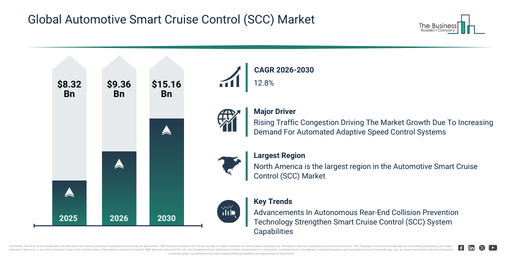
The market size for automotive smart cruise control (scc) has experienced rapid expansion in recent years. It is projected to increase from $8.32 billion in 2025 to $9.36 billion in 2026, achieving a compound annual growth rate (CAGR) of 12.6%. The historical growth of this market can be attributed to factors like a rising demand for driver assistance features, increased highway and long-distance travel, the adoption of radar-based vehicle monitoring systems, a surge in passenger car and commercial vehicle sales, and growing awareness regarding road safety and accident reduction.
The automotive smart cruise control (SCC) market size is projected to undergo substantial expansion over the upcoming years. It is anticipated to attain a value of $15.16 billion by 2030, exhibiting a compound annual growth rate (CAGR) of 12.8%. The impetus for this growth in the forecast period stems from the increasing integration of electric vehicles with advanced driver assistance, the broadening of fleet management and ride-sharing services, the rising incorporation of predictive and semi-automated cruise control technologies, the development of more stringent government regulations on vehicle safety standards, and the advancement of connected car infrastructure and smart mobility solutions. Prominent trends for the same period include the integration of sophisticated radar and lidar sensors, the proliferation of stop-and-go traffic assistance systems, an increased adoption of forward collision mitigation features, the expansion of semi-automated cruise control solutions, and a heightened focus on human-machine interface (HMI) displays and sensor mounting systems.
Get A Free Sample Report With In-Depth Market Insights:
Automotive Smart Cruise Control (SCC) Market Growth Momentum: What Factors Are Shaping Demand?
The increasing issue of traffic congestion is expected to significantly propel the expansion of the automotive smart cruise control (SCC) market going forward. This condition, traffic congestion, occurs when vehicle movement on roadways decelerates or ceases due to excessive demand relative to the available road capacity. The increasing prevalence of traffic congestion is primarily driven by growing urbanization, as expanding metropolitan populations contribute to higher vehicle ownership and greater roadway utilization, creating a density that exceeds infrastructure capacity during peak travel periods. Consequently, rising traffic congestion stimulates the growth of the automotive smart cruise control (SCC) market, as drivers seek automated adaptive speed control systems that mitigate the stress and fatigue of constant manual braking and acceleration in stop-and-go situations. For instance, in August 2024, data from the Federal Highway Administration, a US-based government agency responsible for transportation infrastructure, indicated that the Travel Time Index climbed from 1 hour 22 minutes in 2022 to 1 hour 24 minutes in 2023, demonstrating a year-over-year increase in traffic congestion levels. Therefore, rising traffic congestion is a key factor driving the growth of the automotive smart cruise control (SCC) market.
Automotive Smart Cruise Control (SCC) Market Breakdown By Product Type And Application
The automotive smart cruise control (scc) market covered in this report is segmented –
1) By Vehicle Type: Passenger Cars, Light Commercial Vehicles, Heavy Commercial Vehicles
2) By Component: Sensors, Control Interface, Software, Actuators
3) By Technology: Adaptive Cruise Control, Predictive Cruise Control, Dynamic Radar Cruise Control, Semi-Automated Cruise Control
4) By End Use: Personal Use, Ride Sharing, Fleet Management
Subsegments:
1) Passenger Cars: Sedan, Hatchback, Sport Utility Vehicle, Multi Purpose Vehicle, Luxury Passenger Car
2) Light Commercial Vehicles: Pickup Truck, Cargo Van, Mini Truck, Light Duty Van
3) Heavy Commercial Vehicles: Heavy Duty Truck, Articulated Truck, Intercity Bus, Coach Bus
Automotive Smart Cruise Control (SCC) Market Trends Redefining Industry Growth
Leading companies active in the automotive smart cruise control (SCC) market are prioritizing the development of advanced safety-enhancement technologies to boost adaptive driving performance and support next-generation driver assistance architectures. These safety-enhancement technologies refer to sophisticated systems and features integrated into vehicles or equipment to prevent accidents, minimize risks, safeguard users from potential dangers, and improve overall safety and reliability. For instance, in June 2025, HyundAI Mobis, an automotive technology company based in South Korea, introduced an autonomous rear-end collision prevention technology specifically designed to complement smart cruise control systems. This innovation employs advanced sensor fusion and real-time control algorithms to enable proactive hazard detection and rapid response, thereby supporting modern vehicle safety architectures and increasing scalability for advanced driver assistance systems (ADAS) and autonomous driving applications.
Automotive Smart Cruise Control (SCC) Market Competitive Landscape: Which Companies Lead The Industry?
Major companies operating in the automotive smart cruise control (SCC) market are Volkswagen AG, Toyota Motor Corporation, Ford Motor Company, General Motors Company, Bayerische Motoren Werke AG (BMW AG), Mercedes-Benz Group AG, Honda Motor Co. Ltd., Tesla Inc., Robert Bosch GmbH, Nissan Motor Co. Ltd., Denso Corporation, ZF Friedrichshafen AG, HyundAI Mobis Co. Ltd., Magna International Inc., Subaru Corporation, Valeo SA, Autoliv Inc., Mando Corporation, Visteon Corporation, and Luminar Technologies Inc.
View The Full Automotive Smart Cruise Control (SCC) Market Report:
Automotive Smart Cruise Control (SCC) Market Regional Breakdown: Where Is Demand Concentrated?
North America was the largest region in the automotive smart cruise control (SCC) market in 2025. Asia-Pacific is expected to be the fastest-growing region in the forecast period. The regions covered in the automotive smart cruise control (SCC) market report are Asia-Pacific, South East Asia, Western Europe, Eastern Europe, North America, South America, Middle East, Africa.
Reach Out To Our Team:
The Business Research Company: https://www.thebusinessresearchcompany.com/
Americas: +1 310-496-7795
Asia: +44 7882 955267 & +91 8897263534
Europe: +44 7882 955267
Email us at: marketing@tbrc.info
Follow us on:
LinkedIn: https://in.linkedin.com/company/the-business-research-company
YouTube: https://www.youtube.com/channel/UC24_fI0rV8cR5DxlCpgmyFQ
Global Market Model: https://www.thebusinessresearchcompany.com/global-market-model

Wasay has over a decade of experience in market research, data modelling, and analytics, with prior experience at GlobalData and Decision Tree Consulting Services. At The Business Research Company , he leads research operations across syndicated studies, customized consulting engagements, and the Global Market Model platform. His professional experience includes supporting organizations such as Boston Consulting Group, KPMG, and Ernst & Young. Wasay holds a degree in Electronics and Communications Engineering, postgraduate management qualifications from International Management Institute Belgium and Indian School of Business and Entrepreneurship, and completed the Integrated Program in Business Analytics from Indian Institute of Management Indore.