
Built to provide research that’s more actionable and strategically valuable, The Business Research Company’s 2026 market reports include market attractiveness analysis, total addressable market sizing, company benchmarking matrices, interactive Excel dashboards, broader supply chain intelligence, emerging startup tracking, and in-depth product insights.
Autonomous Shuttles Market CAGR Outlook And Future Development
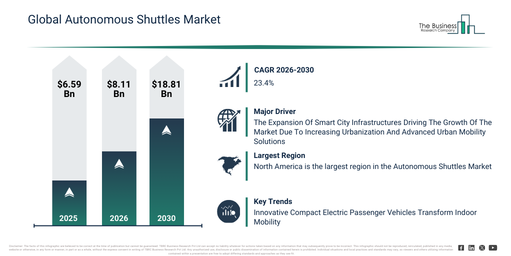
The autonomous shuttles market has seen substantial growth in recent years. Its value is expected to rise from $6.59 billion in 2025 to $8.11 billion in 2026, exhibiting a compound annual growth rate (CAGR) of 23.2%. The expansion observed during the past period can be attributed to factors such as increased urban congestion, growing investments in smart city initiatives, the adoption of autonomous driving prototypes, more stringent safety regulations in public transport, and the ongoing development of electric shuttle technology.
The market for autonomous shuttles is projected to experience rapid expansion over the coming years. It will grow to $18.81 billion in 2030 at a compound annual growth rate (CAGR) of 23.4%. This anticipated growth during the forecast period is fueled by several factors, including the proliferation of autonomous shuttle services on corporate campuses, a surge in demand for driverless public transportation, advancements in smart infrastructure integration, the wider adoption of AI-powered traffic management systems, and the broadening application of shuttles in healthcare and tourism sectors. Key developments expected during this timeframe encompass the growing embrace of lidar-based autonomous navigation, the heightened implementation of camera and radar fusion systems, the emergence of teleoperation and remote monitoring solutions, the increased use of electric powertrain shuttles in urban settings, and the incorporation of sophisticated AI software for dynamic route optimization.
Get A Free Sample Report With In-Depth Market Insights:
Autonomous Shuttles Market Opportunity Drivers: What’s Unlocking New Revenue Potential?
The increasing development of smart city facilities is anticipated to drive the progress of the autonomous shuttles market in the future. Smart city facilities encompass comprehensive physical and digital frameworks, such as transport, power, communication networks, and public services, crafted to boost urban performance, environmental viability, and living standards via cutting-edge technologies and data-led oversight. This growth in smart city facilities stems from escalating urbanization, given that expanding urban populations necessitate improved handling of resources, transit, power, and public amenities using sophisticated digital tools. The advancement of smart city infrastructures facilitates the implementation of autonomous shuttles by offering unified traffic control systems, live data connectivity, and interconnected urban transport solutions that elevate safety, operational effectiveness, and route planning. For example, in January 2024, the Institute of the Americas, a US-based non-profit organization, reported that worldwide investment in smart city projects rose from $190 billion in 2023, reaching $200 billion by 2025. Consequently, the ongoing development of smart city facilities is fueling the expansion of the autonomous shuttles market.
Autonomous Shuttles Market Segment Landscape And Growth Outlook
The autonomous shuttles market covered in this report is segmented –
1) By Technology: Lidar-Based Systems, Camera-Based Systems, Radar-Based Systems, Vehicle-To-Everything Communication Systems
2) By Vehicle Type: Mini Shuttles, Medium Shuttles, Large Shuttles, Electric Shuttles, Hybrid Shuttles
3) By Vehicle Size: Small Shuttles (10-15 Passengers), Medium Shuttles (16-30 Passengers), Large Shuttles (31+ Passengers)
4) By Application: Public Transport, Corporate Campuses, Healthcare Facilities, Tourism And Sightseeing, Educational Institutions
5) By End-User: Government And Municipalities, Private Companies And Corporations, Educational Institutions, Healthcare Organizations, Tourism Operators
Subsegments:
1) By Lidar-Based Systems: 2D Lidar, 3D Lidar, Solid-State Lidar, Mechanical Lidar
2) By Camera-Based Systems: Monocular Cameras, Stereo Cameras, Infrared Cameras, High-Definition Cameras
3) By Radar-Based Systems: Short-Range Radar, Medium-Range Radar, Long-Range Radar, Imaging Radar
4) By Vehicle-To-Everything Communication Systems: Vehicle-To-Vehicle Communication, Vehicle-To-Infrastructure Communication, Vehicle-To-Pedestrian Communication, Vehicle-To-Network Communication
Autonomous Shuttles Market Innovation Trends Shaping Future Development
Companies within the autonomous shuttles market are intensifying their efforts to create new solutions, such as small autonomous electric passenger vehicles, with the goal of improving passenger mobility in terms of efficiency, safety, and accessibility. These small autonomous electric passenger vehicles are essentially modest-sized, self-driving electric shuttles built to transport a restricted number of individuals securely and effectively, especially in environments that are either controlled or partially controlled, including airports, resorts, university campuses, and retail complexes. For instance, in December 2024, Whereable Inc., a Physical AI startup from South Korea, unveiled its “inq” autonomous indoor shuttle, an electric passenger vehicle specifically designed to enhance movement within extensive indoor settings. The shuttle incorporates mapless autonomous navigation, meaning it can function without needing pre-defined routes, thus boosting its adaptability in changing indoor environments. Users can choose their destinations via a touchscreen or a voice-activated system, making its use straightforward and user-friendly. With four-wheel independent steering, the vehicle can execute zero-turn maneuvers and move sideways, granting it exceptional agility in tight areas.
Autonomous Shuttles Market Competitive Overview And Top Companies
Major companies operating in the autonomous shuttles market are Toyota Motor Corporation, Robert Bosch GmbH, Denso Corporation, ZF Friedrichshafen AG, Aptiv PLC, Baidu Inc., Schaeffler AG, Transdev Group, Waymo LLC, Zoox Inc., Nuro Inc., EasyMile SAS, Pony.AI Inc., WeRide Inc., May Mobility Inc., Beep Inc., 2getthere B.V., Aurrigo International Ltd., Milla Group Limited, and Zhengzhou Yutong Bus Co. Ltd.
View The Full Autonomous Shuttles Market Report:
Autonomous Shuttles Market Top Region: Where Does Most Revenue Come From?
North America was the largest region in the autonomous shuttles market in 2025. Asia-Pacific is expected to be the fastest-growing region in the forecast period. The regions covered in the autonomous shuttles market report are Asia-Pacific, South East Asia, Western Europe, Eastern Europe, North America, South America, Middle East, Africa.
Reach Out To Our Team:
The Business Research Company: https://www.thebusinessresearchcompany.com/
Americas: +1 310-496-7795
Asia: +44 7882 955267 & +91 8897263534
Europe: +44 7882 955267
Email us at: marketing@tbrc.info
Follow us on:
LinkedIn: https://in.linkedin.com/company/the-business-research-company
YouTube: https://www.youtube.com/channel/UC24_fI0rV8cR5DxlCpgmyFQ
Global Market Model: https://www.thebusinessresearchcompany.com/global-market-model

Wasay has over a decade of experience in market research, data modelling, and analytics, with prior experience at GlobalData and Decision Tree Consulting Services. At The Business Research Company , he leads research operations across syndicated studies, customized consulting engagements, and the Global Market Model platform. His professional experience includes supporting organizations such as Boston Consulting Group, KPMG, and Ernst & Young. Wasay holds a degree in Electronics and Communications Engineering, postgraduate management qualifications from International Management Institute Belgium and Indian School of Business and Entrepreneurship, and completed the Integrated Program in Business Analytics from Indian Institute of Management Indore.