Built to provide research that’s more actionable and strategically valuable, The Business Research Company’s 2026 market reports include market attractiveness analysis, total addressable market sizing, company benchmarking matrices, interactive Excel dashboards, broader supply chain intelligence, emerging startup tracking, and in-depth product insights.
Missile Interceptors Market CAGR Outlook And Future Development
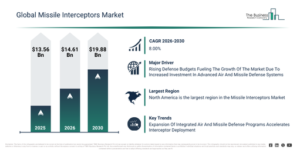
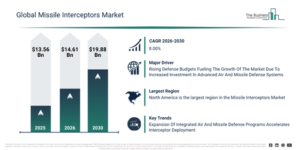
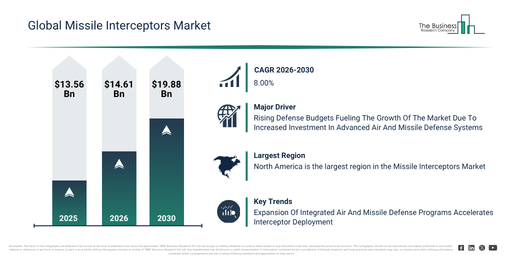
The missile interceptors market has experienced substantial expansion over the past few years. This market is projected to expand from $13.56 billion in 2025 to reach $14.61 billion by 2026, demonstrating a compound annual growth rate (CAGR) of 7.8%. Historically, this growth has been driven by factors such as escalating global geopolitical tensions, the increasing spread of missiles among various countries, advancements in early ballistic missile defense systems, ongoing defense modernization initiatives, and the broader development of radar and surveillance infrastructure.
The missile interceptors market is anticipated to show significant expansion in the near future, reaching $19.88 billion by 2030, at a compound annual growth rate (CAGR) of 8.0%. This projected growth is driven by factors such as the rising implementation of hypersonic defense countermeasures, increased spending on multi-domain defense systems, the development of autonomous and AI-enabled defense platforms, the broadening scope of space-based missile detection systems, and a heightened emphasis on national security and safeguarding critical infrastructure. Prominent trends for the forecast period include the expanding deployment of multi-layered missile defense architectures that merge space, air, and ground-based intercept systems, the increasing adoption of advanced radar and sensor fusion technologies to improve threat detection and tracking speed, the growing integration of hypersonic missile interception capabilities into defense systems, the proliferation of modular and mobile interceptor launch platforms for swift battlefield deployment, and the enhanced utilization of network-centric warfare systems for real-time command and control coordination in missile defense operations.
Get A Free Sample Report With In-Depth Market Insights:
Missile Interceptors Market Growth Drivers: What’s Behind The Acceleration?
Increasing defense allocations are anticipated to stimulate the expansion of the missile interceptors market in the future. These budgets signify government funding dedicated to military capacities, encompassing research, development, acquisition, and active deployment of defense mechanisms. The escalation of these budgets stems from elevated security worries, modernization efforts, and the emergence of new aerial and missile dangers. Consequently, governments are directing a larger share of their defense expenditure towards air and missile defense setups, specifically for acquiring and enhancing interceptors. To illustrate, in February 2024, the North Atlantic Treaty Organization (NATO), an intergovernmental military alliance situated in Belgium, indicated that its constituent nations jointly expended more than USD 1.3 trillion on defense in 2023, marking an actual rise of approximately 3% compared to 2022. Hence, the increase in defense budgets is a primary catalyst for the growth of the Missile Interceptors market.
Missile Interceptors Market Segment Landscape And Growth Outlook
The missile interceptors market covered in this report is segmented –
1) By Type: Kinetic Kill Interceptors, Explosive Warhead Interceptors, Directed Energy Interceptors
2) By Range: Short-Range Interceptors, Medium-Range Interceptors, Long-Range Interceptors
3) By Platform: Ground-Based, Naval-Based, Airborne-Based
4) By End User: Military Defense Forces, Homeland Security Departments, Joint Multinational Defense Coalitions
Subsegments:
1) By Kinetic Kill Interceptors: Exo Atmospheric Interceptors, Endo Atmospheric Interceptors, Midcourse Interception Systems, Terminal Phase Interceptors, Ground Based Interceptors
2) By Explosive Warhead Interceptors: Fragmentation Warhead Interceptors, Blast Fragmentation Warhead Interceptors, Proximity Fuze Warhead Interceptors, High Explosive Warhead Interceptors, Directional Fragmentation Warhead Interceptors
3) By Directed Energy Interceptors: High Energy Laser Interceptors, Particle Beam Interceptors, Microwave Energy Interceptors, Laser Based Missile Defense Systems, Electromagnetic Energy Interceptors
Missile Interceptors Market Trends: What’s Defining The Industry’s Next Phase?
Leading firms within the missile interceptors market are concentrating on creating advanced interceptor technologies, such as interconnected multi-layer interception systems, to boost detection accuracy, refine engagement coordination, and shorten reaction times against sophisticated aerial dangers. Integrated air and missile defense frameworks integrate radar networks, command-and-control infrastructure, and interceptor launch units into a cohesive structure, enabling real-time threat monitoring and synchronized engagement across multiple defensive tiers. These integrated systems bolster national security by enhancing the interoperability between sensors and interceptors while simultaneously increasing their overall scalability. An example of this is the live-fire testing of the Integrated Battle Command System (IBCS) conducted by the U. S. Army, a US-based defense organization, in December 2023, as part of its air and missile defense modernization initiative, which showcased enhanced sensor-to-shooter integration and effective engagement coordination among various defense assets. Additionally, escalating geopolitical tensions and the spread of advanced missile technologies are prompting governments to invest in multi-layered defense systems capable of countering a wide range of concurrent threats.
Missile Interceptors Market Leading Players And Competitive Positioning
Major companies operating in the missile interceptors market are Boeing, Raytheon Technologies, Lockheed Martin, General Dynamics, Northrop Grumman, BAE Systems, Mitsubishi Heavy Industries, Thales Group, L3Harris Technologies, Leonardo S. p. A., Hanwha Aerospace, Elbit Systems, Israel Aerospace Industries, Saab AB, Rafael Advanced Defense Systems, Kongsberg Defence and Aerospace, MBDA, Aerojet Rocketdyne, Roketsan, Denel Dynamics, Bharat Dynamics Limited
View The Full Missile Interceptors Market Report:
Missile Interceptors Market Regional Split: Which Areas Are Fueling Growth?
North America was the largest region in the missile interceptors market in 2025. Asia-Pacific is expected to be the fastest-growing region in the forecast period. The regions covered in the missile interceptors market report are Asia-Pacific, South East Asia, Western Europe, Eastern Europe, North America, South America, Middle East and Africa.
Reach Out To Our Team:
The Business Research Company: https://www.thebusinessresearchcompany.com/
Americas: +1 310-496-7795
Asia: +44 7882 955267 & +91 8897263534
Europe: +44 7882 955267
Email us at: marketing@tbrc.info
Follow us on:
LinkedIn: https://in.linkedin.com/company/the-business-research-company
YouTube: https://www.youtube.com/channel/UC24_fI0rV8cR5DxlCpgmyFQ
Global Market Model: https://www.thebusinessresearchcompany.com/global-market-model

Wasay has over a decade of experience in market research, data modelling, and analytics, with prior experience at GlobalData and Decision Tree Consulting Services. At The Business Research Company , he leads research operations across syndicated studies, customized consulting engagements, and the Global Market Model platform. His professional experience includes supporting organizations such as Boston Consulting Group, KPMG, and Ernst & Young. Wasay holds a degree in Electronics and Communications Engineering, postgraduate management qualifications from International Management Institute Belgium and Indian School of Business and Entrepreneurship, and completed the Integrated Program in Business Analytics from Indian Institute of Management Indore.