Featuring market attractiveness scoring, total addressable market sizing, company benchmarking matrices, interactive Excel dashboards, deeper supply chain intelligence, emerging startup tracking, and granular product-level insights, The Business Research Company’s 2026 market reports are built to deliver research that is both more actionable and more strategically valuable.
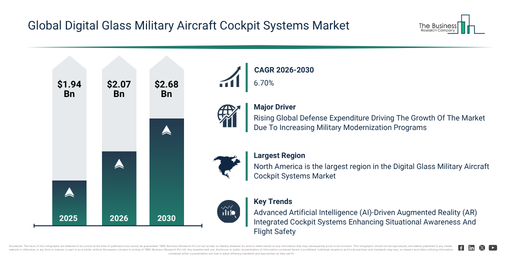
Digital Glass Military Aircraft Cockpit Systems Market Forecast: Value Set To Climb From $2.07 Billion To $2.68 Billion
The digital glass military aircraft cockpit systems market has experienced robust growth in recent times. It is projected to expand from $1. 94 billion in 2025 to $2. 07 billion in 2026, exhibiting a compound annual growth rate (CAGR) of 6. 5%. Historically, this growth has been influenced by factors such as the reliance on analog cockpit instrumentation, the early adoption of glass cockpits in fighter aircraft, post-Cold War defense modernization programs, progressive avionics digitization, and advancements in flight display reliability systems.
The market for digital glass military aircraft cockpit systems is anticipated to experience robust growth in the near future. Its valuation is projected to reach $2.68 billion by 2030, exhibiting a compound annual growth rate (CAGR) of 6.7%. This expansion during the forecast period is largely driven by factors such as the integration of AI-enabled mission avionics, ongoing autonomous combat aircraft development programs, increasing investments in defense modernization, sophisticated sensor fusion and data interoperability capabilities, and the implementation of cybersecurity-hardened cockpit architectures. Key developments anticipated in this period encompass open architecture avionics integration, modular cockpit upgrade systems, initiatives to enhance fly-by-wire systems, real-time mission data fusion platforms, and advanced electromagnetic interference shielding and hardening systems.
Get A Free Sample Report With In-Depth Market Insights:
Digital Glass Military Aircraft Cockpit Systems Market Growth Momentum: What Factors Are Shaping Demand?
The increasing worldwide spending on defense is anticipated to fuel the expansion of the digital glass military aircraft cockpit systems market. This expenditure refers to the financial resources allocated by governments for military forces, encompassing the procurement of advanced aircraft and defense equipment, alongside the modernization of military infrastructure. Global defense expenditure is on an upward trend due to escalating geopolitical tensions, which heighten security concerns and prompt governments to invest more in military capabilities and advanced defense systems. This rising global defense expenditure drives investment in advanced avionics and cockpit modernization, accelerating the adoption of digital glass cockpit systems that enhance situational awareness, mission efficiency, and pilot safety. For instance, in April 2024, according to the Stockholm International Peace Research Institute, a Sweden-based defense research institute, global military expenditure increased from $2.24 trillion in 2022 to $2.44 trillion in 2023, representing an increase of about 6.8%. Therefore, the rising global defense expenditure is driving the growth of the digital glass military aircraft cockpit systems market.
Digital Glass Military Aircraft Cockpit Systems Market Segment Breakdown: Which Categories Lead On Revenue?
The digital glass military aircraft cockpit systems market covered in this report is segmented –
1) By Component: Displays, Sensors, Software, Other Components
2) By Platform: Fighter Aircraft, Transport Aircraft, Military Helicopters, Trainer Aircraft, Unmanned Aerial Vehicles
3) By Installation Type: Line Fit, Retrofit
4) By Application: Navigation, Communication, Surveillance, Other Applications
5) By End-Users: Defense And Aerospace, General Aviation, Commercial Aviation
Subsegments:
1) By Displays: Primary Flight Display, Multi Function Display, Head Up Display, Helmet Mounted Display
2) By Sensors: Air Data Sensors, Inertial Navigation Sensors, Position Sensors, Environmental Sensors
3) By Software: Flight Display Management Software, Navigation Management Software, Mission Planning Software, Data Processing Software
4) By Other Components: Control Panels, Switches And Interfaces, Data Storage Units, Power Supply Units, Communication Modules
Digital Glass Military Aircraft Cockpit Systems Market Trends Redefining Industry Growth
Leading firms operating in the digital glass military aircraft cockpit systems market are prioritizing the creation of systems for real-time mission information, such as artificial intelligence (AI)-enabled augmented reality (AR) integrated cockpit systems, with the goal of improving situational awareness, operational efficiency, and flight safety. These AI-enabled augmented reality (AR) integrated cockpit systems are sophisticated avionics solutions that merge real-time data analysis with smart algorithms and compelling visual projections, aiding pilots in their decision-making process. For example, in October 2024, Universal Avionics, a US-based avionics technology company, unveiled its Aperture system, an augmented-reality cockpit system intended to deliver real-time operational insights directly onto cockpit screens. This system incorporates AI-driven video analysis from various aircraft cameras, along with sensor and ADS-B data consolidation, and visual overlays for purposes such as obstacle identification, taxiing directions, and traffic monitoring, thereby allowing pilots to rapidly and securely process vital mission data during flights.
Digital Glass Military Aircraft Cockpit Systems Market Competitive Analysis Of Leading Industry Participants
Major companies operating in the digital glass military aircraft cockpit systems market are The Boeing Company, Lockheed Martin Corporation, General Dynamics Corporation, Northrop Grumman Corporation, Honeywell International Inc., BAE Systems plc, Safran S. A., Thales S. A., L3Harris Technologies Inc., Elbit Systems Ltd., Dassault Aviation S. A., Saab AB, Kongsberg Defence & Aerospace AS, Moog Inc., Curtiss-Wright Corporation, Mercury Systems Inc., Astronautics Corporation of America, Intellisense Systems Inc., Innovative Solutions and Support Inc., Dynon Avionics Inc., Anodyne Electronics Manufacturing Corp., Thomas Global Systems LLC
View The Full Digital Glass Military Aircraft Cockpit Systems Market Report:
Digital Glass Military Aircraft Cockpit Systems Market Geographic Distribution And Regional Opportunities
North America was the largest region in the digital glass military aircraft cockpit systems market in 2025. Asia-Pacific is expected to be the fastest-growing region in the forecast period. The regions covered in the digital glass military aircraft cockpit systems market report are Asia-Pacific, South East Asia, Western Europe, Eastern Europe, North America, South America, Middle East and Africa.
Reach Out To Our Team:
The Business Research Company: https://www.thebusinessresearchcompany.com/
Americas: +1 310-496-7795
Asia: +44 7882 955267 & +91 8897263534
Europe: +44 7882 955267
Email us at: marketing@tbrc.info
Follow us on:
LinkedIn: https://in.linkedin.com/company/the-business-research-company
YouTube: https://www.youtube.com/channel/UC24_fI0rV8cR5DxlCpgmyFQ
Global Market Model: https://www.thebusinessresearchcompany.com/global-market-model

Wasay has over a decade of experience in market research, data modelling, and analytics, with prior experience at GlobalData and Decision Tree Consulting Services. At The Business Research Company , he leads research operations across syndicated studies, customized consulting engagements, and the Global Market Model platform. His professional experience includes supporting organizations such as Boston Consulting Group, KPMG, and Ernst & Young. Wasay holds a degree in Electronics and Communications Engineering, postgraduate management qualifications from International Management Institute Belgium and Indian School of Business and Entrepreneurship, and completed the Integrated Program in Business Analytics from Indian Institute of Management Indore.