Featuring market attractiveness scoring, total addressable market sizing, company benchmarking matrices, interactive Excel dashboards, deeper supply chain intelligence, emerging startup tracking, and granular product-level insights, The Business Research Company’s 2026 market reports are built to deliver research that is both more actionable and more strategically valuable.
On-Orbit Refueling Market Value Growth And Long-Term Outlook
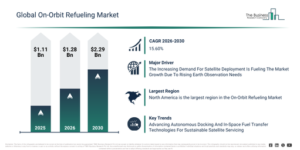
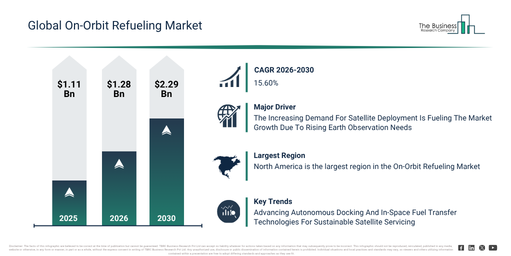
The on-orbit refueling market has experienced rapid growth in recent years. It is projected to increase from $1.11 billion in 2025 to $1.28 billion in 2026, reflecting a compound annual growth rate (CAGR) of 15.3%. This historical expansion is attributable to increasing satellite launch activities, growth in communication and earth observation satellite deployments, rising dependence on chemical propulsion systems, the early development of satellite servicing concepts, and the expansion of government space exploration programs.
The on-orbit refueling market is projected to experience substantial expansion in the coming years, reaching $2.29 billion by 2030, driven by a compound annual growth rate (CAGR) of 15.6%. This growth during the forecast period is fueled by several factors, including the escalating demand for extended satellite missions, the wider adoption of reusable spacecraft systems, increased investment in deep space exploration, the expanding commercial satellite servicing sector, and a greater emphasis on cost-effective orbital operations and mission sustainability. Key trends anticipated within this period involve the enhanced development of autonomous robotic spacecraft docking systems for refueling in orbit, the expanding use of AI-based algorithms for orbital mission planning and fuel optimization, the increasing deployment of standardized refueling interfaces to ensure satellite interoperability, the broadening of reusable spacecraft architectures to facilitate multiple refueling cycles, and the greater integration of digital twin technology for simulating in-orbit fuel transfer and assessing mission risks.
Get A Free Sample Report With In-Depth Market Insights:
On-Orbit Refueling Market Growth Momentum: What Factors Are Shaping Demand?
The future expansion of the on-orbit refueling market is anticipated, driven by the growing requirement for satellite deployment. Satellite deployment involves the method of positioning a satellite into its intended space orbit via a launch vehicle or specific deployment system. This heightened demand for satellite deployment largely stems from the increasing necessity for earth observation, which facilitates various applications like climate monitoring, disaster management, agricultural planning, and urban development by providing real-time data and high-resolution imagery. On-orbit refueling improves satellite deployment capabilities, allowing satellites and spacecraft to resupply propellant while in space. This, in turn, prolongs mission duration, boosts operational flexibility, lessens launch mass limitations, and aids in deploying more extensive and intricate satellite constellations. As an illustration, in January 2024, data from the Space Foundation, a US-based nonprofit space advocacy organization, indicated that over 2,800 satellites were launched into orbit during 2023, marking a 23% rise from 2022. Consequently, the expanding demand for satellite deployment is a key factor propelling the on-orbit refueling market’s growth.
On-Orbit Refueling Market Segmentation: How Does The Market Break Down By Category?
The on-orbit refueling market covered in this report is segmented –
1) By Component: Hardware, Software, Services
2) By Refueling Technology: Docking Based Refueling Systems, Robotic Refueling Systems, Cryogenic Fluid Transfer Systems, Autonomous Refueling Systems, Standardized Fuel Adapter Systems
3) By Application: Communication Satellites, Earth Observation Satellites, Military And Defense, Scientific Satellites, Other Applications
4) By End User: Commercial Satellite Operators, Government Space Agencies, Defense Organizations, Space Infrastructure And Logistics Companies
Subsegments:
1) By Hardware: Refueling Interfaces, Fluid Transfer Systems, Propellant Storage Tanks, Docking And Capture Mechanisms
2) By Software: Mission Planning Software, Autonomous Docking Software, Fuel Transfer Control Software, Telemetry And Monitoring Software
3) By Services: On Orbit Refueling Operations Services, Mission Integration Services, Maintenance And Support Services, Training And Simulation Services
On-Orbit Refueling Market Trends Redefining Industry Growth
Leading companies operating within the on-orbit refueling market are concentrating on developing technologically advanced solutions, including autonomous satellite docking and propellant transfer systems, to prolong spacecraft lifespan, decrease mission costs, and enable sustainable in-space servicing operations. These autonomous satellite docking and propellant transfer systems are space technologies that allow satellites to automatically navigate, connect in orbit, and safely transfer fuel without human intervention. For example, in January 2026, Orbitaid Aerospace Private Limited, an India-based space technology company, deployed AayulSAT. This mini tanker satellite serves as a technology demonstration to test on-orbit refueling and autonomous docking capabilities, utilizing the company’s proprietary standard interface for docking and refueling port (SIDRP). The platform is designed to facilitate propellant, power, and data transfer in microgravity environments and incorporates dual-docking redundancy to improve spacecraft coupling safety and reliability. Furthermore, this platform supports bubble-free fuel transfer experiments, autonomous proximity maneuvers, and in-orbit satellite servicing validation, thereby contributing to the progression of orbital fuel station infrastructure and commercial space logistics networks. The mission also seeks to validate fuel transfer across different orbital conditions and create a scalable framework for future chaser-and-tanker satellite operations, which will help extend satellite lifespan and reduce the need for launching replacement satellites.
On-Orbit Refueling Market Competitive Landscape: Who Leads The Industry?
Major companies operating in the on-orbit refueling market are Airbus Defence and Space GmbH, Northrop Grumman Corporation, Space Exploration Technologies Corp., Blue Origin Enterprises L. P., Thales Alenia Space S. A., MDA Space Ltd., Sierra Space Corporation, Redwire Corporation, Firefly Aerospace Inc., Astroscale Holdings Inc., Impulse Space Inc., D-Orbit S. p. A., Dawn Aerospace Limited, Bellatrix Aerospace Private Limited, ClearSpace SA, Starfish Space Inc., Orbit Fab Inc., Infinite Orbits SAS, Portal Space Systems Inc., TransAstra Corporation, Eta Space LLC, OrbitAID Aerospace Private Limited
View The Full On-Orbit Refueling Market Report:
On-Orbit Refueling Market Geographic Landscape: Which Region Leads Industry Growth?
North America was the largest region in the on-orbit refueling market in 2025. Asia-Pacific is expected to be the fastest-growing region in the forecast period. The regions covered in the on-orbit refueling market report are Asia-Pacific, South East Asia, Western Europe, Eastern Europe, North America, South America, Middle East and Africa.
Reach Out To Our Team:
The Business Research Company: https://www.thebusinessresearchcompany.com/
Americas: +1 310-496-7795
Asia: +44 7882 955267 & +91 8897263534
Europe: +44 7882 955267
Email us at: marketing@tbrc.info
Follow us on:
LinkedIn: https://in.linkedin.com/company/the-business-research-company
YouTube: https://www.youtube.com/channel/UC24_fI0rV8cR5DxlCpgmyFQ
Global Market Model: https://www.thebusinessresearchcompany.com/global-market-model

Wasay has over a decade of experience in market research, data modelling, and analytics, with prior experience at GlobalData and Decision Tree Consulting Services. At The Business Research Company , he leads research operations across syndicated studies, customized consulting engagements, and the Global Market Model platform. His professional experience includes supporting organizations such as Boston Consulting Group, KPMG, and Ernst & Young. Wasay holds a degree in Electronics and Communications Engineering, postgraduate management qualifications from International Management Institute Belgium and Indian School of Business and Entrepreneurship, and completed the Integrated Program in Business Analytics from Indian Institute of Management Indore.