
Market attractiveness scoring, total addressable market sizing, company benchmarking matrices, interactive Excel dashboards, deeper supply chain intelligence, emerging startup tracking, and granular product-level insights are among the key offerings featured in The Business Research Company’s 2026 market reports, designed to deliver more actionable and strategically valuable research.
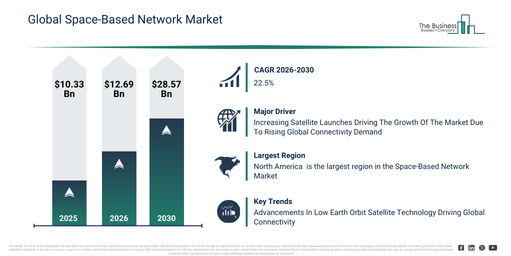
Space-Based Network Market Valued At $12.69 Billion In 2026, Projected To Reach $28.57 Billion By 2030
The space-based network market has observed substantial expansion in recent years. It is projected to escalate from $10.33 billion in 2025 to $12.69 billion in 2026, demonstrating a compound annual growth rate (CAGR) of 22.8%. Historically, this growth stemmed from the deployment of early communication satellite constellations, advancements in inter-satellite link technologies, the adoption of satellite-based navigation systems, the initial integration of earth observation payloads, and the development of spaceborne routers and switches.
The space-based network market size is anticipated to undergo significant expansion in the coming years. It is projected to reach $28.57 billion by 2030, demonstrating a compound annual growth rate (CAGR) of 22.5%. This growth throughout the forecast period stems from factors such as the broadening of LTE/5G satellite connectivity, an increase in mega-constellation deployments, the adoption of AI-enabled network management, integration with IoT and maritime communication networks, and a heightened demand for low-latency global data transmission. Furthermore, major developments expected during this period include an increase in inter-satellite laser communication links, a rising demand for multi-orbit satellite constellations, the expansion of satellite-based emergency response networks, a greater deployment of broadband mega-constellations, and the integration of hybrid space–terrestrial communication architectures.
Request A Complimentary Space-Based Network Market Research Sample:
Key Factor Propelling The Space-Based Network Market Forward
The projected increase in satellite launches is anticipated to accelerate the expansion of the space-based network market. Satellite launches encompass the deployment of satellites into Earth’s orbit (or beyond) via rockets, serving purposes such as communication, navigation, observation, or scientific research. The surge in these launches is primarily fueled by the escalating demand for worldwide broadband internet and connectivity services, particularly through extensive low earth orbit (LEO) constellations. Within a space-based network context, these launches are instrumental in deploying communication satellites that facilitate global connectivity, data transmission, and network coverage. As an illustration, in January 2025, the Space Foundation, a US-based nonprofit organization, reported that the global space industry recorded 259 orbital launches in 2024, signifying a 16% year-over-year increase. Consequently, the rising frequency of satellite deployments is expected to stimulate the growth of the space-based network market.
Space-Based Network Market Segments And Subsegments Explained
The space-based network market covered in this report is segmented –
1) By Type: Ku, Ka, And K Band, C And X Band, L And S Band
2) By Orbit Type: Low Earth Orbit (LEO), Medium Earth Orbit (MEO), Geostationary Orbit (GEO), Highly Elliptical Orbit (HEO)
3) By Component: Satellites, Ground Stations, Transponders, Antennas, Routers And Switches, Launch Vehicles, Network Operations Centers (NOCs)
4) By Application: Data Communication, Voice Communication, Video Transmission, Broadband Connectivity
5) By End-Use Industry: Telecommunication, Government And Military, Commercial Enterprises, Aviation, Maritime, Oil And Gas, Transportation And Logistics, Media And Entertainment
Subsegments:
1) By Ku, Ka, And K Band: Fixed Satellite Services (FSS), Mobile Satellite Services (MSS), Broadcast Satellite Services (BSS), High Throughput Satellites (HTS)
2) By C And X Band: Fixed Satellite Services (FSS), Military And Defense Communications, Weather And Earth Observation Satellites
3) By L And S Band: Mobile Satellite Services (MSS), Navigation And Positioning Services (GNSS), Aeronautical And Maritime Communications, Internet Of things (IoT) And Machine-To-Machine (M2M) Services
Emerging Trends Transforming The Space-Based Network Market
Leading firms within the space-based network sector are prioritizing cutting-edge technologies, including low earth orbit (LEO) satellite constellations, with the aim of boosting worldwide connectivity, decreasing delays, extending service to remote locations, and refining the effectiveness and dependability of communication offerings. These Low Earth Orbit (LEO) satellite constellations consist of multiple satellites positioned in orbits generally ranging from 160 km to 2,000 km above the Earth’s surface, which collectively deliver extensive or near-universal coverage for services such as communication, internet access, navigation, and Earth observation. As an illustration, in August 2025, the US-based aerospace firm SpaceX deployed 28 Starlink V2 mini satellites. These particular satellites incorporate advanced phased array antennas, quadrupling data capacity over earlier versions, E-band backhaul for improved data transmission, and argon-fueled Hall thrusters that provide exceptional on-orbit agility with 2.4 times greater thrust and 1.5 times higher specific impulse. Weighing approximately 800 kilograms and orbiting at roughly 550 km altitude, the V2 mini satellites substantially enhance global broadband connectivity, especially benefiting regions with inadequate service.
Space-Based Network Market Key Players: Major Companies In The 2026 Report
Major companies operating in the space-based network market are Lockheed Martin Corporation, Space Exploration Technologies Corp. (SpaceX), Viasat Inc., Thales Alenia Space SAS, SES S.A., Eutelsat S.A., Iridium Communications Inc., Telesat Canada, Hughes Network Systems LLC (HughesNet brand), AST SpaceMobile Inc., ICEYE Oy, Astranis Space Technologies Corp., Logos Space Inc., Intuitive Machines Inc., E-Space Inc., Muon Space Inc., Inmarsat Global Limited, Aalyria Technologies Inc., Project Kuiper LLC (Amazon Kuiper), SKY Perfect JSAT Holdings Inc.
Explore The Full Space-Based Network Market Report With Forecasts To 2030:
Space-Based Network Market By Region: Where Is Demand Strongest?
North America was the largest region in the space-based network market in 2025. Asia-Pacific is expected to be the fastest-growing region in the forecast period. The regions covered in the space-based network market report are Asia-Pacific, South East Asia, Western Europe, Eastern Europe, North America, South America, Middle East, Africa.
Reach Out To Our Team:
The Business Research Company: https://www.thebusinessresearchcompany.com/
Americas: +1 310-496-7795
Asia: +44 7882 955267 & +91 8897263534
Europe: +44 7882 955267
Email us at: marketing@tbrc.info
Follow us on:
LinkedIn: https://in.linkedin.com/company/the-business-research-company
YouTube: https://www.youtube.com/channel/UC24_fI0rV8cR5DxlCpgmyFQ
Global Market Model: https://www.thebusinessresearchcompany.com/global-market-model

Wasay has over a decade of experience in market research, data modelling, and analytics, with prior experience at GlobalData and Decision Tree Consulting Services. At The Business Research Company , he leads research operations across syndicated studies, customized consulting engagements, and the Global Market Model platform. His professional experience includes supporting organizations such as Boston Consulting Group, KPMG, and Ernst & Young. Wasay holds a degree in Electronics and Communications Engineering, postgraduate management qualifications from International Management Institute Belgium and Indian School of Business and Entrepreneurship, and completed the Integrated Program in Business Analytics from Indian Institute of Management Indore.

